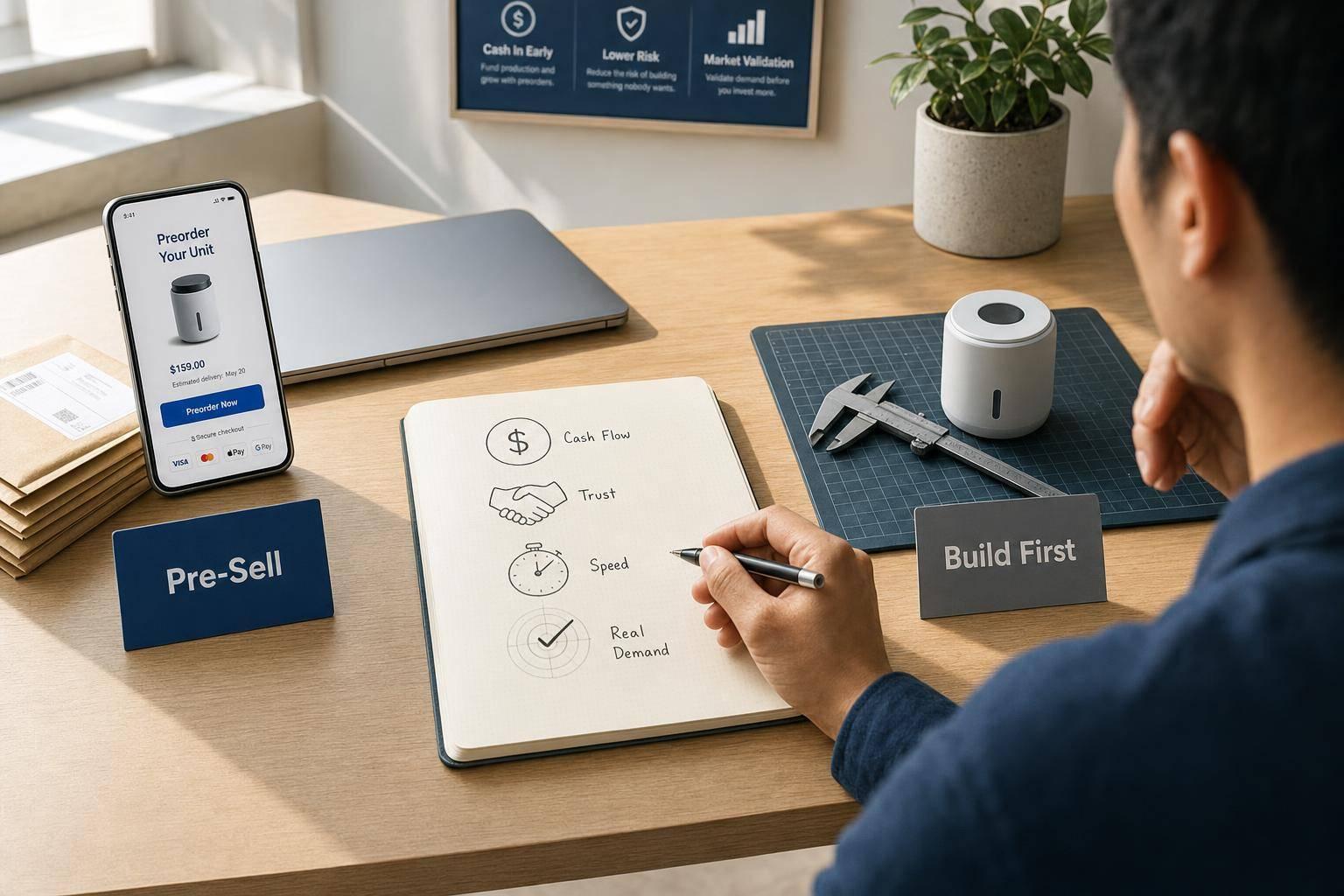
If cash is tight and demand is still unclear, I’d lean toward pre-selling. If trust, compliance, or product complexity is the bigger issue, I’d build first.
Here’s the short version:
- Pre-sell first when I need early cash, fast demand testing, and lower upfront spend
- Build first when buyers need a live product, proof, or tighter delivery certainty
- Paid demand beats interest – a deposit, pilot, or pre-order says more than a waitlist
- The main trade-off is simple: pre-selling lowers early cash pressure but adds delivery and refund risk
A few numbers make the choice hard to ignore:
- Startups that sell before building report a 64% success rate
- Build-first startups report 12%
- The average build-first team waits about 8 months for first revenue
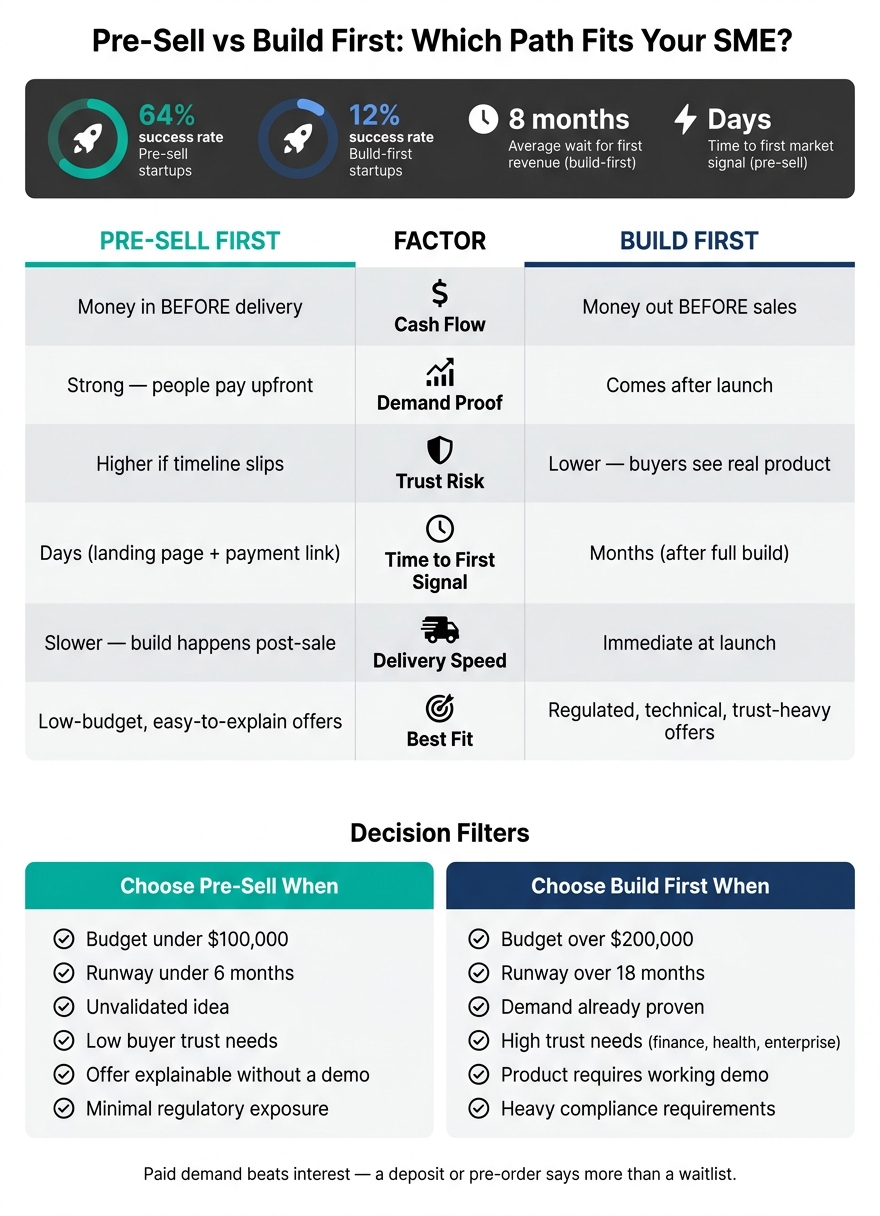
Pre-Sell vs Build First: SME Decision Guide with Key Stats
Pre-Sell It Before You Build Anything
sbb-itb-fd64e4e
Quick Comparison
| Factor | Pre-Sell | Build First |
|---|---|---|
| Cash flow | Money can come in before delivery | Money goes out before sales come in |
| Demand proof | Strong if people pay upfront | Comes later, after launch |
| Trust risk | Higher if timing slips | Lower because buyers see the product |
| Time to first market signal | Often days | Often months |
| Delivery timing | Slower after sale | Faster after launch |
| Best fit | Low-budget, easy-to-explain offers | Regulated, technical, or trust-heavy offers |
So the choice is not about which path is better in general. It’s about which risk I’d rather take – building something no one buys, or selling something I may struggle to deliver on time.
Cash Flow, Trust, and Speed
Cash Flow Impact
Pre-selling brings money in before production starts. Build-first does the opposite – you spend first, then wait to earn later. For SMEs, that gap can hit hard. Build-first startups take an average of 8 months before seeing their first dollar of revenue. With pre-selling, cash can come in before the product is finished, and that money can pay for the next part of the build.
| Pre-Selling | Build-First | |
|---|---|---|
| Upfront cost | Lower – customer payments can fund validation | Higher – requires significant upfront investment |
| Cash conversion timing | Immediate – deposits arrive before fulfillment | Delayed – average 8 months to first revenue |
| Working capital pressure | Lower – customer deposits can finance production | Higher – depends on savings, loans, or outside capital |
| Inventory risk | Lower – built to confirmed demand | Higher – risk of dead stock |
There’s a catch. Pre-sale cash is still a delivery obligation. If timing slips, you can end up dealing with refunds, chargebacks, and compliance issues. Under FTC guidelines, presales also need conservative delivery estimates and a clear refund policy. A simple way to lower that risk is to hold back 15% to 20% of pre-sale revenue as a contingency buffer.
Cash flow matters, but money isn’t the only issue. The bigger question is whether buyers trust what you’re offering.
Trust and Brand Risk
Pre-selling runs on trust before delivery. If your timeline is vague or you miss the promised date, brand damage can happen fast. In trust-sensitive categories like FinTech or HealthTech, a thin pre-sell offer can come across as unreliable instead of scrappy.
Build-first avoids much of that problem because buyers can see, test, or judge a real product before they commit.
| Pre-Selling | Build-First | |
|---|---|---|
| Credibility | Built through transparency and founder credibility | Built through a working demo or finished product |
| Expectation management | Harder – buyers commit based on a promise | Easier – buyers can see what they are getting |
| Refund exposure | Higher – delivery delays can trigger refunds | Lower – no pre-delivery gap |
| Proof buyers need | Transparency and founder trust | Working product or live demo |
A few things help narrow that trust gap:
- Share development milestones
- Be clear about what is built and what is still in progress
- Offer a simple refund policy
Weak trust doesn’t just create brand risk. It also slows buyer commitment before you get a single order.
That same trust gap shapes speed too.
Speed to Market and Delivery Pace
Pre-selling is faster for testing demand. Build-first is faster for fulfillment.
With pre-selling, you can launch a landing page, add a payment link, and find out within days whether people will pay. Build-first usually takes months to reach the same point because you don’t get that signal until the product is finished.
Once orders start coming in, the situation flips. Build-first can ship or deliver right away because the product already exists. Pre-selling creates a lag. The sale happens first, but the build still needs to happen after, and that’s where delays often show up – production bottlenecks, supply issues, or development complexity.
| Pre-Selling | Build-First | |
|---|---|---|
| Time to first market signal | Days – landing page plus payment link | Months – after the full build |
| Time to first dollar | Immediate – pre-orders or deposits | About 8 months on average |
| Time to actual delivery | Slower – build happens post-sale | Immediate – product is ready at launch |
So speed isn’t just about launching fast. It’s a way to test demand early, before you sink time and cash into a full build.
How Each Path Proves Demand
Stronger Signals vs. Weaker Signals
Speed matters only when it leads to a buying signal. A compliment shows interest. A payment shows intent – and for SMEs, only one of those keeps cash coming in.
Paid pre-orders are the clearest proof of early demand because the buyer puts down real money before the product exists. Paid deposits, signed B2B contracts, and paid pilots also carry weight. Waitlists tied to a false-door checkout – where users enter payment details but are not charged – sit in the middle. Email signups and site traffic are the weakest signals. They show curiosity, not commitment.
| Signal Type | Strength | What It Actually Proves |
|---|---|---|
| Full upfront payment / pre-order | Highest | Confirmed purchase intent and market fit |
| Paid deposit | High | Strong intent; validates price sensitivity |
| Signed B2B contract or paid pilot | High | Real commitment from a specific buyer |
| False-door checkout (no charge) | Medium | High intent, but no money captured |
| Email waitlist | Low | Interest only; high drop-off at launch |
| Survey responses and site traffic | Lowest | Vanity metrics; rarely predict actual sales |
When Demand Proof Is Misleading
SMEs often confuse enthusiasm with demand. Someone saying "I’d definitely buy that" is not the same as someone pulling out a card and paying for it. That’s where a lot of teams get fooled.
Surveys show this gap again and again – up to 90% of respondents may say they’d buy a product, but only around 5% actually pay when a real payment is required.
Network bias makes the problem worse. Friends and current customers tend to cheer you on. Strangers tell you whether the market is there. If people outside your circle are willing to put money down, that’s a much stronger signal than support from your own network.
Build-first teams run into a different version of the same issue. Launch-day traffic can look strong on paper. But if that traffic doesn’t turn into paying customers, the signal is weak.
Use payments, deposits, or checkout actions to test demand. Those are the signals that should guide the choice between pre-selling and building first.
When to Pre-Sell and When to Build First
Use the four filters above – cash flow, trust, speed, and demand proof – to pick the right path.
When Pre-Selling Makes More Sense
Pre-selling is the better move when you need proof of demand and cash in the door before you spend on production. It tends to work best for simple digital offers and products people can understand fast, without needing a live demo.
For SME teams, this approach usually works best when the offer is easy to explain and trust can be built with early-bird pricing or simple founder perks. If buyers can grasp the value in a few seconds, pre-selling gets a lot easier.
There are a few non-negotiables, though. Keep timelines realistic, make refunds clear, and avoid fuzzy promises. Under FTC guidelines, you need conservative estimates and a crystal-clear refund policy.
When Build-First Makes More Sense
Some products shouldn’t be sold before they exist.
If your offer falls into a high-trust, regulated category – like healthcare, banking, finance, or enterprise software – buyers usually expect a finished, compliant product from day one. In those markets, a rough pre-sell can damage credibility.
Build-first also makes more sense when the product is too technical to explain without a working demo. The same goes for crowded categories, where a weak first impression can hurt trust before you even get a second shot.
Decision Matrix for SME Teams
Use this quick filter to make the call. The thresholds below line up with common SME budget and runway ranges.
| Factor | Favor Pre-Selling | Favor Build-First |
|---|---|---|
| Budget | Under $100,000 | Over $200,000 |
| Market certainty | Unvalidated idea | Demand already proven |
| Buyer trust needs | Low (e.g., internal tools) | High (finance, health, enterprise) |
| Offer complexity | Explainable without a demo | Requires a working product to evaluate |
| Runway | Short (<6 months) | Long (>18 months) |
| Regulatory exposure | None or minimal | Heavy compliance requirements |
"A successful presale isn’t just about hitting a funding target; it’s about building the first chapter of your company’s story with your customers as co-authors." – Frank Carter, Startup Advisor
Conclusion
The choice comes down to two risks: paying to learn too late, or promising something before you can deliver it.
Neither path wins by default. The better option depends on which risk is bigger for you – weak demand or weak delivery.
Pre-selling makes sense when cash is tight and demand is still unproven, but only if your timeline is honest. Build-first makes more sense when buyers need proof before they commit.
Pick the path that lowers both financial exposure and credibility risk. Pre-sell to test demand. Build first when trust has to come before revenue.
FAQs
How do I know if buyers will trust a pre-sale offer?
Buyers trust a pre-sale offer more when you’re open and make the purchase feel less risky. Share a clear, realistic timeline, explain where development stands right now, and keep people updated on a regular basis.
A formal money-back guarantee helps. So does clear communication if delays happen, behind-the-scenes progress updates, and secure, professional payment gateways.
What products should not be pre-sold?
Avoid pre-selling products you can’t deliver or support with confidence. If you miss the mark, the damage goes beyond one sale – it can hurt your brand and chip away at customer trust.
This approach also falls short when your billing, support, or legal compliance setup isn’t ready for paying customers. And if buyers expect enterprise-grade security and compliance, you’ll usually need a fully developed MSP in place.
How much money should I keep in reserve from pre-sales?
Keep 15-20% of pre-sales in reserve for delays or extra costs you didn’t see coming. Think of pre-sale revenue as fulfillment capital, not money for general overhead.
Put it toward final development, tooling, initial inventory, and packaging so you can avoid cash shortfalls and stay on track with your pre-order promise.