
Disclosure: some links in this article are affiliate links. If you sign up through one, we may earn a commission at no extra cost to you.
Most buyers won’t act until they trust what they’re hearing – and 81% say trust matters before they buy. My take: SMEs need one clear story that links a customer problem, your offer, proof, and the result.
Here’s the short version:
- I start with customer research, not slogans
- I turn that input into one core value proposition
- I back each claim with proof
- I use a simple story flow: before – problem – solution – proof – after
- I keep that same message across web pages, email, sales decks, and social
- I review it often, because mixed messages hurt trust
A few data points from the article make the case:
- 81% of consumers need trust before purchase
- Stories are 22x more memorable than facts by themselves
- Emotional campaigns can hit 31% effectiveness vs. 16% for logic-only campaigns
- Brand consistency can lead to up to 23% higher revenue
If I had to sum it up in one line, it would be this: good value proposition storytelling helps an SME explain why it matters, prove it, and repeat that message everywhere.
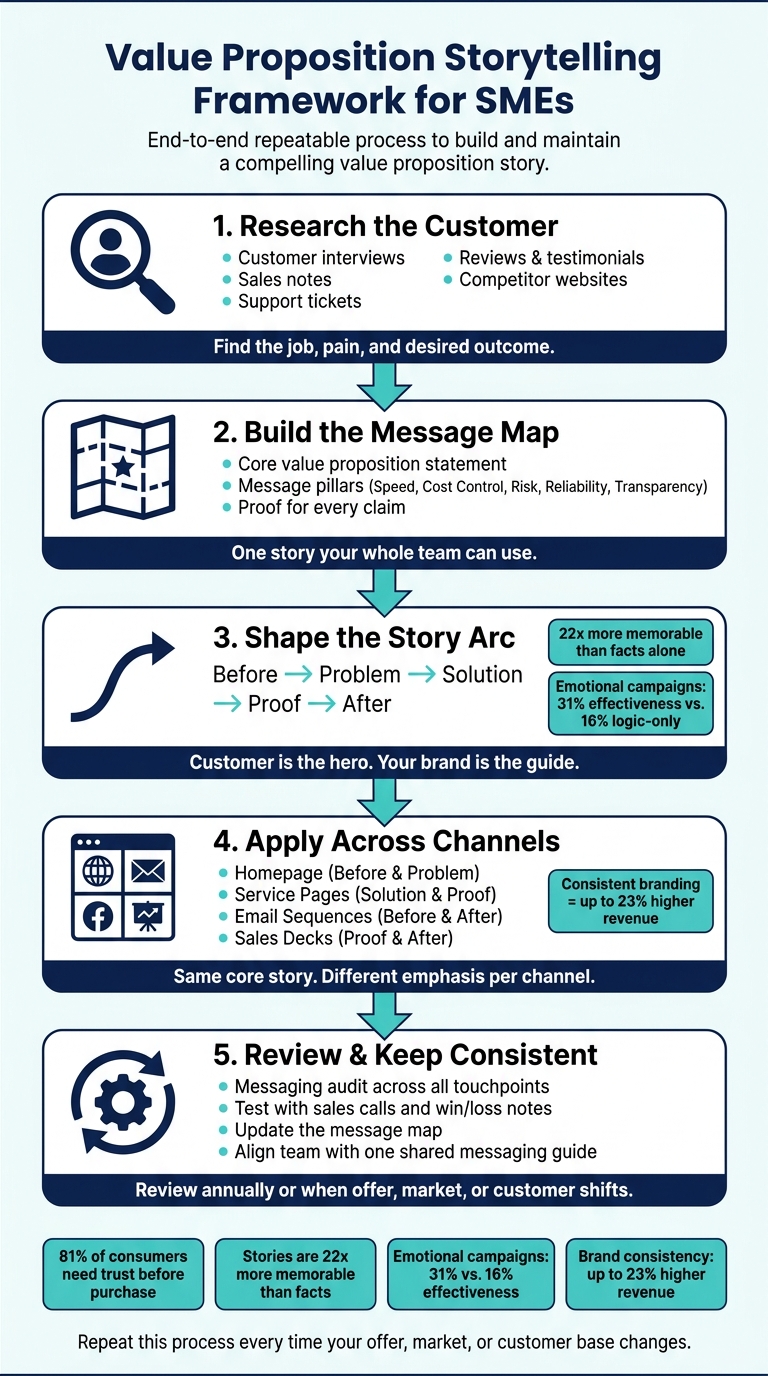
Value Proposition Storytelling Framework for SMEs
How Storytelling Can Change Your Business Fast
sbb-itb-fd64e4e
Research the Customer, Market, and Buying Context
Do the research before you write. Pull the exact words customers use, the pains they mention again and again, and the gaps competitors leave open. Interviews show the person you’re writing for. Support tickets show the friction they deal with. Testimonials give you proof.
| Research Source | What It Reveals | How It Feeds the Story |
|---|---|---|
| Customer Interviews | Motivations, goals, and "why" | Shapes the protagonist and their desired outcome |
| Sales Notes | Common objections and questions | Refines the conflict and resolution |
| Support Tickets | Recurring pain points and friction | Clarifies the problem to solve |
| Reviews & Testimonials | Tangible success and outcomes | Provides proof and transformation language |
| Competitor Websites | Positioning and value claims | Highlights differentiation opportunities |
Use these inputs to define the customer, the conflict, and the proof before you write.
Find Customer Jobs, Pains, and Desired Outcomes
Don’t just ask who the customer is. Ask what problem they need solved, what the purchase says about their priorities, and what exact outcome they expect. That’s where you find the customer’s job, the pain behind it, and the result they want.
When you turn customer language into a clear business benefit – like saving time or cutting costs – the message is easier to trust and easier to repeat.
Once you know the job and the outcome, shape the message for each buyer group based on what they care about, what they fear, and what they need to hear.
Map Segments and Review Competing Messages
Map each segment by priorities, fears, decision drivers, and the channels they use most. Then review competitor websites, ads, and press releases.
Look for patterns in how they talk and the value claims they lean on. Just as important, look for what they skip. Which buyer groups do they blur together? Which pains do they gloss over? That’s your opening.
Those gaps give you room to get more specific and more believable. They become your message angles.
Build the Message Map and Proof Framework
Take the research and turn it into a message map your whole team can use again and again.
Write a Clear Core Value Proposition and Message Pillars
Start with a simple positioning statement:
"For [target audience], [brand] is the [category] that [unique benefit] because [proof]."
HubSpot gives a good example: "For businesses looking to grow, HubSpot is the inbound marketing platform that helps you attract, engage, and delight customers."
Then group your support points into a small set of message pillars. These are the main reasons your value proposition stands up. For SMEs, common pillars include speed of delivery, cost control, and lower implementation risk. Each one should connect directly to a pain point or priority from your research.
"A brand messaging framework is the backbone of every successful brand story." – RCKT Marketing
Match Every Claim to Evidence
A pillar without proof is just a nice-sounding idea. Every claim needs proof a buyer can check – a case study, a performance number, a third-party result, or a testimonial.
Here’s how to link each pillar to the pain it solves and the proof behind it:
| Message Pillar | Customer Pain | Promised Outcome | Proof Type |
|---|---|---|---|
| Speed | Slow delivery or long onboarding | Faster time to value | Case studies, performance data |
| Cost Control | Unpredictable spend | Predictable, lower costs | ROI data, case studies |
| Implementation Risk | Fear of disruption during switch | Smooth, low-friction transition | Step-by-step process, testimonials |
| Reliability | Inconsistent results | Consistent performance | Performance data, usage statistics |
| Transparency | Hidden fees or vague promises | Clear, honest partnership | Full test results, open roadmaps, failure stories |
Once the map is set, you can turn it into copy that keeps the same core story across channels.
Adjust the Message for Founders, SMEs, and PE-Backed Operators
The core value proposition stays the same. What changes is the lead pillar and the proof you put up front.
- Founders respond first to speed and scale
- SME operators tend to care most about cost and ease of rollout
- PE-backed leaders look for margin, growth, and board-level proof
For PE-backed leaders and mid-market operators, proof should tie back to leadership visibility and margin improvement. Same core story. Different proof in the spotlight, based on what each audience needs to see before they move.
Turn the Value Proposition Into a Story and Use It in Copy
Once your message map is in place, use it to shape your value proposition into a story customers can see themselves in.
Use a Simple Story Arc: Before, Problem, Solution, Proof, After
A simple structure works best: Before → Problem → Solution → Proof → After. The customer is the hero. Your brand is the guide.
"A brand story only works when every element – from the protagonist to the conflict to the resolution – reflects something customers can verify or feel in their own experience." – Michael Jacobs, Brand Strategist, Momo Advisors
The numbers back this up. Stories are 22 times more memorable than facts alone, and emotional ad campaigns show 31% effectiveness compared to 16% for those driven purely by logic. Start with the story, then support each claim with proof.
| Story Element | Purpose | SME Application |
|---|---|---|
| Before | Set the starting point | Show the customer’s current situation and goals |
| Problem | Define the conflict | Show the cost of staying the same |
| Solution | Introduce the fix | Position your value proposition as the answer |
| Proof | Build trust | Use data, testimonials, or third-party results |
| After | Show the outcome | Highlight financial or operational results |
Use this arc as the template for every channel below.
Apply the Story to Homepage, Service Pages, Email, and Sales Decks
Keep the same core story. Change the emphasis based on the channel.
Your homepage should lead with the conflict and the resolution. Use outcome-led headlines that tie your strengths to what the customer wants. Skip the feature dump.
Service pages should go deeper. This is where you show the change in more detail and back up claims with case studies or third-party verification.
Email sequences tend to work best as short before-and-after stories. A welcome series should introduce your brand’s purpose and values, not push an immediate discount. Follow-up emails can walk through a specific before-and-after case that answers a common objection.
Sales decks should start with the business problem, not your company background. Move from conflict to resolution, then end with financial or operational proof.
Businesses that keep branding consistent across all touchpoints can see up to 23% higher revenue. That’s a strong case for keeping the same story, proof, and outcome in every format.
| Channel | Narrative Focus | Key Elements |
|---|---|---|
| Homepage | Before & Problem | Outcome-led headlines, clear customer "hero" |
| Service Pages | Solution & Proof | Problem-solution arcs, case studies, third-party data |
| Email Sequences | Before & After | Brand purpose, customer success stories, objection handling |
| Sales Decks | Proof & After | Business problem first, financial or operational results last |
Next, audit each touchpoint for the same promise, proof, and outcome.
Review, Test, and Keep the Story Consistent
Once your story is live, check how it reads across every channel. Then review it at least once a year – or any time your offer, market, or customer base shifts in a major way.
Run a Messaging Audit Across Every Customer Touchpoint
Start with a full list of channels: website, social, email, ads, sales decks, and internal docs. Review each one against the same core value proposition, pillars, and proof. Then score each channel against four simple checks.
"Confusion is the enemy of conversion. When your message shifts between platforms, customers lose trust." – Seamer Design
| Channel | Clarity | Customer Outcome | Proof Present | Story Consistent |
|---|---|---|---|---|
| Homepage | Is the offer clear? | Does it show a result? | Is proof included? | Does it match other channels? |
| Service Pages | Is the language free of jargon? | Is the outcome front and center? | Is there a case study or other proof? | Does it match the homepage story? |
| Email Campaigns | Does the subject line match the body promise? | Does it address a real pain point? | Is there a before-and-after example? | Is the tone consistent with the brand voice? |
| Social Media | Is the value proposition clear at a glance? | Is the benefit easy to grasp? | Is there a link to proof or results? | Does it match website messaging? |
| Sales Decks | Is the problem stated before the solution? | Is the financial or operational outcome clear? | Are client results or data included? | Does it stay consistent with other channels? |
The weakest channels usually tell you the most. If one touchpoint sounds off, vague, or disconnected, there’s a good chance that’s where your message is breaking down.
Test, Update, and Align the Team
Look at recent sales calls, interviews, and win/loss notes. Pay close attention to where prospects paused, pushed back, or asked for more detail. A quick check before a broader rollout can catch problems early.
If sales, marketing, and customer success all explain the value in different ways, update the message map. Then put the approved version into one messaging guide that marketing, sales, and HR can all use. That guide becomes the shared source for the whole team.
"If employees are unclear on the brand message, it will show up in customer interactions. Likewise, if external messaging is not aligned with internal beliefs, your brand reputation can suffer." – RCKT Marketing
Conclusion: The Process SMEs Can Repeat
This process is meant to be reused. Research buyer needs, define the proposition, add proof, shape the story, apply it across channels, and review it on a regular schedule.
FAQs
How do I find the right customer insights?
Combine direct and indirect voice of customer input with behavioral data. Use surveys and one-on-one interviews to find the why. Then look at reviews, social comments, scroll depth, exit points, and purchase patterns to spot where your message falls flat.
Pull themes from interviews, support tickets, sales calls, and reviews. Tag them into Customer Jobs, Pains, and Gains. In many cases, patterns start to show up after 15 to 20 interviews.
Then check your analytics to see which narratives lead to engagement and conversions. From there, fine-tune the message with A/B tests.
What proof should support my value proposition?
Back up every emotional claim with proof people can check. Use hard numbers like revenue growth, percentage gains, hours saved, or cost cuts. If you say a product saves time, show how much time. If you say it helps sales, show the lift in closed deals or average order value.
Add social proof that feels concrete, not generic. That can include case studies, testimonials with photos, verified buyer badges, live usage data, or user-generated content. When it fits, bring in third-party validation, certifications, process docs, and direct customer language so the claim doesn’t read like ad copy.
For example:
- “Cut onboarding time by 37% in 60 days”
- “Helped increase monthly revenue by $18,400”
- “Used by 12,000+ teams”
- “Rated 4.8/5 from 1,326 verified reviews”
Direct customer wording helps a lot here. Instead of polished brand language, use the exact phrases buyers use when they describe the result. That makes the message feel grounded and easier to trust.
How often should I update my brand story?
Treat your brand story and value proposition as working tools – not something you write once and leave alone. A simple habit helps: review both every 90 days as part of quarterly planning, and do an annual review at a minimum.
You may need to revisit them sooner if warning signs show up. Common triggers include:
- declining sales
- negative customer feedback
- major market shifts
- entering a new category
- major regulatory changes