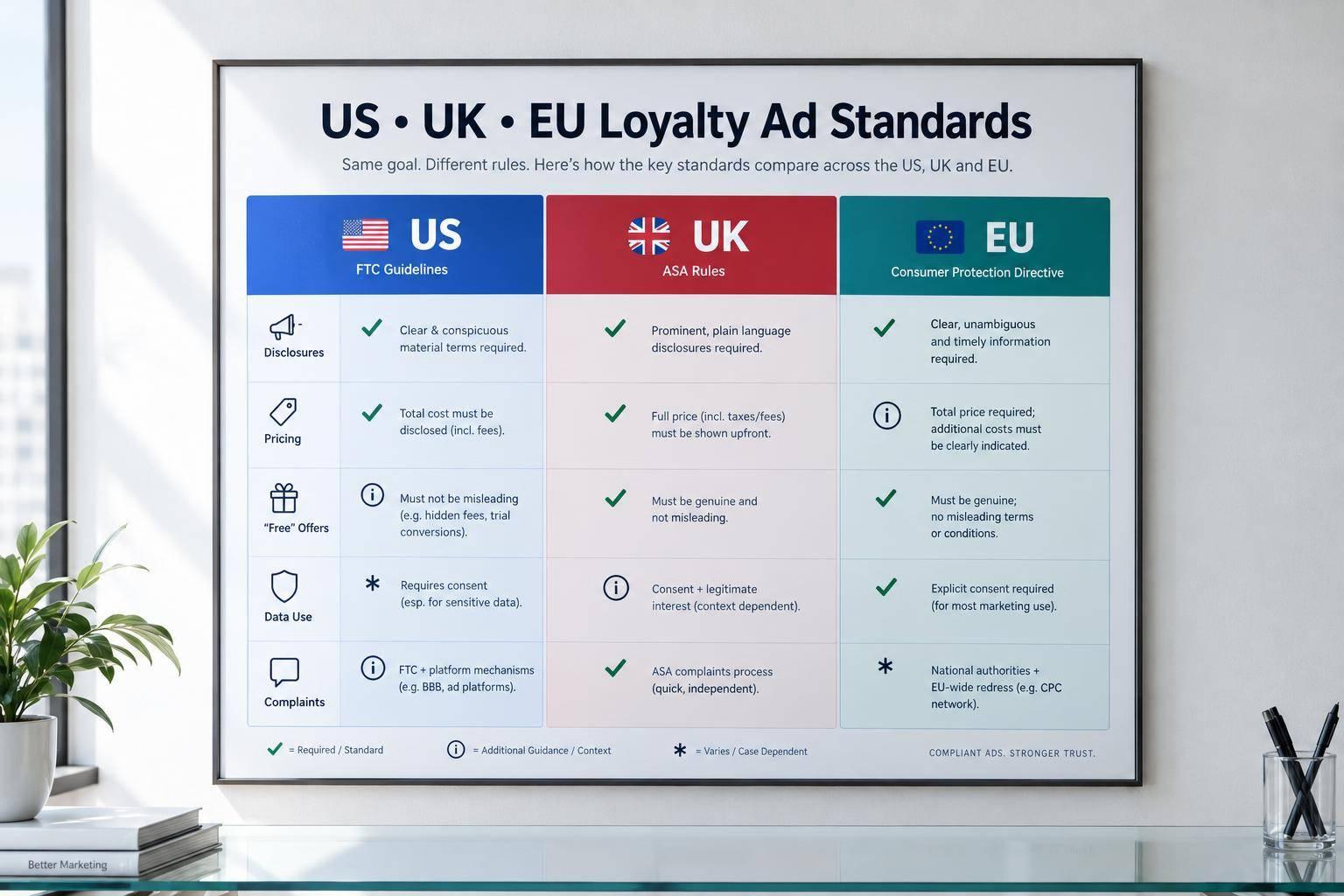
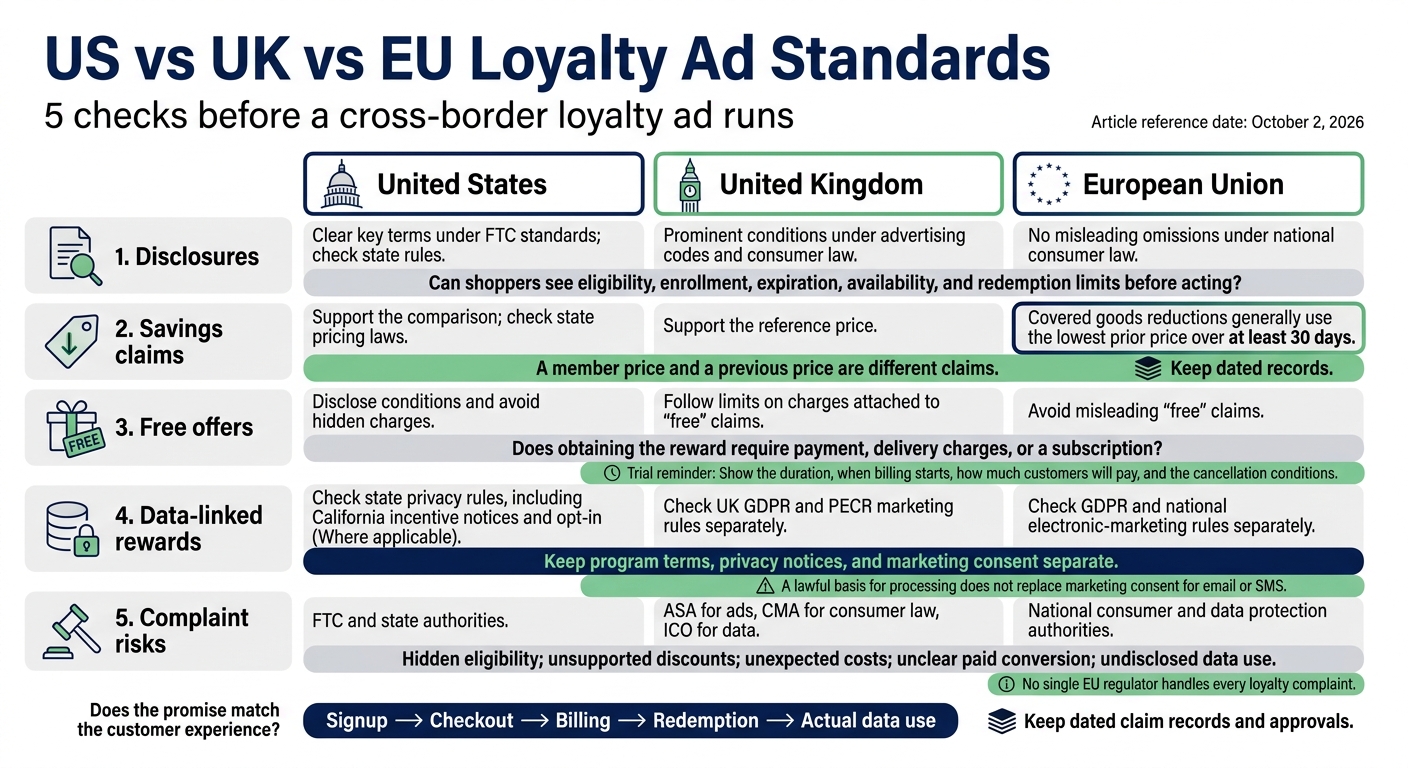
I check 5 areas before a loyalty ad runs: disclosures, savings claims, free offers, data-linked rewards, and complaint risks. Your ad should tell shoppers who qualifies, what they must spend, and whether charges or commitments apply.
For campaigns running on October 2, 2026, I separate offer terms from <u>data use and marketing permissions</u>. The US combines FTC standards with state laws. The UK uses advertising codes and consumer law. The EU applies consumer and privacy rules through national authorities.
Quick Comparison
| Review area | United States | United Kingdom | European Union |
|---|---|---|---|
| Disclosures | Clear key terms under FTC standards; check state rules | Prominent conditions under advertising codes and consumer law | No misleading omissions under national consumer law |
| Savings claims | Support the comparison; check state pricing laws | Support the reference price | Covered goods reductions generally use the lowest prior price over at least 30 days |
| Free offers | Disclose conditions and avoid hidden charges | Follow limits on charges attached to “free” claims | Avoid misleading “free” claims |
| Data-linked rewards | Check state privacy rules, including California incentive notices and opt-in | Check UK GDPR and PECR marketing rules separately | Check GDPR and national electronic-marketing rules separately |
| Complaints | FTC and state authorities | ASA for ads, CMA for consumer law, ICO for data | National consumer and data protection authorities |
My final check: does the promise match signup, checkout, billing, redemption, and actual data use? I keep dated claim records and approvals because ad changes, legal remedies, and fines can follow when those steps do not match.
US vs UK vs EU Loyalty Ad Standards
Loyalty Advertising Rules and Regulators
The same loyalty offer can face different rules depending on where it runs and how it uses customer data.
United States: FTC Standards and State Laws
The FTC sets the US baseline; state laws can add privacy and incentive rules. Under the FTC Act, loyalty claims must not mislead, and advertisers should have evidence to back them up. Make material terms and conditions clear and conspicuous. Review the whole offer, not just the headline.
Review California loyalty incentives tied to personal information separately for privacy compliance. CCPA/CPRA notice and opt-in rules may apply, as may other state privacy laws.
United Kingdom: Advertising Codes and Consumer Law
CAP covers nonbroadcast ads; BCAP covers broadcast ads. The ASA handles ad compliance, the CMA handles consumer law, and the ICO handles data protection and PECR marketing rules.
The ASA looks at how consumers are likely to understand an ad. Material conditions must be prominent, savings claims need evidence for the comparison price, and “free” wording must accurately describe costs and commitments. A lawful basis for processing does not replace marketing consent for email or SMS.
These differences shape the five issue areas covered next.
European Union: Consumer Rules and National Enforcement
The Unfair Commercial Practices Directive bans misleading actions and omissions, including misleading “free” claims. The Price Indication Directive governs price-reduction claims for covered goods.
National laws and authorities enforce these rules. No single EU regulator handles every loyalty complaint. Use EUR-Lex for the legal texts and the relevant member state’s regulator for local requirements.
| Issue | EU-wide baseline | Member-state check |
|---|---|---|
| Savings claims | Qualifying goods reductions generally use the lowest prior price over at least 30 days. | Check local implementation. |
| Data-linked rewards | GDPR governs personal-data processing; joining a program does not automatically authorize every data use. | Check the national data protection authority’s guidance and electronic-marketing consent rules. |
Keep reward rules and marketing rules separate during review; confusing them is the main compliance trap. Document the purpose and lawful basis for each data use, and consult EDPB guidance alongside national electronic-marketing rules.
sbb-itb-fd64e4e
US vs. UK vs. EU: 5 Key Differences
These 5 issues create the biggest gaps in cross-border compliance risk.
| Compliance issue | United States | United Kingdom | European Union | Campaign review question |
|---|---|---|---|---|
| Disclosures | FTC standards require clear, prominent key terms; state laws can add duties. | The CAP Code requires clear disclosure of key terms; consumer law applies separately. | National authorities enforce consumer-law rules on misleading omissions. | Can shoppers see eligibility, enrollment, expiration, availability, and redemption limits before acting? |
| Savings claims | Savings claims need supporting evidence; check state pricing laws. | Advertising codes require evidence that the reference price is genuine. | Qualifying price reductions for goods generally use the lowest prior price over at least 30 days. | Is this a member-versus-nonmember comparison or a reduction from a previous price? |
| Free offers | FTC guidance on “free” claims addresses conditions and hidden charges. | CAP rules restrict charges attached to “free” claims. | National authorities enforce consumer-law bans on misleading “free” claims. | Does obtaining the reward require payment, delivery charges, or a subscription? |
| Data-linked rewards | State privacy laws may require financial incentive notices and opt-in. | UK GDPR governs processing; PECR adds electronic-marketing requirements. | GDPR governs processing; electronic-marketing rules vary nationally. | Are reward conditions, data purposes, and marketing permissions handled separately? |
| Complaint triggers | Deceptive claims can draw FTC or state scrutiny; privacy complaints create separate issues. | ASA reviews advertising; consumer enforcement can involve the CMA. | National consumer and data protection authorities handle different concerns. | Does the advertised promise match checkout, billing, redemption, and actual data use? |
Start with what shoppers must see before they act.
Disclosures: Make Offer Conditions Clear
For a hypothetical US claim like “Members save $10,” show who qualifies, any enrollment cost, and which purchases earn the saving.
Back up the offer in each market, not just its translated wording.
Savings Claims: Use the Right Comparison Price
A member price and a previous price are different claims. Keep dated records. Check US state pricing requirements, UK reference-price evidence, or the EU lowest-prior-price rule where applicable. This comparison logic also drives most pricing complaints.
Free Offers: Disclose Costs and Commitments
Required charges can make “free” misleading under FTC, CAP, and EU rules. Before trial signup, show the duration, when billing starts, how much customers will pay, and the cancellation conditions.
Data-Linked Rewards: Follow Privacy Rules
Review privacy separately from the offer. State when data is required, then assess each use of that data.
For loyalty signups, check California incentive notice and opt-in requirements where applicable. In the UK and EU, document the legal basis for each use and check email or SMS marketing permissions separately.
Complaint Triggers: Claims That Draw Scrutiny
Hidden eligibility, unsupported discounts, unexpected costs, unclear paid conversion, and undisclosed data use can reveal gaps between a loyalty ad and the customer experience. Review the full customer path in each target market: affiliate copy, the landing page, checkout, redemption, and actual data use.
Where to Complain and What Enforcement Can Follow
Where to file a complaint depends on the issue: advertising, consumer rights, or data use. For loyalty ads, the table below maps the main complaint routes and possible enforcement outcomes.
| Jurisdiction | Complaint destination | Common triggers | Potential outcomes |
|---|---|---|---|
| United States | FTC; state attorneys general | Advertising, consumer-rights, or data issue | Investigations, litigation, consent decrees, monitoring requirements, and state penalties. |
| United Kingdom | ASA for ads; CMA for consumer rights; ICO for data | Advertising, consumer-rights, or data issue | Public ASA rulings, required ad changes, and separate statutory fines and remedies. |
| European Union | National consumer authorities for ads and consumer rights; data-protection authorities for data; national courts for legal remedies | Advertising, consumer-rights, or data issue | Required changes, enforcement orders, statutory remedies, and applicable GDPR penalties. |
These bodies usually handle enforcement, not individual compensation. Contact the brand directly for refunds, corrections, or deletions. Consumers in the United Kingdom and European Union may also seek remedies through national courts.
Complaint handling and penalties are separate matters. ASA rulings can require ad changes, but fines come through separate statutory enforcement. Under the United Kingdom’s DMCC Act 2024, CMA penalties for consumer-law breaches can reach £300,000 or 10% of annual global turnover, whichever is higher. Serious GDPR breaches can bring fines of up to €20 million or 4% of global annual turnover, whichever is higher.
Keep a dated file with targeting records, claim evidence, screenshots in context, offer versions, consent records, approvals, and monitoring logs.
Conclusion: Cross-Border Loyalty Campaign Checklist
Test the customer-facing campaign against this checklist: disclosures, savings claims, free offers, data-linked rewards, and complaint risks.
Check Claims, Offer Terms, and Data Use
Review the offer terms. Place key terms beside the claim, and disclose trial conversion, recurring charges, cancellation steps, and data-use conditions.
Ad approval does not cover privacy or subscription terms. Keep program terms, privacy notices, and marketing consent separate.
Keep Website, Email, and Ad Claims Consistent
Make sure every channel shows the same terms. Check ads, landing pages, and emails against the approved offer, and review affiliate and influencer copy too.
FAQs
Can I use one loyalty ad across all three markets?
No. You need to tailor your loyalty ad for the US, UK, and EU because each market has different advertising, data privacy, and consumer protection rules.
Local rules govern disclosures, proof for claims, and transparency. Expectations about discounts, status, and group-based rewards vary, too. Adjust your ads so they remain truthful, backed by evidence, and compliant with each market’s legal standards.
Does the EU’s 30-day rule apply to member-only discounts?
The provided search results do not confirm whether the EU’s 30-day rule applies to member-only discounts. They cover general consumer protections, including the EU Consumer Rights Directive and transparent loyalty program terms, but do not address the 30-day rule for member-only pricing.
Can customers decline marketing and still earn rewards?
Customers can generally opt out of marketing messages and still earn loyalty rewards. Under the GDPR, customers have the right to object to direct marketing. Businesses must stop sending promotional messages when customers opt out.
The CCPA prohibits discrimination against customers who exercise their privacy rights, including opting out of data sales. Granular privacy controls let customers choose their preferences without losing their rewards program status.