Most local partnerships fail for 4 plain reasons: unclear goals, bad fit, mixed messages, and weak follow-up. If I want a partnership to work, I need 7 things in place before launch – a written brief, a clear give-get deal, a pilot, 1 owner on each side, one approved message sheet, a shared action log, and a review schedule.
That matters because local trust is easy to lose. 85% of consumers trust online reviews as much as personal recommendations, and 93% say reviews affect what they buy. So when a joint offer is confusing or one partner drops the ball, the hit is not just lost time – it can mean lost sales, wasted spend, and brand damage.
Here’s the short version:
- Set clear goals – each side needs a target, timeline, and way to measure results
- Check fit before you commit – audience, reputation, staff time, and work style all matter
- Use one public message – offers, logos, CTAs, and staff talking points should match
- Build follow-up into the plan – weekly or monthly reviews stop small issues from turning into public problems
- Know when to stop – if trust breaks or results keep missing the mark, end it in an orderly way
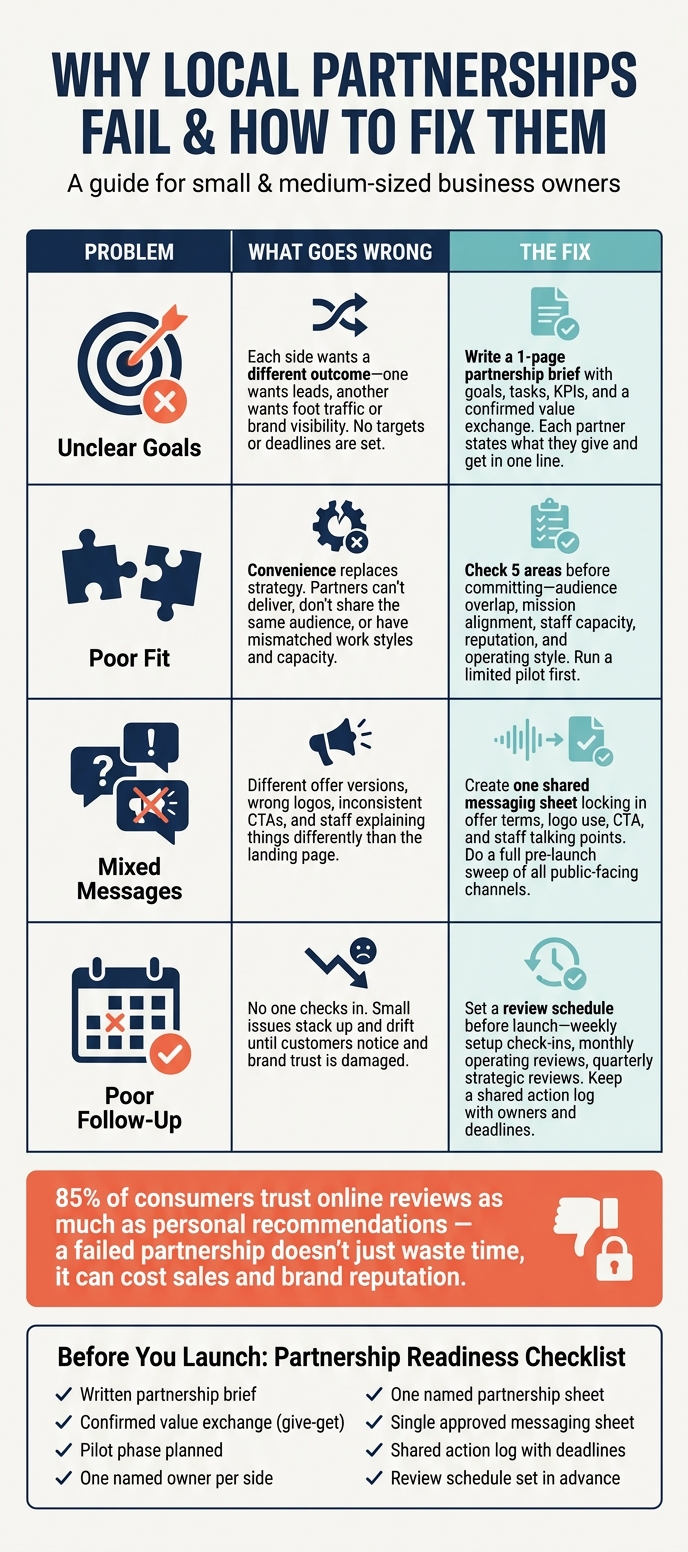
| Problem | What goes wrong | Fix |
|---|---|---|
| Unclear goals | Each side wants a different outcome | Write a 1-page brief with goals, tasks, and KPIs |
| Poor fit | The partner cannot deliver or does not match your brand | Run a small pilot and assign clear owners |
| Mixed messages | Customers see different offers or confusing branding | Use one approved message sheet before launch |
| Poor follow-up | Issues drift until customers notice | Set review dates, escalation contacts, and an action log |
If I strip the article down to one point, it’s this: local partnerships do not fail because the idea was bad – they fail because the work was never set up clearly.
Why Local Partnerships Fail: 4 Problems & Their Fixes
Problem 1: Unclear Goals and Unequal Value
Local partnerships break down when each side is chasing a different win. One partner wants leads. The other wants foot traffic, volunteers, or brand visibility. If that gap isn’t clear at the start, trouble usually shows up fast.
Warning signs before launch
Watch for these three red flags:
- Vague goals – a partner says success means "more leads, foot traffic, or registrations" but gives no target or deadline
- One-sided requests – one business is expected to promote, host, or pay for the campaign while the other mostly just appears
- No written roles or metrics – one side pushes back on putting tasks or success measures in writing
Fix: write a simple partnership brief
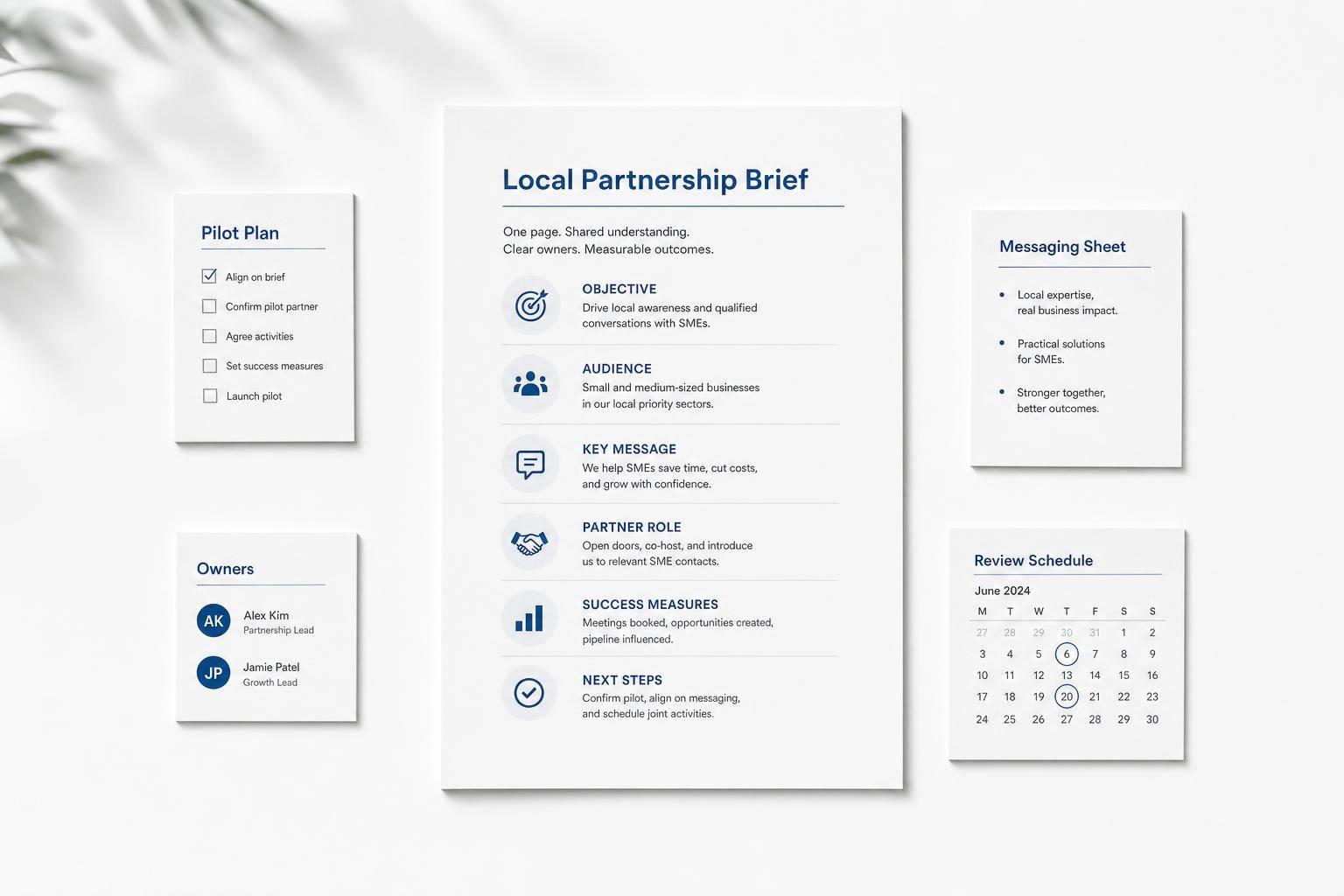
A one-page brief makes both sides spell out what they want before anything goes public. It doesn’t need to be a legal document. It just needs to answer the right questions in writing.
| Brief Field | What It Covers | Example |
|---|---|---|
| Objectives | Specific goals for each partner | "Partner A: 50 booked consultations; Partner B: $1,500 in attributed sales" |
| Deliverables | Tangible items each side must produce | "3 co-branded posts, 1 joint email, 500 flyers" |
| Success Metrics | How results will be measured | "Qualified referrals or revenue tied to a promo code" |
| Value Exchange | What each side gives and gets | "Partner A provides audience reach; Partner B provides event space" |
| Review Dates | When partners will assess progress | "Bi-weekly check-ins; final debrief on Jan 15" |
Assign one owner from each business. Then get sign-off from both sides before launch.
Review point: confirm the value exchange in writing
Before launch, each partner should be able to state what it gives and what it gets in a single line. If either side can’t do that, stop there and fix it first.
"Misunderstandings fester in ambiguity. Establish clear roles and responsibilities early on, ideally inside the agreement itself." – Beverly Amp, Social Media Analyst, Ampfluence
If the brief looks clear but the workload still feels uneven, the next problem is usually fit and ownership.
sbb-itb-fd64e4e
Problem 2: Poor Fit and Unclear Responsibilities
Even when the value exchange looks fair, a partnership can still fall apart if the other side can’t deliver. Sharing the same ZIP code doesn’t mean you’re a good match. Local partnerships often fail when convenience stands in for strategy. And when the fit is off, you don’t just lose time – you create brand confusion and weaker execution.
How to check for fit before saying yes
Before you agree to anything, check five areas: audience overlap, mission alignment, staff capacity, reputation, and operating style. Do your customers have similar buying habits and interests? Does the partner’s public image match your brand? Can they staff and fund their side of the work, or are they already stretched thin?
Meet the partner’s team. If you can, talk to past vendors and clients too. A lot of partnership trouble starts below the owner level, where day-to-day work actually happens.
Start with a limited pilot – one co-marketing event or one referral offer with a clear end date. That gives you a small, controlled test before you commit. You can see whether the partner hits deadlines, communicates well, and handles joint work without friction.
Work style matters because execution lives there. Two businesses can look aligned on paper and still struggle if one side moves fast and the other drags its feet.
Fix: assign owners and write down responsibilities
Put one decision-maker in charge on each side. Then write down deadlines, approvals, escalation steps, and exit terms in the agreement. That’s how you turn a handshake into something people can actually run.
For more involved campaigns, use a simple task matrix to show who does the work, who approves it, who gives input, and who needs updates. Even if the partnership started as a friendly handshake deal, a written agreement is what protects that relationship when things get hard.
Comparison table: poor fit vs. workable fit
Use this table to judge whether a potential partner is worth a pilot – or a pass.
| Area | Poor Fit | Workable Fit |
|---|---|---|
| Audience | Shared location, different customers | Overlapping customers and buying habits |
| Mission | Conflicting goals or purely transactional intent | Shared values and aligned commercial KPIs |
| Capacity | No owner, no budget | Named owner, budget, clear authority |
| Reputation | Inconsistent messaging or public controversies | Credible positioning and reliable delivery |
| Operating Style | Different pace, weak communication | Agreed cadence, compatible workflow |
If a potential partner shows signs of poor fit, treat that as a cue to run a very limited pilot with tight guardrails – or walk away before the partnership costs more than it gives back.
Once fit and ownership are clear, the next weak spot is what customers actually see and how the work gets carried through. That leaves messaging and follow-up, which is where many partnerships start to break in public.
Problems 3 and 4: Mixed Messages and Poor Follow-Up
Even when goals and fit are clear, partnerships can still go off track when execution feels uneven to customers. Mixed messages and poor follow-up are two different issues, but they feed each other fast. One creates confusion at the start. The other gives that confusion room to spread.
Mixed messages: fix the public-facing details first
Mixed messages often start with small misses. One partner promotes one version of the offer, while the other uses a different one. One promo uses the wrong logo. A staff member explains the offer one way, but the landing page says something else.
On their own, each issue may seem minor. Put them together, though, and they make the partnership look sloppy. Customers pick up on that.
Before anything goes live, both sides should agree on a shared messaging sheet. This should lock in the offer terms, logo use, CTA, and staff talking points. Then do a full pre-launch sweep across every public-facing channel, including:
- promotions
- landing pages
- signage
- staff scripts
If one side’s version doesn’t match, fix it before launch – not after.
Poor follow-up: set a review schedule and a recovery process
Most partnership problems don’t blow up all at once. They drift. No one checks in, small issues stack up, and by the time someone spots the pattern, the damage is already done.
Set the review cadence before launch:
| Review Type | Frequency | Focus |
|---|---|---|
| Setup check-ins | Weekly | Task alignment and pre-launch troubleshooting |
| Operating reviews | Monthly | Performance against agreed KPIs and adjustments |
| Strategic reviews | Quarterly | Long-term alignment and overall ROI |
Each side should name one escalation contact who has decision authority. Along with the schedule, keep a shared action log – a simple running document that tracks open issues, who owns each one, and the deadline to fix it.
Use social listening and direct customer feedback to spot complaints early. Also set escalation steps and conflict-resolution steps before you need them.
If a partner misses a deadline or a customer complaint comes in, both sides should already know who escalates it, how fast it moves, and what the resolution window looks like. End each campaign with a debrief.
If the same gaps keep showing up, the partnership is already hurting brand trust.
How branding fits into local partnerships for SMEs and PE-backed operators
Branding support matters when a partnership changes how customers see the business.
That makes the next step simple: decide whether to fix the partnership or end it.
Repair, Review, or End the Partnership
If goals, fit, messaging, or follow-up are still off track, make a clear call: is this something you can fix, or is the problem built into the partnership itself?
Some issues are tactical. Weak tracking, weak creative, or weak follow-up usually point to process problems. Those can often be fixed with better systems and clearer ownership. Other issues run deeper. If values don’t line up, trust has worn down, or a partner’s public mistake hurts your brand, recovery gets much harder.
If you’re not sure which kind of problem you’re dealing with, use this framework:
| Decision | When It Applies | What to Do |
|---|---|---|
| Repair | Goals are aligned, but execution or communication is lagging | Realign roles, assign a single owner, and tighten the follow-up process |
| Review | KPIs are being missed or market conditions have shifted | Re-examine audience overlap, attribution, and creative fit |
| End | Trust is damaged, values clash, or performance thresholds are consistently missed | Follow the exit clause and wind down in an orderly way |
Write the exit clause before the partnership goes live. It may feel awkward at the start, but it saves trouble later. Defining what failure looks like while the relationship is still in a good place helps both sides stay honest about expectations and avoids messy disputes down the line.
Checklist for your next partnership
- A written brief that defines the "why"
- A clear value exchange
- A pilot phase to test fit before full commitment
- One named owner per side
- A single approved sheet covering logo usage, messaging guidelines, and quality standards
- A shared action log with deadlines
- A review schedule set in advance
Key points to carry forward
The four causes of local partnership failure – unclear goals, poor fit, mixed messages, and poor follow-up – each have a simple fix. Start with a written brief and a confirmed value exchange. Run a pre-launch fit audit and a pilot. Use one approved version of every public-facing detail. Then set a review schedule, keep a shared action log, and name escalation contacts on both sides. Written agreements and regular reviews help stop local partnerships from drifting and help protect your brand reputation.
FAQs
How do I choose the right local partner?
Choose a local partner with care. The goal is simple: find a business that serves the same kind of customer you want, but sells something that complements your offer instead of competing with it.
A good partnership works when both sides gain from it. That means looking past surface-level fit and checking whether the match makes sense in day-to-day business. Pay attention to shared values, brand voice, audience fit, reputation, market position, and past performance.
It also helps to watch for warning signs early. If a business has mixed messaging, a shaky reputation, or a pattern of short-lived partnerships, that’s usually a sign to slow down.
Robust Branding can help SMEs build the digital presence and brand base needed to attract and keep strong local partnerships.
What should a partnership brief include?
A partnership brief should spell out the shared goals, the problem both sides are trying to solve, and the KPIs that will define success. It also needs to set clear expectations around roles, responsibilities, deliverables, messaging guidelines, creative guardrails, and the timeline.
To help avoid conflict later, document the project scope, payment terms, intellectual property rights, communication expectations, and exit terms. Leave some room for creative freedom, but make sure the agreement is clear and written down.
When should I end a local partnership?
End a local partnership if it still misses agreed objectives or KPIs after the set review points, if goals or priorities stop matching, or if disputes can’t be settled through the agreed decision process.
Plan for this from the start. Put clear exit terms and performance thresholds in the contract, then carry out the wind-down in line with those terms to limit brand damage and fallout.