Somewhere between signing and Day 1, the integration plan on a portfolio company stops being a diligence artifact and becomes a set of running obligations that someone has to own. That is usually the point where an operating partner or a portfolio CEO starts looking for a PMI consultant for a portfolio company, and it is also the point where the wrong scope, the wrong owner, or the wrong measure of done can cost a full quarter of the value creation plan. What you are deciding is which work to buy, who holds the decision rights, and how you will know within 90 days whether the money produced anything.
This guide is written for the person accountable for revenue operations and integration inside a PE-backed business, someone with budget and a board timeline, not someone learning the category. It walks through the decisions that determine whether an integration engagement returns its cost, and how to judge the work while it is still in flight rather than at the post-mortem.
1. Name the commercial outcome before you name the workstream
Integration spend defends itself when it maps to a number the deal thesis already promised. Bain’s annual review of the industry has tracked for years how much of the return in a typical hold now depends on operating improvement rather than multiple expansion, which means the integration plan is not administrative cleanup. It is where a meaningful slice of the modeled EBITDA either shows up or does not. You can read the pattern in Bain’s Global Private Equity Report and in McKinsey’s private capital research, both of which have documented the shift toward operating value.
Before you brief a single firm, write down the outcome in the language the investment committee used. Not “integrate the CRMs,” but “protect the 8% net revenue retention assumption during the systems cutover” or “hit the €2.4M cross-sell run-rate the model booked for month nine.” The workstream is downstream of that sentence. If a consultant cannot restate their scope in those terms in the first conversation, they are selling you activity.
This matters most right after the LOI clears into confirmatory diligence, because that is when the integration hypotheses are still soft enough to test and hard enough to plan against. The HBR archive on mergers and acquisitions is blunt on the recurring failure: deals are underwritten on synergies that no one is later made responsible for delivering.
2. Decide which of the three integration problems you are actually solving
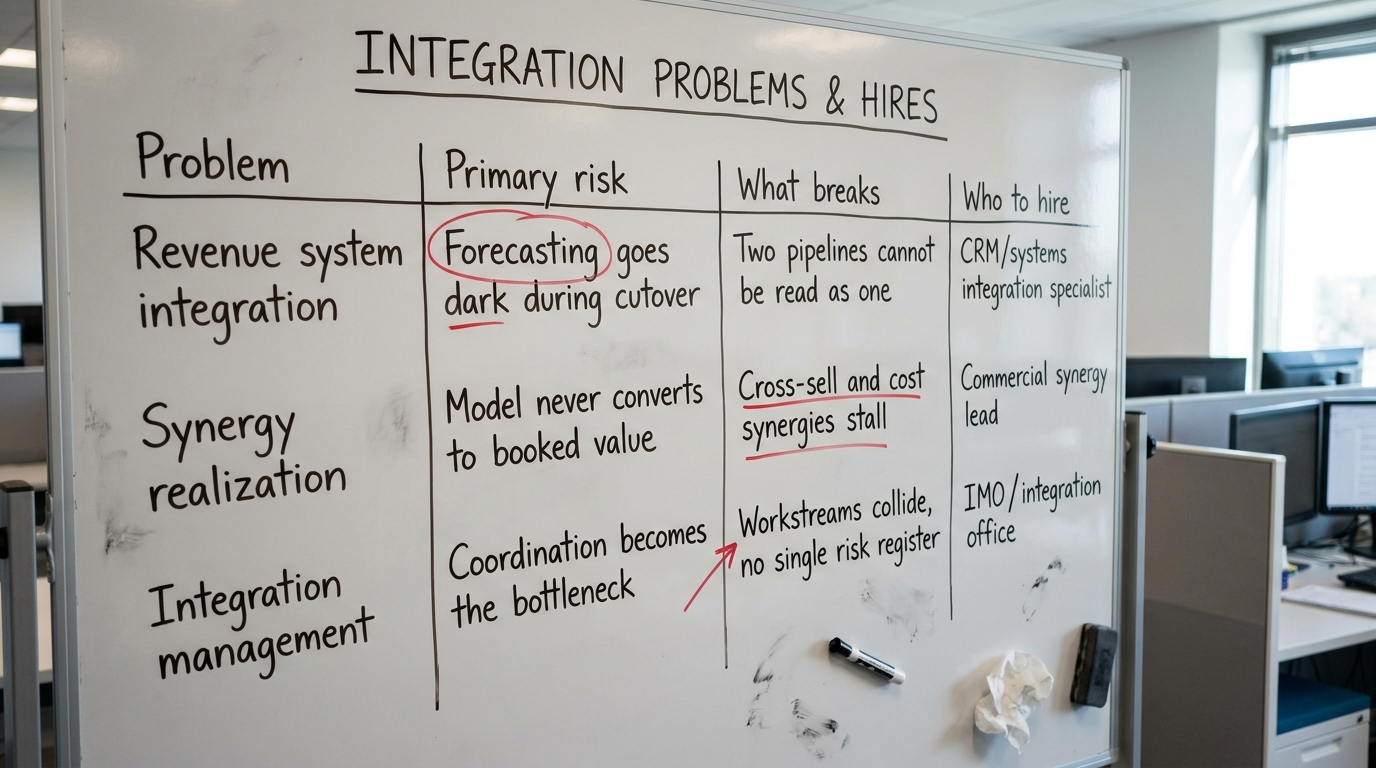
Most portfolio integrations are one of three distinct jobs wearing the same label, and they need different consultants.
Revenue system integration
This is the CRM, the marketing stack, the quoting and billing path, the lead-to-cash data model. It is where revenue leaks during a merger because two pipelines cannot be read as one and forecasting goes dark for a quarter. If your primary risk is a botched systems cutover, the specific competence you want is closer to a post-merger CRM integration consultant than a generalist PMI shop, and the way to evaluate that competence is covered in detail in this guide on choosing a systems integration post-merger consultant and judging the work.
Synergy realization
This is the cross-sell, the procurement savings, the headcount rationalization, the pricing harmonization. The work is commercial, not technical, and the failure mode is a beautiful synergy model that never converts to booked revenue or captured cost. The guide on how to hire a synergy realization consultant without buying a slide deck covers the competence and the buying discipline for this problem specifically.
Integration management
This is the coordination layer, the IMO that runs the cross-functional plan, holds the risk register, and reports actual versus plan to the board. When the deal has more than a handful of workstreams running in parallel, the coordination itself becomes the bottleneck, and the answer is a structured office rather than a subject expert. The tradeoffs are laid out in this piece on hiring an integration management office consultant.
The buying mistake is treating these as interchangeable. A firm that is excellent at synergy modeling will not save you during a Salesforce migration, and an IMO lead will not fix a data model. Decide which problem is on the critical path first, then buy for that.
3. Fix the decision rights before the first invoice
The single most reliable predictor of a stalled integration is ambiguity about who can actually decide. A consultant can recommend a target CRM, a chart-of-accounts mapping, or a rep territory redraw, but someone inside the company has to hold the decision right and be able to say yes on the day it is needed. When that owner is unnamed, every recommendation becomes a slide that waits for a meeting that keeps slipping.
Before the engagement starts, write a short table: each major decision, the single accountable owner inside the business, the consultant’s role (recommend, execute, or both), and the date it must be made to protect the timeline. The Harvard Law School Forum on Corporate Governance has published extensively on why governance clarity, not effort, separates deals that hit plan from deals that drift.
A good PMI consultant for a portfolio company will ask for this table on their own and refuse to start without it. A weaker one will accept an open-ended mandate, because open-ended mandates bill longer.
4. Judge the firm on baseline and evidence, not on the deck
Ask any candidate firm one question early: “What baseline will you measure against, and where does the number come from?” The answer tells you almost everything. A serious integration lead wants the current-state actuals, the pipeline data, the system inventory, the churn and retention numbers, before they will commit to a target. A weaker firm wants to present a maturity model.
The evidence discipline here is the same discipline you already apply in technology due diligence: claims are only as good as the data behind them, and forecast value is not realized value until it clears the P&L. Data providers like PitchBook and S&P Global Market Intelligence are useful for external benchmarks, but the baseline that matters is the company’s own, pulled from its own systems.
Insist that every synergy or improvement the consultant asserts is classified honestly: realized, run-rate, forecast, or merely enabled. A firm that lets a forecast number read as banked money is doing the same thing that gets deals underwritten on synergies nobody delivers. The AICPA and CIMA materials on quality-of-earnings discipline are a reasonable reference point for how rigorous that classification should be.
5. Size the engagement to the decision it informs, not to the calendar
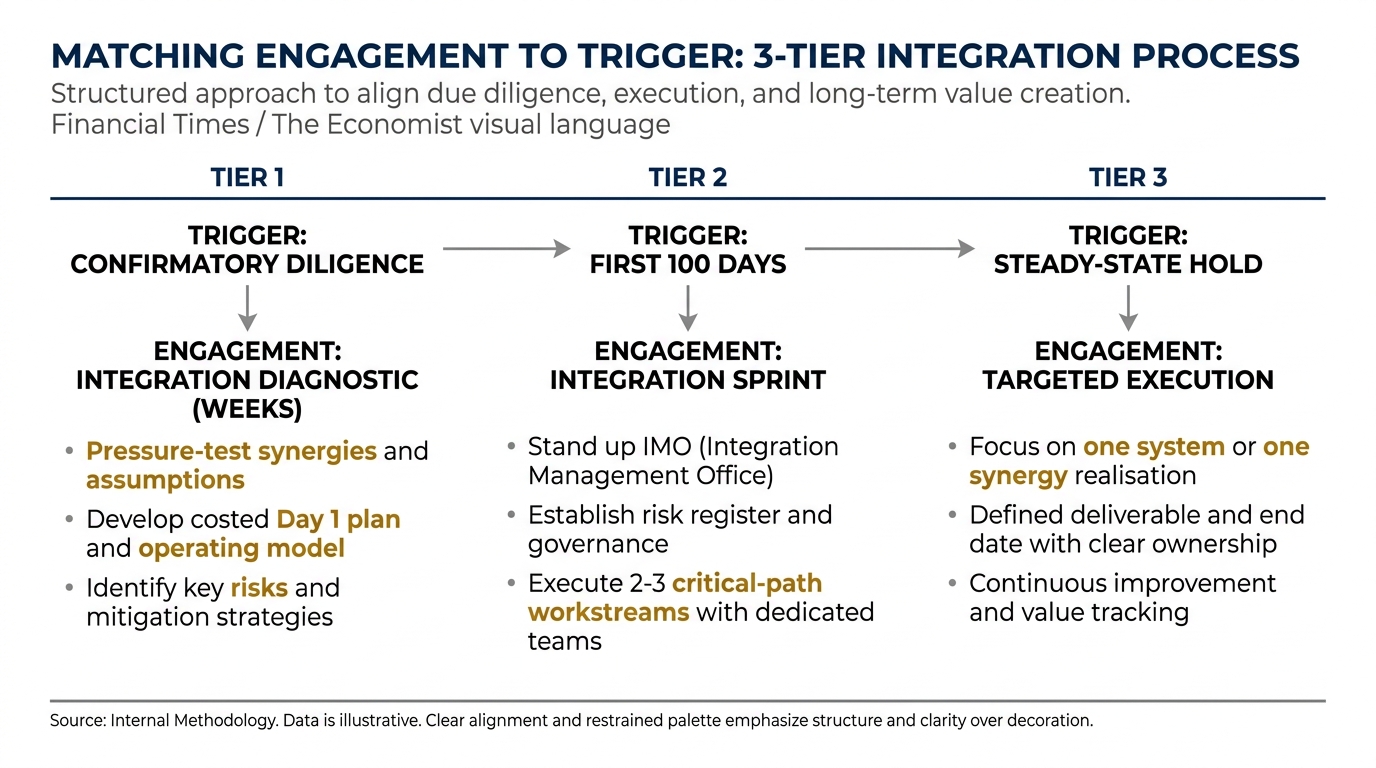
The most common overspend is a twelve-month integration retainer bought when the actual need was a focused eight-week diagnostic that would have told you which workstream to fund and which to kill. Match the shape of the engagement to the decision in front of you.
In confirmatory diligence, a short integration diagnostic pressure-tests the synergy assumptions and produces a costed Day 1 plan (weeks, not months). During the first 100 days, a sprint stands up the IMO, the risk register, and the two or three workstreams on the critical path, which is where the first 100 days plan is either executed or missed. In steady-state hold, targeted execution on a specific system or commercial synergy is scoped to a defined deliverable and a defined end.
A defined-scope sprint in the $25K to $75K range does more for a mid-market deal than an open retainer, because it forces a decision point. If the diagnostic says the cross-sell synergy was fiction, you have saved a quarter of misdirected build. The framing across post-merger integration consulting in private equity is consistent on this: scope to a decision, not to a duration.
6. Insist on the risk register as a live document
The integration risk register is the one artifact that tells you whether the work is real. It should list each integration dependency, the owner, the current status, the trigger date, and what happens to the plan if it slips. If the consultant treats it as a one-time deliverable that ships in week two and never updates, the engagement has already drifted.
A live register does three things for you as the accountable executive. It shows the board actual versus plan without a translation layer. It surfaces the dependency that is about to blow the timeline while there is still time to act. And it makes the consultant’s own performance legible, because a register that never changes is a register nobody is using.
The recurring integration failures documented across the Private Equity International and Buyouts coverage tend to trace back to dependencies that were known and simply not tracked to a decision.
7. Protect the revenue engine during the cutover
For a RevOps owner, the acute risk in any integration is the window where the pipeline, the forecast, or the customer record temporarily cannot be trusted. Two CRMs merging into one, a billing migration, a territory redraw, each creates a period where reps are working blind and the forecast the board sees may not reflect reality.
A competent integration plan treats that window as a managed event with a rollback path, not as an inevitability. It sequences the cutover so that at least one clean source of pipeline truth exists at all times, and it does not let the migration land in the middle of a quarter-end. Getting the customer-facing narrative right during the transition matters too, which is why the discipline in value proposition storytelling is not a soft add-on. Customers notice a merger, and a muddled message during the cutover costs retention.
If the transition goes public and something breaks, the response window is short. Having the first 24 hours of a reputation crisis playbook on the shelf before Day 1 reduces the time spent deciding what to do when the clock is running.
8. Decide build versus buy on the integration function itself
A real decision, and one operating partners often skip: does this portfolio company need external integration help at all, or does it need to hire the capability. If the platform is running a roll-up with a dozen add-ons ahead, the repeatable playbook belongs in-house and a consultant’s job is to build it and hand it over. If this is a one-time integration on a single hold, buying the capability outright is the wrong spend.
The honest test is frequency. A firm doing one integration wants a sprint that leaves a documented, repeatable process behind. A serial acquirer wants an embedded IMO that gets cheaper per deal over time. Research from BCG on serial acquirers has documented how much of the premium in programmatic M&A comes from repeatable integration capability rather than from any single deal.
The engagement should be scoped so the internal team can run the next one with less outside help. A consultant whose plan requires more support each quarter is building dependency into the contract.
9. A checklist to run before you sign
Before you authorize a PMI consultant for a portfolio company, confirm you can answer each of these in one sentence.
- The commercial outcome, stated in the investment committee’s own numbers.
- Which of the three integration problems is on the critical path.
- The single accountable owner inside the company for each major decision.
- The baseline the consultant will measure against, and its source system.
- How every asserted synergy is classified: realized, run-rate, forecast, or enabled.
- The engagement shape matched to the trigger: diagnostic, sprint, or targeted execution.
- A live risk register with owners and trigger dates, updated weekly.
- The cutover sequence that keeps one clean source of pipeline truth at all times.
- Whether you are buying execution or building an in-house capability, and which the plan leaves behind.
- The 90-day evidence you will use to judge whether the spend produced anything.
If more than two of those are still blank, the engagement is not ready to start, regardless of how good the firm is. The gap is on the buy side, and no consultant fixes an unowned decision.
10. How to judge the work at the first board meeting
The first board meeting after Day 1 is the real test. By then you should be able to show the register moving, the baseline confirmed, and at least one workstream reporting actual against plan with a number rather than a status color. A consultant who arrives with a refreshed slide deck and no movement in the underlying evidence has given you activity. One who arrives with a shorter register, a closed dependency, and a realized number, even a small one, has given you the thing you bought.
Firms like Preqin and the PE Hub reporting keep showing the same market pressure: holds are longer, and the operating plan carries more of the return than it used to. That raises the cost of a wasted integration quarter and the value of getting the buy-side decisions right before anyone starts work.
The commercial context sits inside the broader private equity operating agenda, where integration is one of the few levers a sponsor controls directly during the hold. Getting the fit and typography of the customer-facing assets right during a rebrand is a smaller but real part of that, covered in the reference on fluid typography tools for teams consolidating brand systems post-close.
If your integration decision is live now, at LOI, at Day 1, or heading into the first board meeting, and you want a scoped diagnostic or sprint that produces a costed plan and a working risk register rather than a deck, review the DevriX PE integration offer and bring the ten-line checklist above to the first conversation.