An operating partner who signs off on an add-on in late Q3 usually reaches Day 1 about three weeks later. By then the deal team has moved to the next file, the portfolio company CFO is staring at two charts of accounts, and the CEO is trying to keep selling while merging two order-to-cash processes nobody mapped. The buyer with budget needs to decide what to buy, from whom, and how to judge the work once it starts.
This guide is for the person accountable for revenue operations and commercial continuity in a portfolio company, not for someone learning the field. It walks through the decisions that sit with the buyer, the scope that is worth paying for, and the signals that separate a firm that moves enterprise value from one that bills hours.
Decide what the integration is actually protecting
Every integration serves the investment case, and the investment case is rarely “merge two companies.” It is a specific number: synergy capture by a date, a combined revenue base that supports a higher multiple, or a cost structure that frees cash for the next add-on. Before scoping any m&a integration consulting engagement, the buyer should be able to state in one sentence which part of enterprise value the integration is meant to protect or build.
Bain’s annual private equity report has tracked for years how much of the holding period gets consumed by integrations that drift, and the pattern is consistent: value leaks fastest when nobody owns the commercial continuity during the merge. You can read Bain’s ongoing coverage of these dynamics in its Global Private Equity Report.
The practical test is whether a consultant can connect each workstream to the thesis. If a proposal lists “systems rationalization” and “org design” without naming the revenue, margin, or cash effect each one carries, it is a capability list, not an integration plan. For the sequencing of decisions a portfolio executive owns before close, the detailed walk-through of the M&A and integration decisions a portfolio company executive owns before Day 1 is worth reading alongside this.
Separate the three jobs that get sold as one
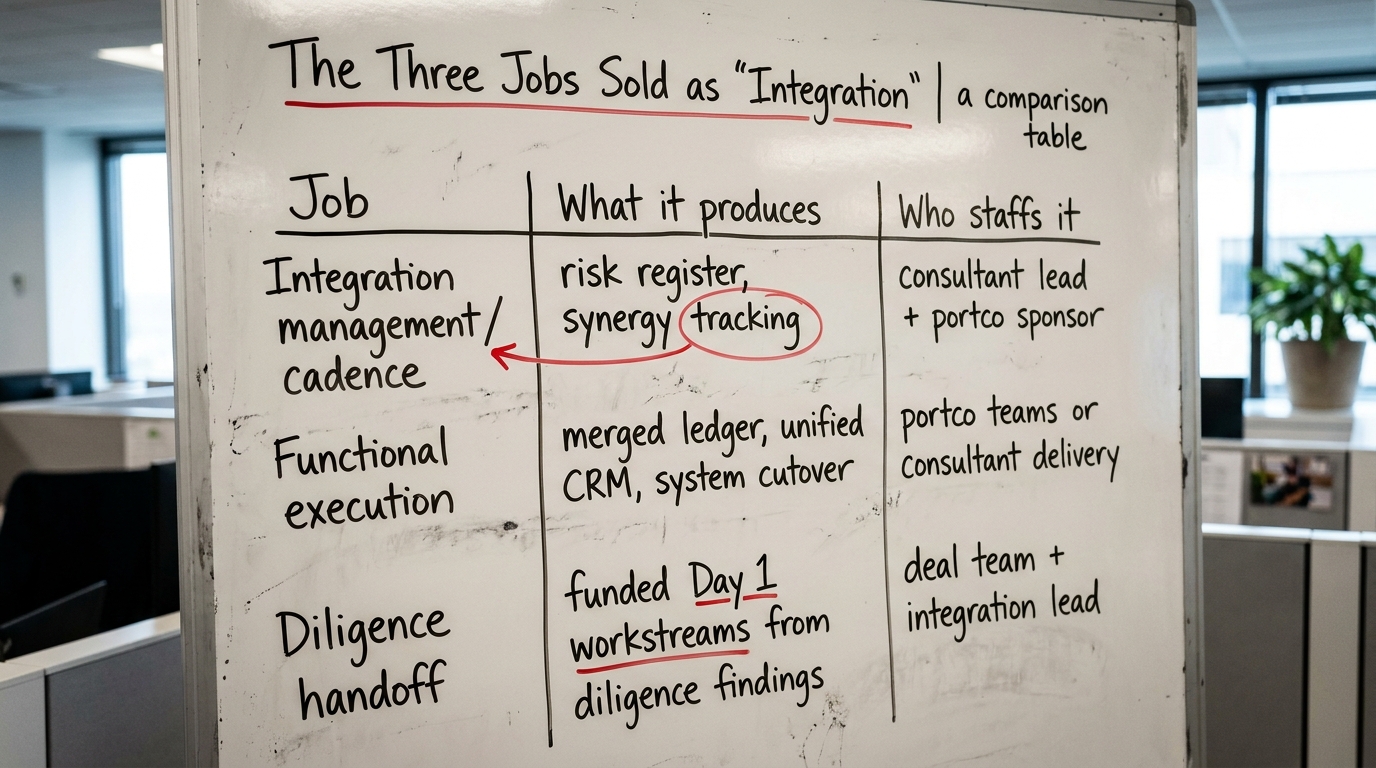
“M&A integration consulting” covers at least three different jobs, and firms blur them because the bundle sells better than the parts. A buyer who knows which job they need will not overpay for the other two.
Integration management
The program office runs the cadence, the risk register, the dependency map, and the weekly actual-versus-plan on synergy capture. It coordinates and forces decisions. A good integration lead spends most of their time surfacing conflicts between workstreams and forcing a decision owner to resolve them before the delay compounds.
Functional execution
This is the hands doing the migration: the finance team merging the ledger, the RevOps team unifying two CRMs and a pricing model, the IT team cutting over systems. Some firms supply this, some only orchestrate and expect the portfolio company to staff it. Confusing the two is how a buyer ends up with a thick deck and no one to run the data migration.
Diligence-to-integration handoff
This is the bridge between what the deal team found and what the integration must fix. It is where a technology due diligence finding about brittle systems becomes a funded Day 1 workstream rather than a surprise in month four. Firms that did the diligence have the context; firms that did not need to earn it fast or they will re-litigate the deal.
Match the engagement to where you are on the deal clock
The right scope changes depending on whether the buyer is pre-signing, between signing and close, or already past Day 1. Hiring the same generalist retainer for all three wastes money in the first case and loses value in the third.
Pre-signing, the useful work is confirmatory: pressure-testing the synergy math and the integration cost assumptions so the model is not fiction. McKinsey’s private capital research has documented repeatedly that integration costs get underestimated at the model stage, and you can follow that body of work through McKinsey’s published research. Between signing and close, the work is planning and staffing the first 90 days. Past Day 1, the work is execution and course correction, which is a different muscle entirely.
If the deal clock is already running and nobody has been engaged, the constraints are tighter and the selection criteria shift toward speed and pre-built playbooks. The specifics of that situation are covered in how to hire M&A integration for private equity when the deal clock is already running.
Price the scope before you take the proposal
A buyer with budget still needs a defensible number, because the board will ask what the fee bought. The problem with most m&a integration consulting pricing is that it is quoted against effort, not against the value at stake, which leaves the buyer with no way to judge whether the quote is reasonable.
The better frame anchors fee to the synergy or continuity value the engagement protects. If an integration protects a combined revenue base of several million in recurring revenue, a program office that keeps that revenue from churning during the merge is cheap at a fraction of one month’s billings. If it only protects a modest back-office saving, the same program office is overbuilt. The full breakdown of what a post-merger engagement should deliver and how to size the fee against it is set out in what a PMI consulting engagement should actually deliver, and how to price the scope.
BCG’s work on principal investors has made the point that the firms capturing the most integration value treat it as a capped, milestone-gated program. Their perspective is collected under BCG’s principal investors and private equity practice. The buyer’s leverage is to tie payment to delivered milestones.
Judge the firm on the first commercial artifact, not the credentials deck
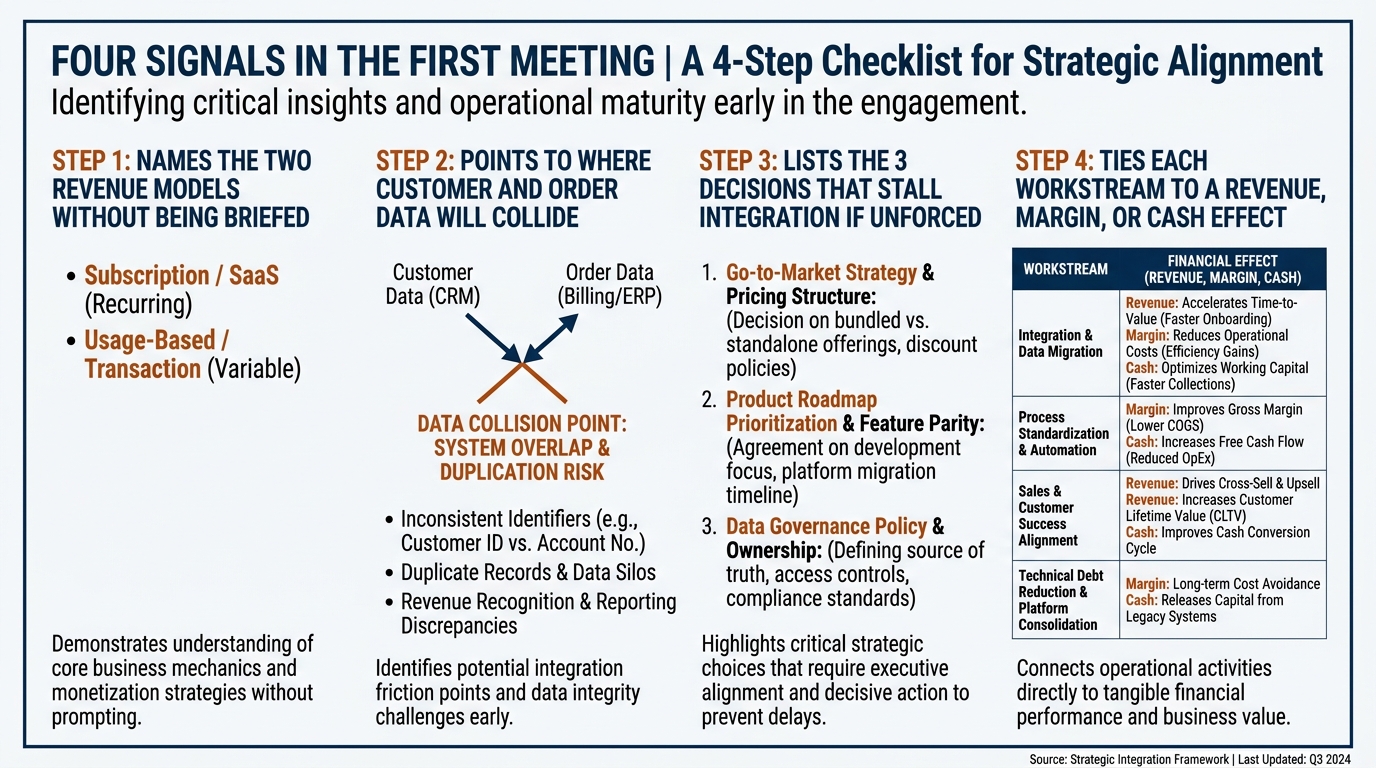
Credentials establish that a firm has done this before. They do not establish that it understands this business. The signal that matters is what the firm brings to the first working session, before it has been paid for discovery.
A firm worth hiring arrives having done outside-in work on both companies: it describes the two revenue models, points to where customer and order data will collide, and names the decisions that will stall the integration if nobody forces them early. A firm that needs the first two weeks to “understand the business” is charging the buyer to learn what a serious competitor already knew before the meeting.
This is the same test a buyer applies when hiring any M&A advisor. The detailed version of that filter, written for the board-meeting horizon, is in how to hire a private equity M&A consultant who earns their fee before the next board meeting.
Insist on a baseline before anyone touches a system
Integrations go wrong quietly because nobody recorded the starting point. If the combined company cannot see its own numbers before the merge, it will not be able to tell whether the integration helped or hurt. This is the most common gap in portfolio companies: the ERP, CRM, and reporting live in disconnected tools and the business runs on spreadsheets.
A competent engagement builds a baseline first. That means read-only connections into the two companies’ systems, a unified view of the metrics that matter to the thesis, and an agreed actual-versus-plan format before a single migration begins. Without it, every later claim about synergy capture is an assertion the CFO cannot verify. The AICPA and CIMA have published extensively on the reporting discipline that makes integration numbers defensible, available through AICPA and CIMA.
The baseline protects the buyer in the board room. When a director asks whether the integration is on track, the answer should be a number against a plan. For the broader context of how a first 100 days plan converts a diligence thesis into a measured operating baseline, that resource maps the sequence.
Protect the revenue engine during the merge, not after
The fastest value leak in any integration is commercial, and it happens while the finance and IT workstreams get all the attention. Two sales teams with overlapping territories, two pricing models, two sets of customer records, and a quota plan that assumed neither disruption nor overlap: this is where revenue quietly walks out during the merge.
A buyer should require the m&a integration consulting firm to treat the revenue engine as a protected system with its own owner and its own plan, running in parallel with the back-office work. That means mapping the combined pipeline early, deciding how the two CRMs reconcile before the cutover, and keeping attribution honest so the board sees real combined performance.
When the two companies also share external providers, agencies, implementation partners, data vendors, the sequencing of which provider stays and which goes directly affects revenue continuity. The practical approach to that is covered in how to sequence providers in post-merger integration for a private equity portfolio company, and the broader version for running the full provider merge without stalling the deal is in how to run providers M&A integration for private equity without stalling the thesis.
Watch the dependencies that cross jurisdictions
Cross-border add-ons add a layer that generalist integration plans tend to skip: the same commercial practice can be compliant in one market and not in another. Loyalty programs, promotional offers, and data handling rules differ enough between the US, UK, and EU that a unified marketing motion assembled on Day 1 can create exposure the deal team never priced. The differences that matter for a combined marketing function are laid out in the comparison of US, UK, and EU loyalty ad standards.
The governance side of cross-border integration, disclosure obligations, board process, and the structure of integration oversight, is tracked closely by the Harvard Law School Forum on Corporate Governance, which is a useful reference for the operating partner who needs to brief the board on integration risk. The point for the buyer is to ask the consultant how the integration plan changes across jurisdictions, and to be wary of any plan that treats the combined entity as one market.
Set the evidence standard for synergy claims
Synergy numbers are where integrations lose credibility. A firm will report “70 percent of synergies captured” and the CFO has no way to audit it. The fix is to agree, at the start, how each synergy will be evidenced and classified: realized and in the numbers, run-rate and annualizing, forecast and dependent on a future action, or merely enabled by work now complete.
PitchBook and S&P Global Market Intelligence both publish data on deal performance that the buyer can use to sanity-check whether the synergy pace a consultant proposes is realistic for the sector. Those datasets are available through PitchBook and S&P Global Market Intelligence. Harvard Business Review’s ongoing coverage of what actually drives post-merger performance, collected in its M&A topic hub, is a useful counterweight to a consultant’s optimism.
The buyer’s job is to refuse any synergy report that mixes these categories. When forecast value reads as realized value in a report, the integration looks fine until the exit diligence finds the gap.
Plan for the handover before the engagement ends
The worst outcome of an integration engagement is that the knowledge leaves with the consultant. A firm that built the cadence, the baseline, and the synergy tracking should hand all of it to a named internal owner, with the operating documentation that lets the portfolio company run the remaining capture without a retainer.
The buyer should write this into the scope from the start: who inside the company owns the integration program at month four, what they receive, and what the consultant’s role becomes once the heavy lifting is done. If a firm resists defining its own exit, that is a signal the engagement is being structured to persist rather than to finish.

A buyer’s checklist for m&a integration consulting
Before signing, the operating partner or portfolio executive should be able to answer each of these in one line:
- Which specific part of enterprise value does this integration protect or build?
- Which of the three jobs, program management, functional execution, diligence handoff, am I actually buying, and who staffs the rest?
- Does the scope match where the deal is on the clock, pre-signing, pre-close, or post Day 1?
- Is the fee tied to milestones and to the value at stake, not to elapsed weeks?
- Did the firm arrive at the first meeting already understanding both revenue models?
- Will a verifiable baseline exist before any system is touched?
- Is the revenue engine protected with its own owner and plan, in parallel with back-office work?
- Does the plan account for jurisdictional differences in any cross-border add-on?
- Is every synergy claim classified as realized, run-rate, forecast, or enabled?
- Is there a named internal owner and a defined consultant exit before the engagement ends?
A firm that answers these cleanly is selling an integration tied to the thesis. A firm that cannot is selling activity, and activity is what fills the hours between signing and the first board meeting where someone asks why the synergy capture slipped. For the broader operating context, the private equity resources cover how these decisions connect across the holding period.
When the integration touches the commercial engine, the data foundation, or the GTM systems that carry the revenue through the merge, route the scope to a partner who runs that work as a measurable program rather than a deck. See how the DevriX private equity practice structures integration execution against the deal thesis, and bring them the baseline and synergy questions above before Day 1.