By the time the deal partner hands a bolt-on to the operating team, the revenue question is already late. Someone has to decide whether the two businesses share a pipeline, a pricing model, a CRM instance and a brand before the first combined board meeting, and that someone is usually the person accountable for revenue operations in the acquiring platform. M&A and integration work fails most often not because the thesis was wrong, but because no one named the decision owner for the commercial systems that carry revenue through the cutover.
This guide is for the operating partner or portfolio executive who has budget and a close date, not for someone learning the field. It walks the decisions you own, the evidence you should demand before you make them, and how to judge whether the integration is on plan or drifting toward a missed quarter.
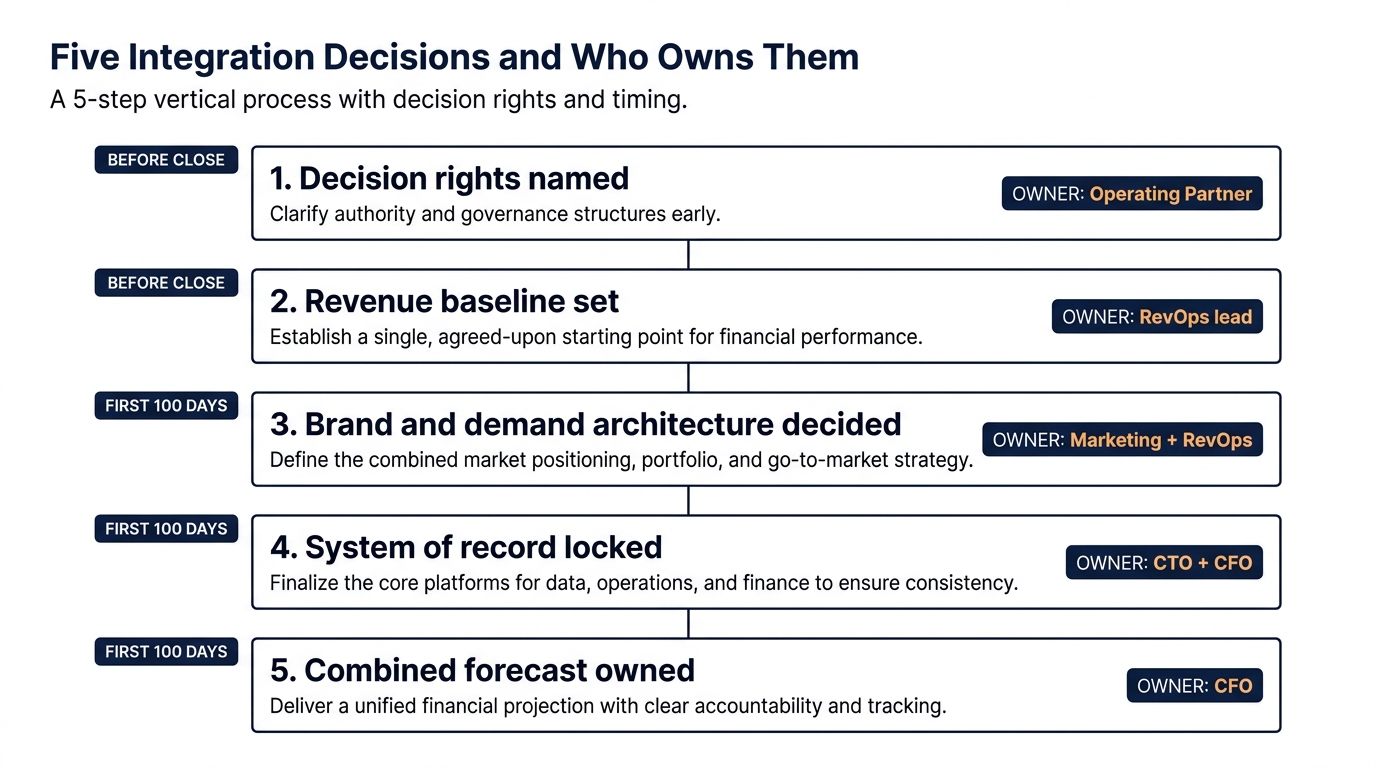
1. Name the integration decisions that belong to revenue, not to the deal team
The deal team models synergies. It rarely decides who processes an order on Day 1, which quote-to-cash system survives, or whether the acquired salesforce keeps its comp plan through the transition. Those are revenue operations decisions, and they have cash consequences inside the first two quarters.
Bain’s annual work on private equity, tracked in its Global Private Equity Report, has consistently pointed to value creation moving earlier in the hold period, which means the commercial integration plan needs an owner before close rather than after. The practical test is simple: for every revenue-touching system and process, you should be able to name one person with the decision right and one date by which the decision is locked.
Decisions that sit with revenue, not the deal team:
- Whether the two companies sell as one brand, two brands, or a house of brands through the transition period.
- Which CRM and which order-management system is the system of record on Day 1.
- Whether the acquired pipeline migrates immediately or runs in parallel for a defined window.
- How comp plans, quotas and territories reconcile, and when.
- Who owns the combined forecast, and against which baseline it is measured.
If any of these lacks a named owner, that is the first gap to close, and it usually surfaces in technology due diligence if the work is done properly.
2. Separate what has to be decided before close from what can wait
Not every integration decision needs to be made before you sign. Confusing the two is how teams burn the first 100 days relitigating choices that could have waited, while the genuinely urgent cutover items slip.
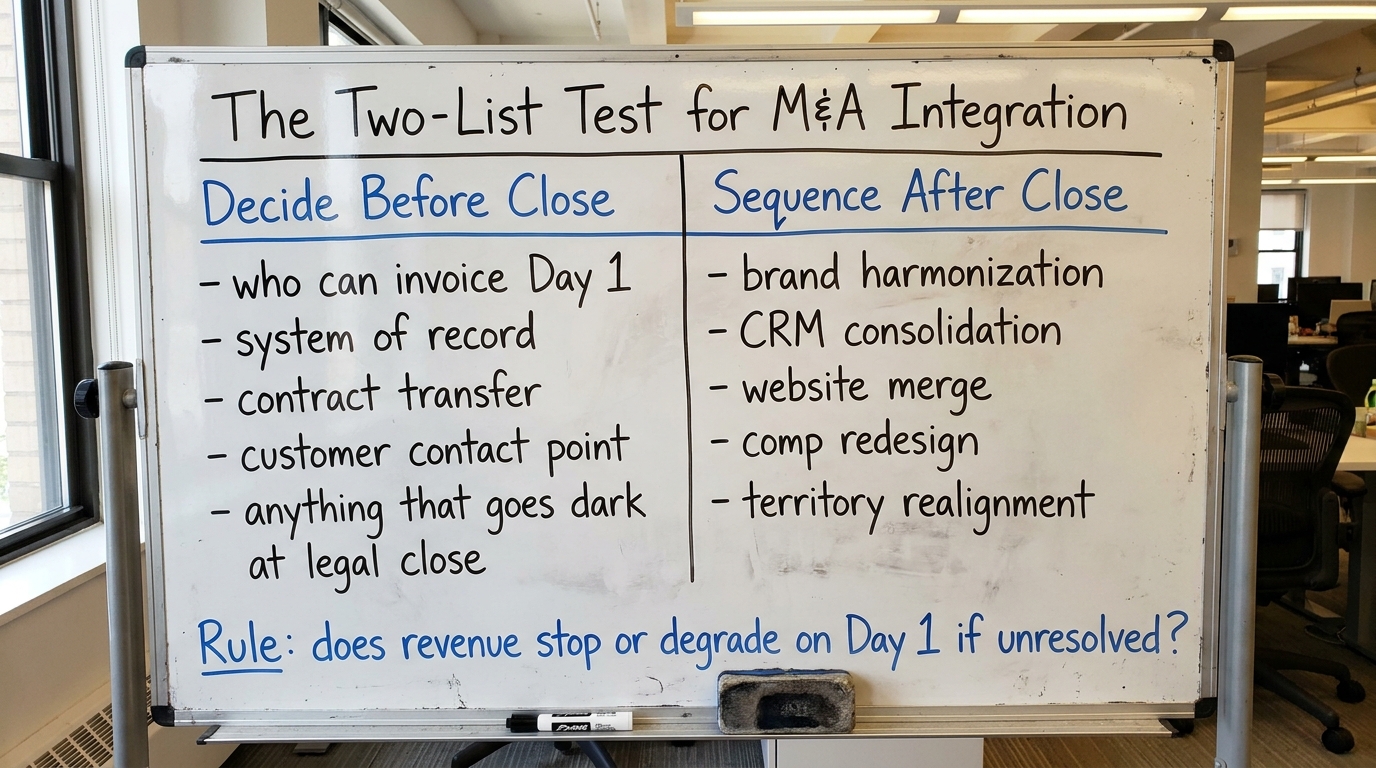
A workable split looks like this. Before close, you need the decisions that affect whether revenue keeps flowing on Day 1: who can invoice, who the customer calls, which contracts transfer and how, and whether any system goes dark at the moment of legal close. Everything else, brand harmonization, CRM consolidation, website merges, comp redesign, belongs in a sequenced plan with its own milestones.
Harvard Law School’s Forum on Corporate Governance regularly publishes practitioner analysis on deal governance and post-close execution risk, and the recurring theme is that unclear decision rights, not missing strategy, derail integration. The useful discipline is to force every item onto one of two lists and defend why it sits where it does.
The two-list test
For each integration workstream, ask one question: does revenue stop or degrade on Day 1 if this is unresolved? If yes, it is a pre-close decision with an owner and a fallback. If no, it is a post-close workstream with a milestone and a budget line.
This is also where sequencing matters. The order in which you bring providers, systems and teams online determines whether the integration compounds or collides, a point developed at length in this guide to how to sequence providers in post-merger integration for a private equity portfolio company.
3. Build a revenue baseline before you touch anything
You cannot judge an integration you cannot measure, and you cannot measure against a plan you did not set. Before any system migrates or any team reorganizes, establish a revenue baseline for each entity: pipeline by stage, win rates, average deal size, churn, net revenue retention, and the actual cost to acquire a customer in each channel.
This matters because integration almost always dents short-term productivity, and without a baseline you will not be able to tell a normal transition dip from a real problem. PitchBook’s research and data on deal performance and McKinsey’s private capital research both reinforce that the value-creation plan has to be anchored to pre-deal operating metrics, not to the model’s synergy line alone.
The baseline is also your defense in the first board meeting. When the forecast moves, the board will ask whether it moved because of integration friction or because the underlying business weakened. Only a clean baseline lets you answer that honestly.
What a usable baseline includes
- Pipeline coverage and conversion by stage for each entity, dated to the close.
- Historical seasonality, so a Q1 dip is not misread as integration damage.
- Customer concentration and the revenue at risk if key accounts react badly to rebranding or contract changes.
- The marketing engine’s actual contribution, including which demand sources you keep and which you retire.
4. Decide the brand and demand architecture early
Brand decisions get treated as cosmetic and deferred, which is a mistake when the acquired company’s demand engine depends on its name, its domain authority and its existing customer trust. Collapsing two brands into one can erase years of organic search equity and confuse a customer base mid-contract.
Keeping two brands preserves demand but doubles the marketing operation. Merging them simplifies operations but risks a demand dip you have to model and fund through. The patterns behind local partnership failures apply here too, because many bolt-ons carry channel and partner relationships tied to the acquired brand.
If the acquired business runs paid acquisition, the brand and offer decision also interacts with advertising compliance across markets, which is not uniform. The differences in US, UK and EU loyalty ad standards can constrain how fast you unify promotions and messaging across a combined footprint.
Protect the search and content assets you bought
If the acquired company’s inbound pipeline leans on organic traffic, a domain migration done without care can cost a quarter of demand. Audit the content and ranking assets before you merge sites, and treat the migration as a sequenced project with its own checklist rather than a flag flip. The same discipline applies to tooling consolidation, where a clear-eyed comparison of SEO tool pricing often reveals redundant subscriptions you can retire post-close.
5. Judge the technology integration before it costs you a quarter
The quote-to-cash stack is where M&A and integration most often goes quietly wrong. Two CRMs, two billing systems and two data models do not merge cleanly, and a botched cutover shows up as delayed invoices, lost pipeline visibility and a forecast no one trusts.
The right sequence is to treat the technology estate as a diligence item with commercial consequences, not an IT project to be handled later. A practical framing of what to look for sits in this guide on how to judge technology integration for private equity before it costs you a quarter, and the broader technical workstreams belong under proper private equity operating discipline.
S&P Global’s Market Intelligence and the AICPA and CIMA’s work on finance operations and controls both point to data and systems integration as a recurring source of post-close financial reporting delay. The executive takeaway is that system-of-record decisions have to be locked before close, because fixing them live is how a quarter’s visibility disappears.
Questions that separate a real plan from a slide
- On Day 1, which system issues invoices and which one holds the pipeline? If the answer is both, there is no plan.
- How does data map between the two models, and who validated that it holds?
- What breaks if the migration slips two weeks, and what is the manual fallback?
- Who signs off that the combined numbers reconcile to the baseline?
6. Choose the integration partners before you need them
Most portfolio companies do not have spare internal capacity to run a full commercial integration while also hitting the plan. That means outside help, and the decision of whom to bring in, for what scope, and at what price is itself a decision you own.
Judge an integration consultant on commercial outcomes, not on methodology decks. The practical criteria are laid out in this guide on how to judge a technology integration consultant on an M&A deal, and the hiring timing is addressed in how to hire a post-close integration consultant without losing the first 100 days. Both make the same point: a partner you engage after the problem appears is already behind.
Scope and price discipline matters as much as selection. What a post-merger integration engagement should actually produce, and how to price it so you are not paying for activity, is covered in this breakdown of what a PMI consulting engagement should deliver and how to price the scope. The test is whether the engagement ties to enterprise-value outcomes you can see in the forecast, rather than hours logged.
7. Set the forecast and the governance that catches drift
Once the baseline exists and the decisions have owners, the remaining job is to build a combined forecast and a cadence that surfaces drift before it becomes a miss. The forecast should reconcile to the baseline, name the synergy items separately from the base business, and track actual against plan weekly during the transition rather than monthly.
Harvard Business Review’s ongoing coverage of mergers and acquisitions repeatedly returns to the same failure: integration plans that look complete on paper but have no mechanism to catch early slippage. BCG’s work with principal investors and private equity makes a similar point about the first reporting cycles being where credibility with the board is won or lost.
The governance that works is unglamorous. A weekly operating review during the transition, a short risk register with named owners and dates, and a forecast that flags variance against baseline rather than against an internal optimism. When a workstream slips, the review should produce a decision, not a status update.
The risk register that actually gets used
A risk register is only useful if every line has an owner, a trigger and a cost. “CRM migration delayed” is not a risk entry. “CRM migration delayed past Nov 15, owner J. Smith, cost is loss of pipeline visibility for forecast, fallback is parallel reporting from both systems” is one. The discipline of writing it that way forces the team to decide what it will actually do.
8. Check the integration against evidence, not against the plan’s optimism
The last thing you own is judgment. A plan can be fully populated and still be wrong, so the executive’s job is to keep asking whether the evidence supports the forecast. Preqin’s alternative assets data and reporting in PE Hub both show integration quality increasingly separating strong exits from weak ones, which raises the cost of self-deception during the hold.
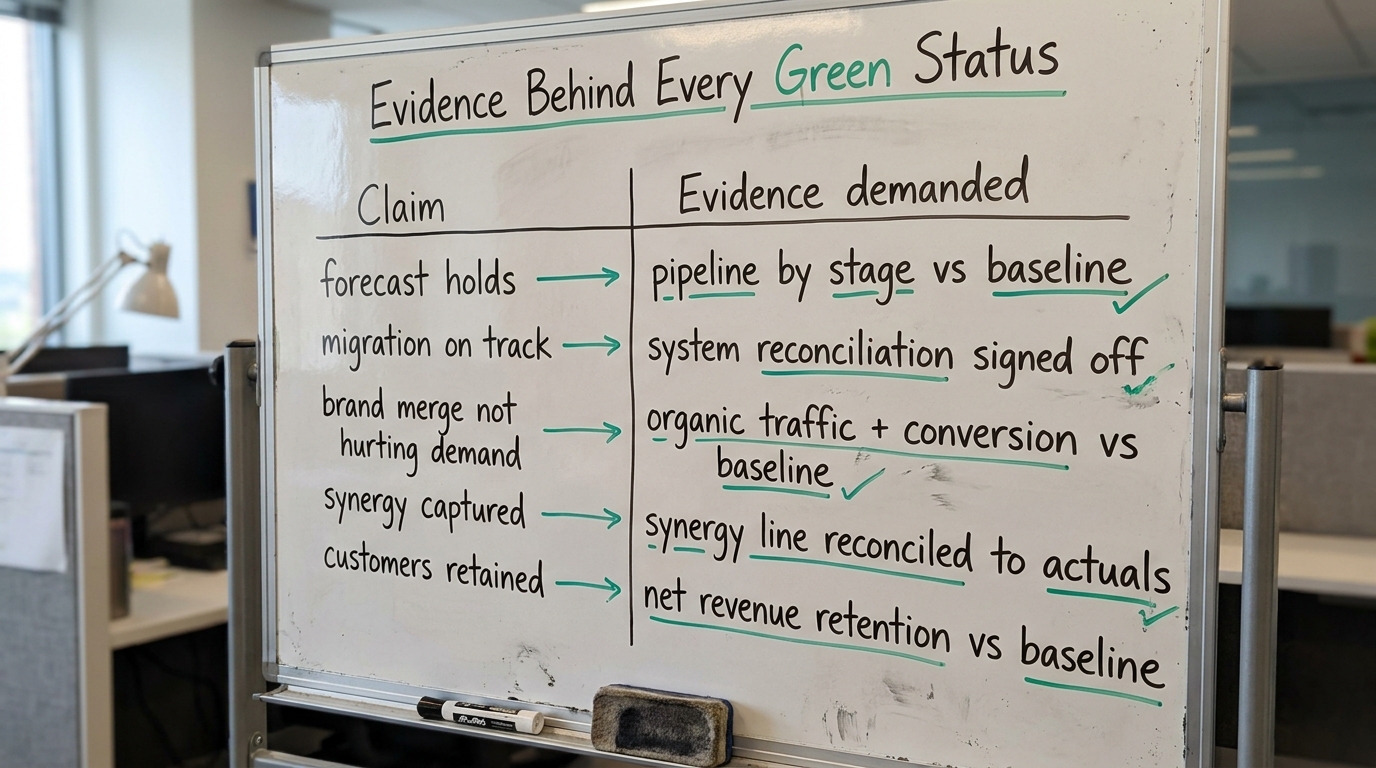
The useful habit is to treat every green status as a claim that needs evidence. The pipeline should be visible by stage against baseline if the forecast holds. The reconciliation should be signed off if the migration is on track. Traffic and conversion data against baseline should confirm that the brand merge is not costing demand. A review where everything is green and no one can produce the number behind it is a review that is hiding something.
9. The executive checklist for M&A and integration
Before close:
- Every revenue-touching decision has one named owner and a lock date.
- The two-list test is done: Day 1 revenue-critical items are separated from sequenced post-close work.
- A clean revenue baseline exists for each entity, dated to the close.
- The system of record for invoicing and for pipeline is decided and documented.
- The brand and demand architecture decision is made, with the demand cost modeled either way.
First 100 days:
- A combined forecast reconciles to the baseline, with synergy items shown separately.
- A weekly operating review runs, producing decisions rather than status updates.
- The risk register has owners, triggers, costs and fallbacks on every line.
- Integration partners are engaged on outcome-tied scopes with defined deliverables and success criteria.
- Every green status can produce the number behind it.
None of this requires a larger team. It requires that the person accountable for revenue operations names the decisions early, measures against a real baseline, and refuses to accept a status without the evidence underneath it. The deals that integrate cleanly are the ones where that discipline was set before Day 1, not improvised after the first forecast slipped.
If you are heading into a close or are already inside the first 100 days and want the commercial systems, brand and technology integration sequenced against the value-creation plan rather than left to improvisation, review how the DevriX private equity practice scopes integration and operating support for portfolio companies.