When a deal closes and the integration budget lands on your desk, the first proposal from a post-merger integration firm usually reads as a list of workstreams and a weekly cadence. That tells you what the consultant will do with their time. It does not tell you what you are buying, who holds which decision, or what the number at the bottom buys in enterprise value. For an operating partner or a portfolio company executive, that gap is where the first quarter gets lost. Understanding what’s typically included in a pmi consulting engagement is less about reading a scope document and more about deciding which pieces you need, which you already have in-house, and which you are paying for twice.
This guide is written for a buyer with budget and a clock. It walks the standard components of a PMI engagement, the decisions each one forces, and the tests you can apply before you sign.
1. Why the scope matters more than the hours
A PMI engagement is sold against a timeline, usually 100 days for the first phase, often tied to the integration thesis the deal team wrote before close. The trouble is that two proposals can carry the same headline price and the same duration while buying very different things. One firm staffs a program manager who coordinates your existing teams. Another embeds functional specialists who do the work your teams cannot. You need to know which one you are approving, because they fail in different ways.
Bain’s annual private equity report has tracked for years how value creation plans slip when ownership of integration tasks stays ambiguous after close, and the pattern holds across cycles. You can read the current edition on Bain & Company’s Global Private Equity Report hub. The lesson for scoping is direct. If the proposal does not name who owns each deliverable, the hours are a cost and not yet an outcome.
Before you evaluate any specific component, decide what the engagement is for. A thesis that depends on cross-selling two customer bases needs commercial integration muscle. A thesis built on cost synergies from consolidating back-office systems needs technical and operational capacity. The scope should serve the thesis.
2. The integration management office and who really runs it
Most engagements open with an integration management office, the central function that tracks workstreams, dependencies, and the synergy plan against actuals. This is almost always included, and it is usually the right place to start. The decision is not whether to have one. The decision is who staffs and who chairs it.
There are three common arrangements, and they carry different costs and different risks.
Consultant-led IMO
The firm supplies the program lead, builds the tracker, and runs the weekly reviews. This is fast to stand up and useful when the portfolio company has no integration muscle of its own. The risk is that institutional knowledge leaves when the engagement ends, so insist that the tracker, the templates, and the decision log are handed over in a usable form from week one.
Hybrid IMO
The firm runs the office jointly with a company executive, often the CFO or a COO. This builds internal capability while the deal is live and tends to survive the transition better. It costs more management attention from your own team, which is the point.
Company-led, consultant-supported IMO
Your executive chairs it and the firm supplies method, templates, and surge capacity. This is the cheapest arrangement in fees and the most expensive in internal bandwidth, and it only works when the company already has someone credible to run it.
Whatever arrangement you choose, the IMO scope should name the reporting line to the board, the cadence of the first board update, and the escalation path for a missed milestone. McKinsey’s published work on merger integration, available through McKinsey’s private capital research, has long argued that governance decided early is cheaper than governance imposed after the first slip.
3. Functional workstreams and the capacity question
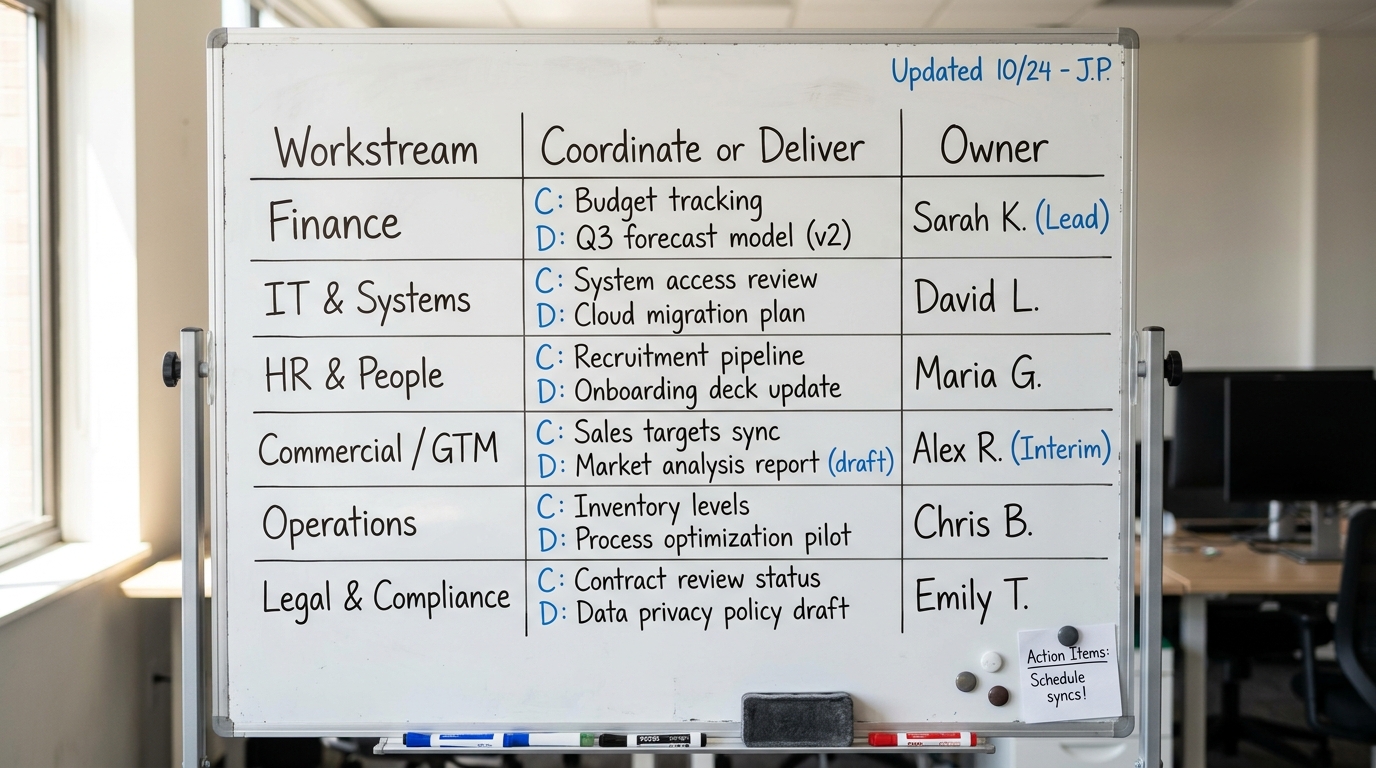
Underneath the IMO sit the functional workstreams: finance, IT and systems, HR and people, commercial and go-to-market, operations, and legal and compliance. A proposal will list these and assign a lead to each. The question that decides your budget is simple. For each workstream, is the firm coordinating people you employ, or supplying people you do not have?
Mark every workstream in the proposal with one of two labels. Coordinate means the firm manages your team’s work and reports on it. Deliver means the firm does the work itself. A firm that prices a “deliver” workstream at a “coordinate” rate will come back for a change order in week six, and a firm that prices “coordinate” work as “deliver” is selling you capacity you already own.
The commercial and go-to-market workstream is where RevOps buyers get the most value and the most waste. Integrating two CRMs, reconciling pipeline definitions, and merging two sales motions is specialist work with a real revenue consequence. If the proposal treats it as a line item next to “office relocation,” push back. The same discipline applies to sequencing vendors across these workstreams, which is its own problem worth reading on separately in this guide to sequencing providers in post-merger integration.
4. The synergy plan, baselined and tracked
Every engagement promises synergy capture. The ones worth paying for baseline it before they claim it. A synergy plan has three parts you should be able to see in the proposal: the identified synergies with a euro or dollar figure attached, the baseline each is measured against, and the method for tracking actual versus plan each month.
Where buyers get burned is on the difference between a synergy that is forecast, one that is run-rate, and one that is realized. A proposal that reports “€4m in synergies captured” without stating which of the three it means is reporting activity, not outcome. Insist that the monthly synergy report classifies each line. The distinction matters at the board table, where a forecast number treated as realized sets an expectation you will have to walk back.
PitchBook and S&P Global both publish deal-level data that operating partners use to sanity-check synergy assumptions against comparable transactions. Their research hubs sit at PitchBook and S&P Global Market Intelligence. If a firm’s synergy targets look unanchored to any comparable, ask where the number came from before you underwrite it in your value creation plan.
5. Technology and data integration, the part that eats quarters
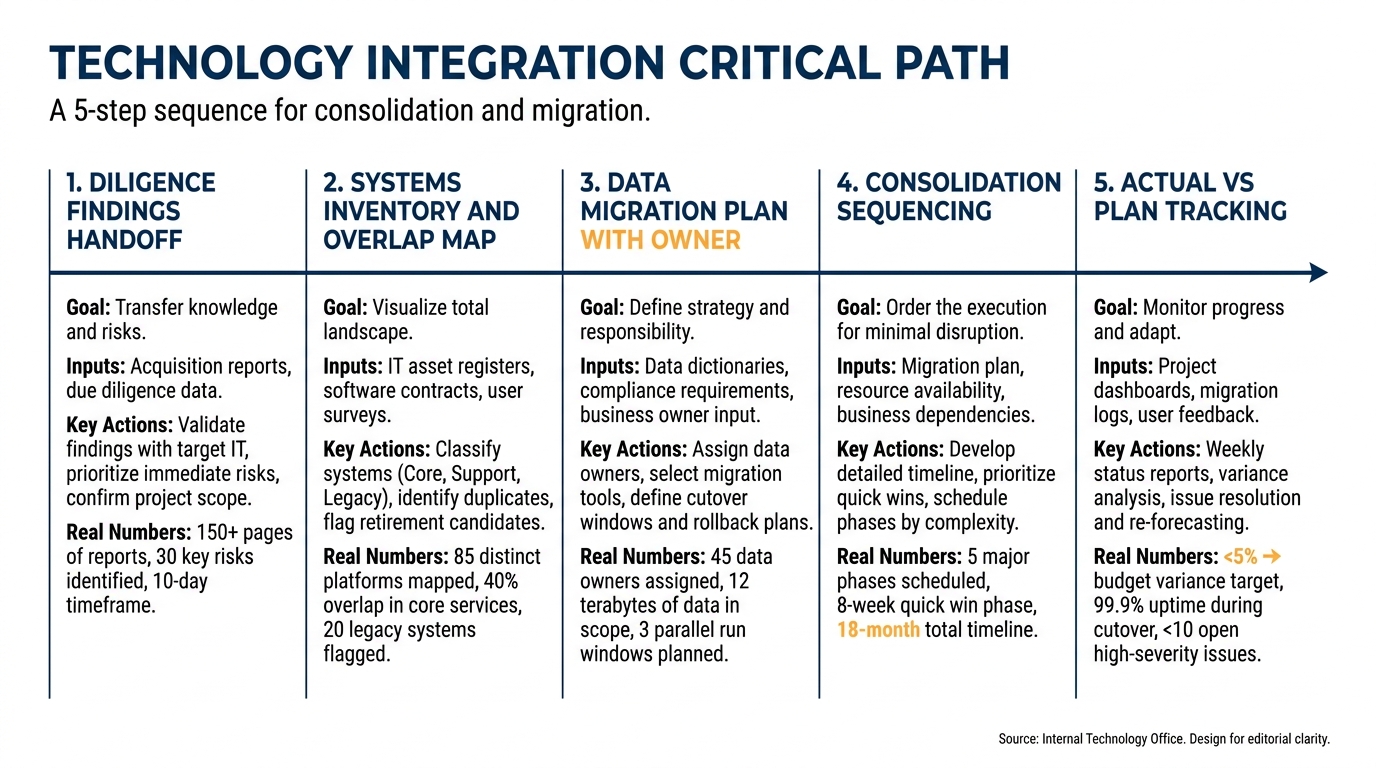
Systems integration is the workstream most likely to overrun, and the one a generalist PMI firm is least equipped to deliver. Merging ERPs, consolidating two instances of the same CRM, reconciling customer master data, and deciding which analytics stack survives are technical decisions with commercial consequences. They also sit on the critical path for most cost synergies.
If the deal thesis leans on systems consolidation, the engagement needs real technical capacity, not a workstream lead who schedules meetings with the IT team. This is where the line between a management consultant and an execution partner matters, and it is worth judging that capability explicitly, as laid out in this read on how to judge technology integration before it costs you a quarter.
Two upstream points connect here. The first is that much of this risk should have surfaced during technology due diligence, so the integration scope should reference the diligence findings rather than rediscover them. The second is that the people you hire for this need to be judged on execution, not slideware, a test covered well in this piece on judging a technology integration consultant on an M&A deal.
6. The first 100 days and what gets front-loaded
The strongest engagements decide what happens in the first 100 days before Day 1, not during it. The proposal should show a Day 1 readiness list, a 30-60-90 plan, and a clear statement of what is explicitly deferred past day 100. Deferral is a sign of discipline. A plan that tries to do everything in 100 days usually does nothing well.
Front-loading should cover the decisions that block everything else: the leadership and reporting structure, the chart of accounts and reporting consolidation, access and security for shared systems, and any customer-facing change that cannot wait. The Harvard Business Review’s M&A collection, at HBR’s mergers and acquisitions topic, carries a durable body of work on why the early sequencing of integration decisions predicts the outcome more than the quality of any single workstream.
Hiring the right person to run this window is its own decision with real downside if you get it wrong, which is why it is worth reading separately on hiring a post-close integration consultant without losing the first 100 days.
7. Change management, communications, and retention
The soft workstreams are where cost synergies quietly leak. When a merger announcement goes out and two sales teams start comparing comp plans, attrition in the first two quarters can undo the headcount math the deal model assumed. A PMI engagement should include a communications plan, a retention plan for named key people, and a defined approach to culture and operating-model change.
The decision for you is how much of this you want the firm to own versus your own HR and leadership. External help is useful for method and for the hard conversations an insider cannot have cleanly. It is poor value when it substitutes for leaders who should be visible themselves. The Harvard Law School Forum on Corporate Governance, at corpgov.law.harvard.edu, publishes regularly on governance and stakeholder communication through transactions, which is useful background for how the board will expect this handled.
On the commercial side, retention of the acquired company’s channel and partner relationships deserves explicit scope. Partnerships break after a change of control more often than buyers expect, a pattern covered in this field guide on why local partnerships fail and how SMEs fix them. If the deal thesis counts on those relationships, name them in the integration plan.
8. Commercial and GTM integration for the RevOps buyer
For the person accountable for revenue operations, the commercial workstream is the one to scrutinize line by line. It usually bundles several distinct jobs that have different owners and different timelines, and lumping them together hides where the work actually sits.
- CRM and data consolidation. Merging pipeline data, reconciling account hierarchies, and agreeing one definition of a qualified opportunity. This is technical and should carry a named data owner.
- Sales motion and territory design. Deciding whether the two sales teams merge, stay separate, or cross-sell, and redrawing territories without stalling live deals.
- Marketing and brand consolidation. Deciding whether the acquired brand is retained, merged, or retired, and sequencing the web and demand-generation work that follows.
- Compliance across markets. If the two businesses operate under different jurisdictions, advertising and loyalty rules can differ in ways that affect campaigns, as set out in this comparison of US, UK and EU loyalty ad standards.
The practical tooling and content choices under this workstream are rarely in the consulting scope and usually fall to your own team, from the SEO tools a consolidated web presence needs to a video SEO checklist for new content as the brands come together. Decide early which of these the firm does and which you keep, so you do not pay consulting rates for work an in-house marketer does better and cheaper.
9. How the engagement is priced, and what the number should buy
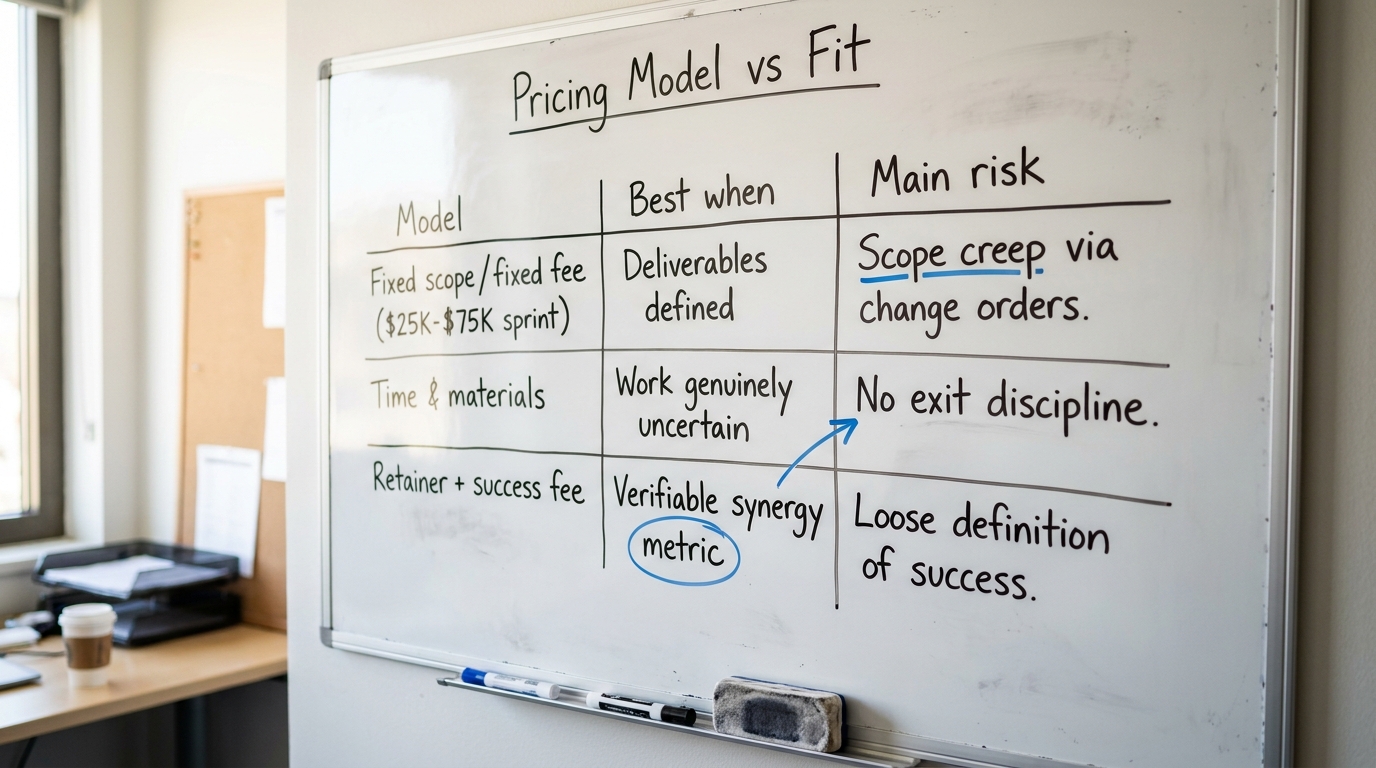
PMI engagements are priced one of three ways, and each tells you something about what you are buying.
Fixed scope, fixed fee
Best when the deliverables are well defined, which usually means a focused initiative rather than an open-ended program. A sprint to stand up the IMO, baseline the synergy plan, and deliver the 30-60-90 plan fits here. For a mid-market portfolio company, a focused initiative of this kind commonly sits in the $25,000 to $75,000 range, which buys a defined output rather than an open retainer.
Time and materials
Honest for genuinely uncertain work, dangerous when it replaces scoping discipline. Cap it, define the exit, and require a weekly burn report against the plan.
Retainer with a success component
Aligns incentives when the success metric is a verifiable synergy number with an agreed baseline and method. It becomes an argument when “success” is defined loosely, so write the measurement rules before the first invoice.
Whatever the structure, the number should map to enterprise value, not activity. The test for every line is whether it moves revenue, EBITDA, cash, integration speed, management visibility, or operating risk. A line that cannot be tied to one of those is a line to question. The broader case for treating integration as a set of priced commercial decisions with owners and deadlines is made well in this piece on why post-merger technology integration requires commercial decisions with owners and deadlines.
10. Judging the proposal before you sign
Run every proposal through a short set of tests. These separate a scope you can govern from a scope that governs you.
- Ownership is named. Every deliverable has a person accountable, on the firm’s side or yours.
- Coordinate or deliver is marked. Each workstream states whether the firm manages your people or supplies its own.
- Synergies are baselined. Every synergy carries a figure, a baseline, and a monthly actual-versus-plan method, classified as forecast, run-rate, or realized.
- The critical path is visible. You can see which decisions block others, especially in systems and data.
- Handover is built in. Trackers, templates, and the decision log transfer to you in usable form from the start.
- Deferral is explicit. The plan names what is intentionally pushed past day 100.
- The number ties to value. Each major cost line connects to revenue, EBITDA, cash, speed, visibility, or risk.
- Diligence is referenced. The scope builds on technology and commercial diligence findings rather than starting from scratch.
A proposal that passes these tests is one you can take to the board and defend. A proposal that fails two or more of them is a program you will be renegotiating in week six. For the wider operating context around how these engagements sit within a fund’s value creation work, the broader private equity operating practice is the place to start.
11. A short checklist to take into the vendor call
Bring these eight questions to the first scoping conversation with any PMI firm.
- Who runs the IMO, and does the tracker transfer to us from week one?
- For each workstream, are you coordinating our people or delivering the work yourselves?
- What is the baseline for each synergy, and how will you classify capture each month?
- Where is the systems and data critical path, and who owns the migration plan?
- What happens in the first 30, 60, and 90 days, and which work is intentionally deferred?
- Which commercial and GTM jobs are in scope, and which stay with our team?
- How is retention of key people and key partner relationships handled?
- How does each cost line connect to enterprise value?
The data and research hubs behind most of the benchmarks a firm will cite are public, so you can check their assumptions yourself. Beyond Bain, McKinsey, PitchBook, and S&P Global, the AICPA & CIMA resources are useful on the accounting and reporting side of integration, and the U.S. Securities and Exchange Commission filings archive is the primary source for anything disclosed in a public comparable.
A PMI engagement is a set of decisions about who owns what, what gets front-loaded, and how capture is measured, priced against the value the deal thesis promised. Scope it that way and the number at the bottom of the proposal becomes something you can defend rather than something you hope works out.
If you are scoping a focused post-close initiative and want the IMO stood up, the synergy plan baselined, and the first 90 days sequenced as a fixed-scope sprint, review the DevriX PE integration offer and bring your deal thesis to the first scoping call.