
An operating partner approving a confirmatory diligence budget two weeks before a signing deadline faces a narrow decision. The deal team wants confidence that the revenue number in the model is real, the commercial diligence provider wants another three weeks, and the sponsor wants to know whether the number survives contact with the target’s own data. Private equity due diligence consulting is the work that answers those questions, and the quality of what the firm buys here decides whether the first board meeting opens with a clean baseline or a round of corrections.
This guide is written for the person accountable for revenue operations in a portfolio company, or the operating partner who will inherit the integration. It assumes budget authority and working knowledge of the deal. It covers what to scope, what to refuse, and how to judge the output so the price paid turns into a defensible baseline rather than a slide deck no one reopens after close.
1. What the diligence spend is actually buying
The firm buys reduced uncertainty on the three or four assumptions that move the model most, and a baseline the operating team can hold the business to after Day 1. When commercial diligence confirms that 70% of revenue is contracted and recurring, that finding changes the debt structure the deal can carry and the aggression of the integration plan. When it cannot confirm it, the sponsor either reprices or walks.
Bain’s annual private equity report has tracked how holding periods and entry multiples compress the margin for error on the underwriting case. The practical consequence is that diligence has to produce evidence the operating partner can act on, not a narrative that reads well in the investment committee and then sits in a data room folder. Treat every workstream by one test: does it change a decision, or does it decorate one already made?
Across technical, data, revenue and operating diligence, the output you should insist on is a baseline with owners attached. Numbers without owners do not survive the first forecast miss.
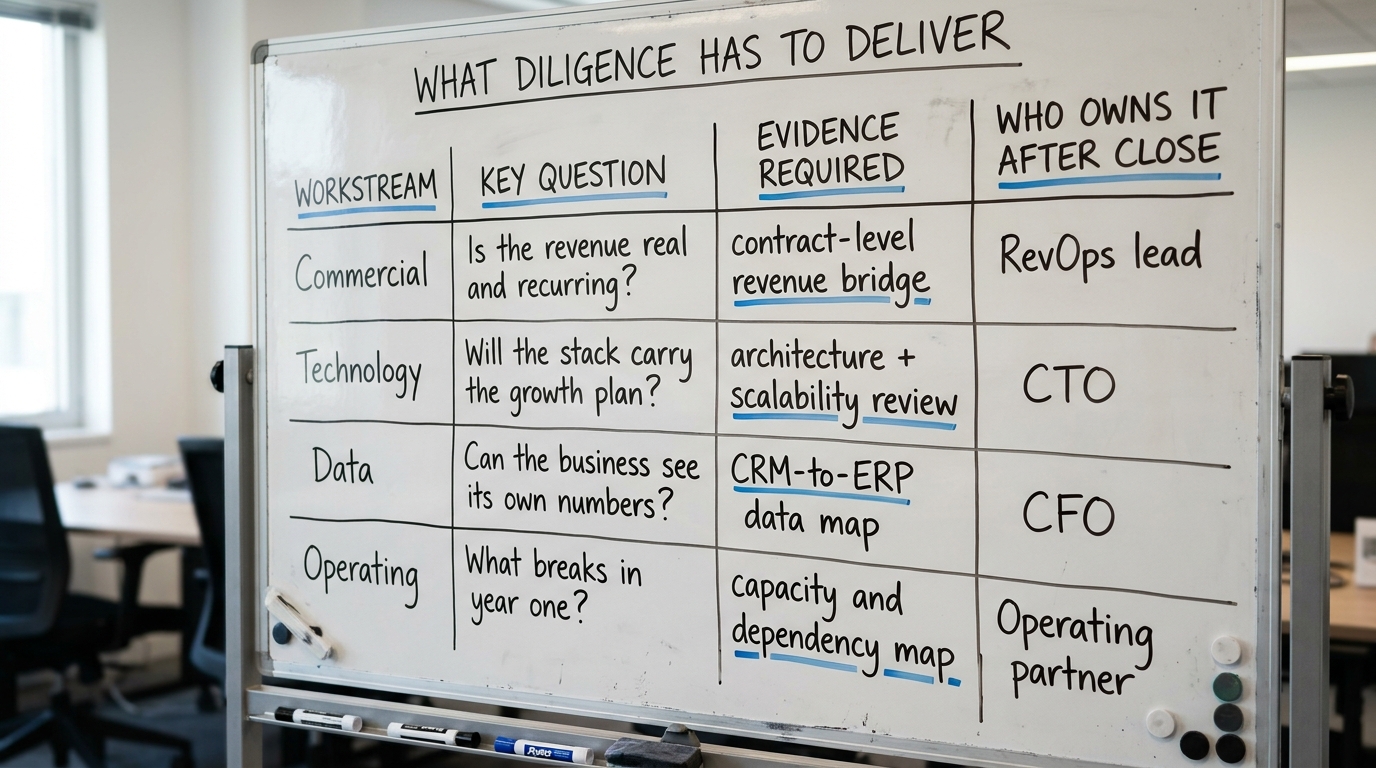
2. Separate the four diligence workstreams and staff each one differently
Buyers who treat diligence as a single purchase get a generalist team that is strong in one area and thin in the rest. The four workstreams ask different questions and reward different expertise.
Commercial and revenue diligence
This workstream tests the demand side of the model: customer concentration, retention, pricing power, pipeline conversion and the durability of the revenue mix. McKinsey’s private capital research has consistently placed revenue durability and margin expansion at the center of value creation, which is why commercial diligence should produce a revenue bridge the finance team can rebuild from source data, not a chart whose inputs no one can trace.
Technology diligence
For any software-enabled or platform target, the technology due diligence workstream decides whether the stack can carry the growth modeled in the thesis. The workstream covers architecture, technical debt, security posture, key-person risk in engineering, and the real cost of the roadmap the seller is promising. A clean commercial case sitting on an unscalable platform is a repricing event waiting for the first board meeting.
Data and systems diligence
This is where many mid-market deals are weakest, and where the operating team feels the pain first. If the target runs on disconnected CRM, ERP and spreadsheets, the revenue number the model relies on may not be reconstructable from the systems that produced it. Diligence should flag whether the business can see its own numbers at all, because that gap becomes the first 100 days problem whether or not anyone budgeted for it.
Operating and integration readiness
The final workstream maps capacity, dependencies and the integration risk register. It answers what breaks in year one if the plan proceeds as modeled. BCG’s work on principal investors has repeatedly made the point that the integration plan should begin during diligence, not after close, which means the operating diligence output has to feed directly into the Day 1 plan.
3. Scope the engagement around decisions, not deliverables
A diligence provider will quote by deliverable: a report, a data room review, a management-interview round. That framing suits the vendor and buries the thing the buyer needs, which is a decision on each material assumption. Rewrite the scope as a list of questions, each with the evidence that would answer it and the decision it informs.
An illustrative scope line reads: “Confirm that the top-20 customers represent no more than X% of revenue and that contracted terms extend beyond the hold period; evidence is signed contracts and the billing system export; the decision is whether customer concentration changes the debt quantum.” That line tells both sides what finished looks like and what counts as evidence. A line that reads “customer concentration analysis” does neither.
This discipline also controls cost. When scope is written as decisions, you can cut the questions that do not move the model and spend the saved days on the two or three that do. The approach mirrors how a disciplined buyer treats M&A integration consulting that protects the deal thesis: scope against the thesis, not against a menu.
4. Judge the provider on evidence standards, not brand
The name on the proposal matters less than whether the team will show its work. A provider worth the fee gives each material finding a source, a method and a confidence level, and tells you plainly where the data was too thin to conclude. A provider to avoid hands over a confident narrative with no trail back to the underlying records.
Ask for a sample finding from a prior engagement, redacted, before you sign. You are checking three things: whether the finding names its evidence, whether the method is one your finance team could rerun, and whether the provider was willing to write down something inconvenient. The AICPA and CIMA standards for quality-of-earnings work exist precisely because buyers need findings that hold up under a lender’s and an auditor’s scrutiny, and the same standard belongs on the commercial and data side.
The Harvard Law School Forum on Corporate Governance regularly publishes on diligence failures and the disclosure gaps behind them. The recurring theme is that the problems were visible in the data and the diligence process did not surface them. Judge the provider on how it handles the inconvenient finding, because that is the one that protects the deal.
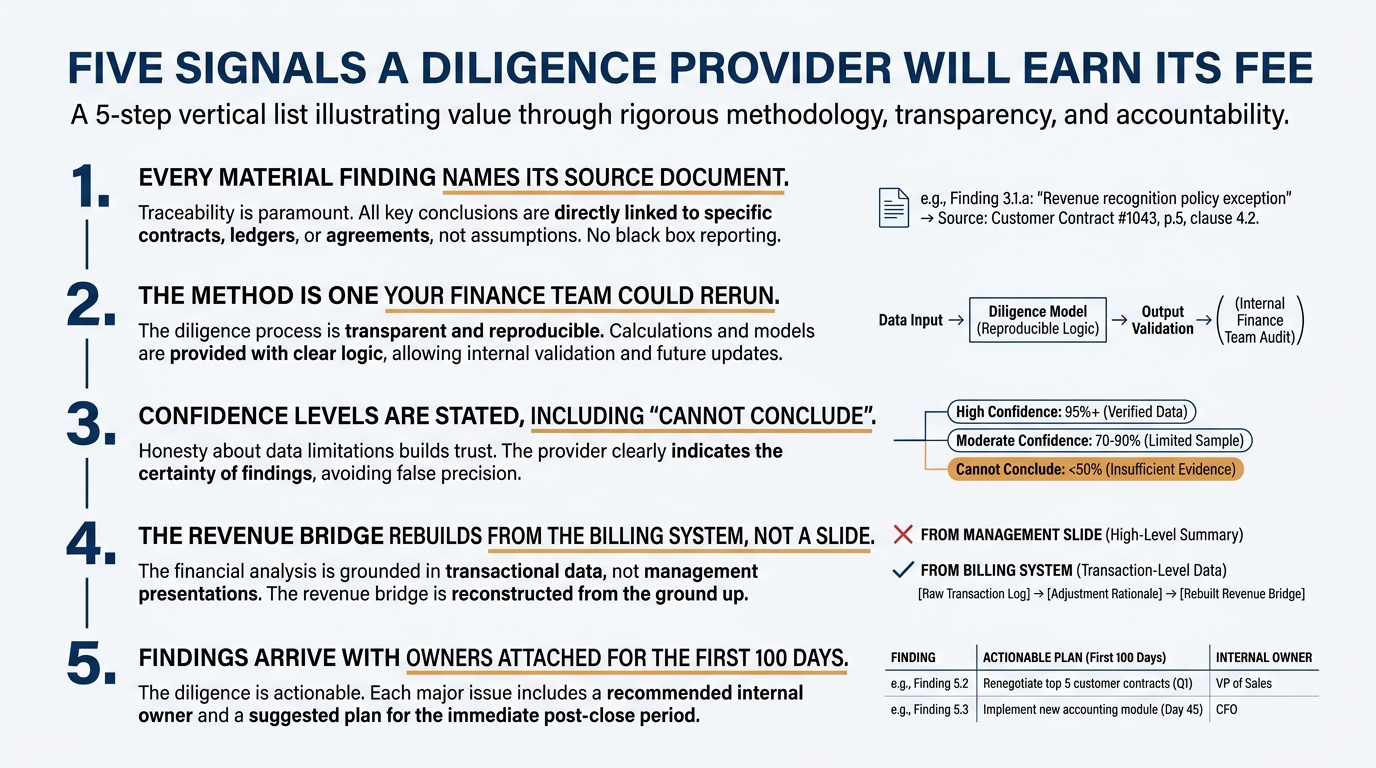
5. Insist on a baseline the operating team can hold the business to
The gap between a diligence report and a usable baseline is where most of the value leaks. The report describes the business as it was during diligence. The baseline is the set of numbers the operating team will run against actual-versus-plan from Day 1, with each metric defined the same way the diligence team defined it.
Require the provider to hand over the model behind the findings, not just the findings. If the revenue bridge lives in a spreadsheet only the consultant can open, the baseline dies when the engagement ends. The finance team should receive the same data in a format they keep working in, which is usually Excel on the same source data, while leadership and the board get the dashboard view with the material risks flagged.
This is the same two-format discipline a well-run RevOps function uses after close: finance keeps its working model, leadership gets a visual summary, and both read off one source. The operating partner who sets this up during diligence inherits a baseline on Day 1 instead of commissioning one in month two.
6. Price it against what the work costs now, not the old consulting rate
Diligence pricing has not kept pace with what the work actually requires. A commercial and data diligence scope that a large firm quotes in the low six figures and six weeks can often be delivered in a fraction of that, because the data extraction and analysis that used to consume junior hours now run far faster. PitchBook and Preqin both publish deal and fund data that let you sanity-check whether a provider’s effort estimate matches the size and complexity of the target.
Judge the price against the number of real decisions in scope and the depth of evidence each one requires. A provider quoting a flat six-figure fee for a $15M add-on with three material questions is pricing for its own cost structure. One quoting tens of thousands and moving in days, with the same evidence standards, is pricing for the deal.
When the timeline is already compressed, the pricing conversation changes again. The constraints of hiring M&A integration help when the deal clock is already running apply to late-stage diligence too: you pay for speed and focus, so the scope has to be ruthless about which questions survive.
7. Connect diligence findings to the first 100 days before close
A diligence finding that does not convert into a Day 1 action is a cost with no return. The handoff from diligence to integration is the moment most of the value is made or lost, and you design it before signing.
Every material risk the diligence team surfaces should carry forward into the first 100 days plan with an owner, a decision right and a date. If data diligence found that the CRM and ERP do not reconcile, the first 100 days plan needs a named owner for the integration, a target date for the first unified dashboard, and a decision on whether that work is hired or rented. Harvard Business Review’s coverage of M&A integration keeps returning to the same finding: deals underperform when the integration plan starts after close rather than during diligence.
The decisions a portfolio company executive owns in this window are concrete and time-boxed. The sequence is laid out well in this breakdown of the integration decisions an executive owns before Day 1, and it starts with the risk register the diligence team produced.
8. Decide who owns the work after the consultants leave
Diligence is a project; the baseline it produces is a standing responsibility. Before the engagement closes, decide whether the RevOps lead, the CFO, or an external partner will own the metrics, the data model and the integration workstreams the diligence surfaced. This is the capability question most deals defer and then regret.
The honest answer for many mid-market portfolio companies is that they do not have the internal RevOps capacity to own a newly built data model and the integration at the same time, in the first six months, with a lean team. The choice is to hire a RevOps lead, contract the function as a service, or split it. Each has a different cost and a different speed to standing capability, and the right call depends on the thesis timeline rather than a general preference.
Sequencing matters here as much as the hiring decision. When multiple providers and systems are involved, the order in which they come online determines whether the thesis stalls, a problem covered in detail in this guide to sequencing providers in post-merger integration.
9. Avoid the four ways diligence spend turns into waste
Four patterns reliably convert diligence budget into findings no one uses.
- The activity report. Hours logged, interviews conducted, documents reviewed, with no statement of which assumptions changed. S&P Global Market Intelligence and the SEC both publish enough on disclosure and risk that there is no excuse for a report that counts effort instead of resolving questions.
- The SaaS template on a non-SaaS business. A diligence framework built for recurring-revenue software, applied to a distributor, a services firm or a clinic group, produces metrics that do not describe the business. The provider has to build for the actual revenue model or the baseline is wrong from the start.
- The confident narrative with no trail. Findings that read well and cannot be rebuilt from source data. These collapse the first time the lender’s team or the auditor asks for the underlying records.
- The orphaned baseline. A model the consultant built, in a format the finance team cannot maintain, with no owner named for after close. It is usable for exactly as long as the engagement lasts.
The common thread across all four is that the work was scoped around deliverables and brand rather than decisions and evidence. Buyers who choose a provider the way they would choose an M&A consultant who earns the fee before the next board meeting rarely fall into these traps, because they are testing for usable output from the first conversation.
10. A checklist for the operating partner signing off
Before approving the diligence budget, confirm each of the following. If more than two are missing, the scope is built for the vendor rather than the deal.
- The scope is written as decisions and questions, each with the evidence that would answer it.
- The four workstreams (commercial, technology, data and operating) are staffed by people with real depth in each discipline.
- Every material finding will name its source, its method and its confidence level, including where the data was too thin to conclude.
- The revenue bridge and the baseline model are handed over in a format the finance team keeps working in.
- Each material risk carries forward into the first 100 days plan with an owner, a decision right and a date.
- The price maps to the number of real decisions in scope, benchmarked against what the analysis costs to run today.
- A named owner for the baseline and the integration workstreams is decided before the consultants leave.
- The framework was built for this target’s actual revenue model.
The same standard applies when the diligence feeds a platform-plus-add-on strategy, where the integration work compounds across deals. For that case, the pricing and scope discipline in this guide to what a PMI engagement should deliver and how to price the scope pairs directly with the diligence decisions above.
Diligence done this way produces a baseline the operating team can defend at the first board meeting and run against for the length of the hold. Done the other way, it produces a report that confirmed what the committee already believed and told the operating partner nothing they could act on.
If you are scoping confirmatory diligence or planning the handoff into integration on a live deal, DevriX runs commercial, data and technology diligence and the first 100 days execution behind it for private equity sponsors and their portfolio companies. Bring the thesis and the timeline, and the scope gets built around the decisions that move your model.