Most integration failures are priced into the deal long before the first workstream lead is hired. An operating partner who signs an LOI with a synergy case built on cross-sell and a shared ERP, then waits until Day 30 to think about who runs the integration, has already lost weeks the investment committee expected to be productive. By the time the integration management office is stood up, the sales teams have started poaching each other’s accounts and the two finance functions are reconciling to different charts of accounts. That is the situation where a portfolio company executive starts pricing M&A integration consulting services, and it is usually a month late.
This guide is for the person who already owns the number. It assumes budget, a signed or imminent deal, and a synergy case that someone will hold you to at the next board meeting. It walks through what to decide before you engage a firm, what the engagement should actually produce, and how to judge whether the work is moving the value case or just producing decks.
1. Decide what the integration is actually supposed to buy
Before scoping any external help, write down the two or three numbers the integration exists to protect or create. Not the thesis in prose, the numbers. A cost synergy of X in run-rate savings by month 12. A revenue synergy of Y from cross-sell, with a named owner and a pipeline assumption behind it. A working-capital release of Z from consolidating vendors and payment terms.
Bain’s annual private equity report has tracked for years how much of the value creation plan now rests on operational improvement rather than multiple expansion, which is exactly the part an integration either delivers or quietly forfeits. You can see the shape of that shift in Bain’s Global Private Equity Report, and it matters here because the integration budget is only justified against a value case someone will measure.
If the synergy case is soft, a consulting engagement will not harden it. It will document it more expensively. Firm up the baseline first: what the two businesses actually cost to run today, at the line-item level, and where the overlap is real versus assumed.
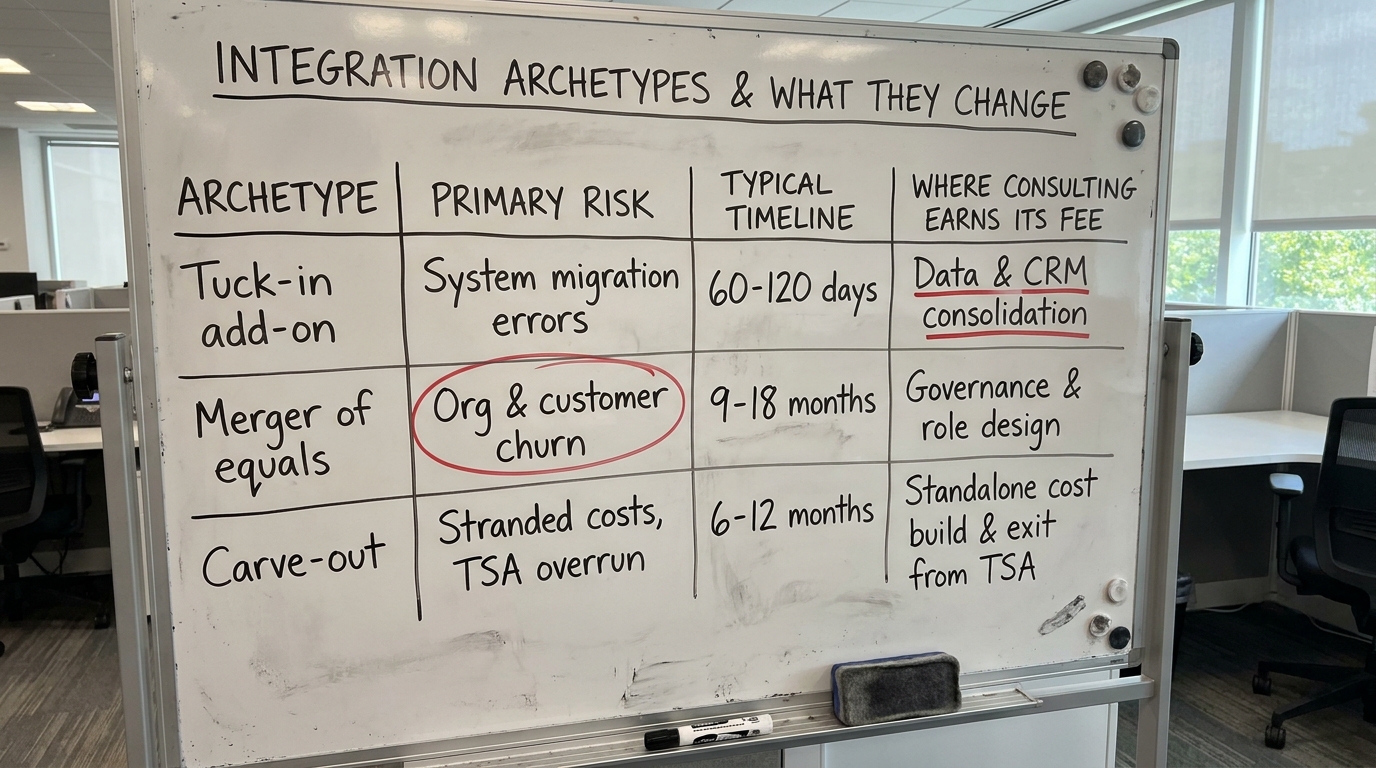
The three integration archetypes and why they price differently
A tuck-in add-on that folds into the platform’s systems is a different job from a merger of equals where both sides keep operating for a year. A carve-out from a larger parent carries stranded-cost risk that neither of the other two does. When a firm quotes M&A integration consulting services at a flat rate without asking which of these you are running, that is a signal they are selling a template.
2. Separate the integration management office from the advisory
Two distinct things get sold under the same heading. One is the integration management office, the standing function that runs cadence, tracks synergies against plan, and escalates dependencies. The other is functional advisory, the deep work inside a single area like CRM consolidation, finance-system migration, or commercial due diligence follow-through.
You may need both, but you buy them differently and you judge them differently. The office is judged on whether decisions get made and tracked on time. The functional work is judged on whether the specific system, process, or team it touched now performs to plan. Confusing the two is how a portfolio company ends up paying senior day rates for people who schedule meetings.
If you are deciding whether to staff the office internally or bring it in, the trade-offs are worth reading through before you scope anything, and there is a practical treatment in this walkthrough of hiring an integration management office consultant. The short version: bring in the office when you lack internal integration muscle or when the deal is large enough that pulling operators off the day job breaks the base business.
3. Fix the decision rights before Day 1
Integration stalls where ownership is unclear. Who decides which CRM survives. Who owns the combined pricing model. Who has the authority to cut a duplicate role. If those decision rights are not assigned before Day 1, the integration stops at exactly the points where speed matters most, because every functional leader can escalate and none can resolve.
The research literature on merger integration is consistent that early, decisive leadership on structure and people is one of the few reliable predictors of a deal that hits its case. The Harvard Law School Forum on Corporate Governance and Harvard Business Review’s M&A coverage both return to the same point, that ambiguity in the first weeks compounds.
A good integration firm will insist on a decision-rights matrix as a Day 1 deliverable, not a month-two artifact. If the scoping conversation skips this, the firm is planning to bill you for the discovery that should have been the starting condition. This is also where the first 100 days plan lives or dies, because the calendar does not wait for governance to catch up.
What the matrix has to name
- Name the single person who owns each workstream.
- The decisions that require investment-committee or board sign-off versus those the operating team can make.
- The escalation path and the maximum time a decision can sit unresolved before it goes up.
- The customer-facing decisions that cannot be reversed later, so they get more scrutiny up front.
4. Scope the systems and data work as its own workstream
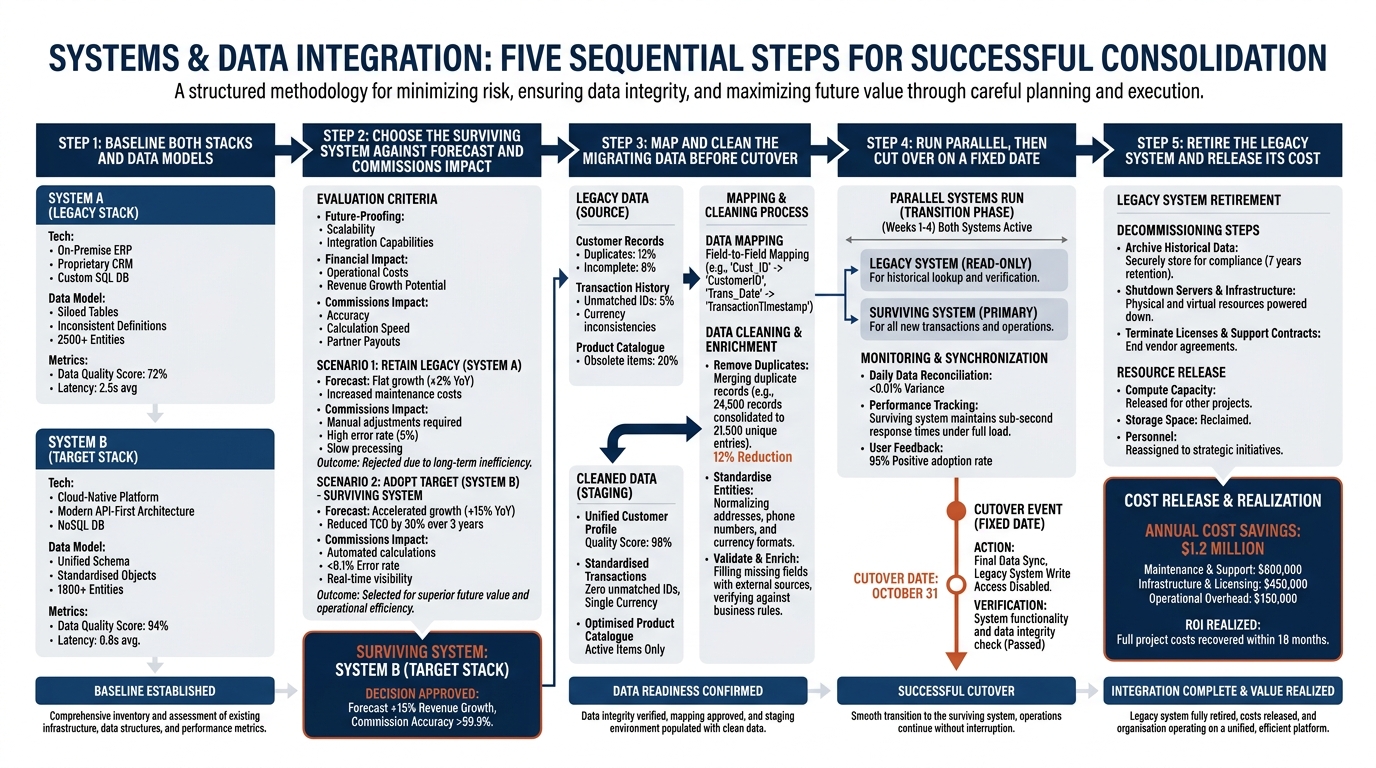
Systems integration is where synergy cases go to die quietly. The revenue synergy assumed a single view of the customer; the two businesses run different CRMs with incompatible data models, and nobody costed the reconciliation. The cost synergy assumed a consolidated ERP; the migration takes three quarters longer than the plan and the finance team spends that time maintaining two sets of books.
Treat this as a named workstream with its own owner, budget, and risk register, separate from the general integration cadence. A post-merger CRM integration consultant is solving a different problem than a general PMI advisor, and the CRM decision touches pipeline, forecasting, and commissions all at once. Get it wrong and the sales team loses trust in the numbers for two quarters.
This is also the point where technical diligence pays off, because the integration is only as feasible as the systems reality you inherited. If the deal team ran proper technology due diligence, the integration workstream starts from a documented state of the architecture rather than discovering it live. When it did not, the first month of integration becomes the diligence that should have happened before close.
How to judge the systems work
The test is not whether the migration happened. It is whether the surviving system now produces forecasting and pipeline data the commercial leaders trust, and whether the retired system’s cost actually came out of the run rate. A migration that finishes but leaves both licenses running has realized nothing. There is a fuller treatment of how to evaluate this kind of deliverable in this piece on how to choose a systems integration post-merger consultant and judge the work.
5. Hold the commercial synergies to a tracked pipeline
Cost synergies are easier to plan and easier to verify because they show up in the run rate. Revenue synergies are where most integration cases overpromise, and where a consulting firm can hide the longest, because “cross-sell is building” is not a number.
Insist that every revenue synergy resolve into a tracked pipeline with named accounts, expected values, and stage-gated probability, reviewed on the same cadence as the cost side. If a firm proposes revenue synergy work without proposing the tracking that proves it, they are selling optimism. The discipline here is closer to RevOps than to classic PMI, which is why the revenue owner should sit on the integration steering group and not just receive its minutes.
PitchBook and S&P Global both publish deal-level data showing how differently cost and revenue synergies actually land after close, and the pattern favors caution on revenue. You can find that kind of evidence in PitchBook’s research and S&P Global Market Intelligence, and it is worth reading before you let a revenue synergy number carry the deal case.
The offer that should make you wary
Be skeptical of any engagement that promises synergy realization and delivers a slide deck of initiatives. The value is in the tracking and the closing of specific gaps, not in the taxonomy of opportunities. This distinction is laid out plainly in this guide to hiring a synergy realization consultant without buying a slide deck.
6. Protect the customer and the brand through the transition
Integrations lose value at the customer boundary faster than anywhere on the org chart. Renaming, re-contracting, migrating support systems, and consolidating the go-to-market all touch the customer directly, and each one is a chance for churn that the synergy case never modeled.
Decide early what the customer experiences on Day 1 and what changes on a deliberate schedule after that. If the acquired brand carries equity you are keeping, the messaging through the transition matters, and getting the story straight is real work. There is a practical frame for that in this guide to value proposition storytelling.
Have a plan for the transition going wrong in public, too, because a botched systems cutover or a mishandled account transfer can become a reputation problem overnight. The first day of a reputation incident sets the outcome, and the sequence is covered in this piece on the first 24 hours of a reputation crisis.
7. Scope the engagement to a decision-driven sprint, not an open retainer
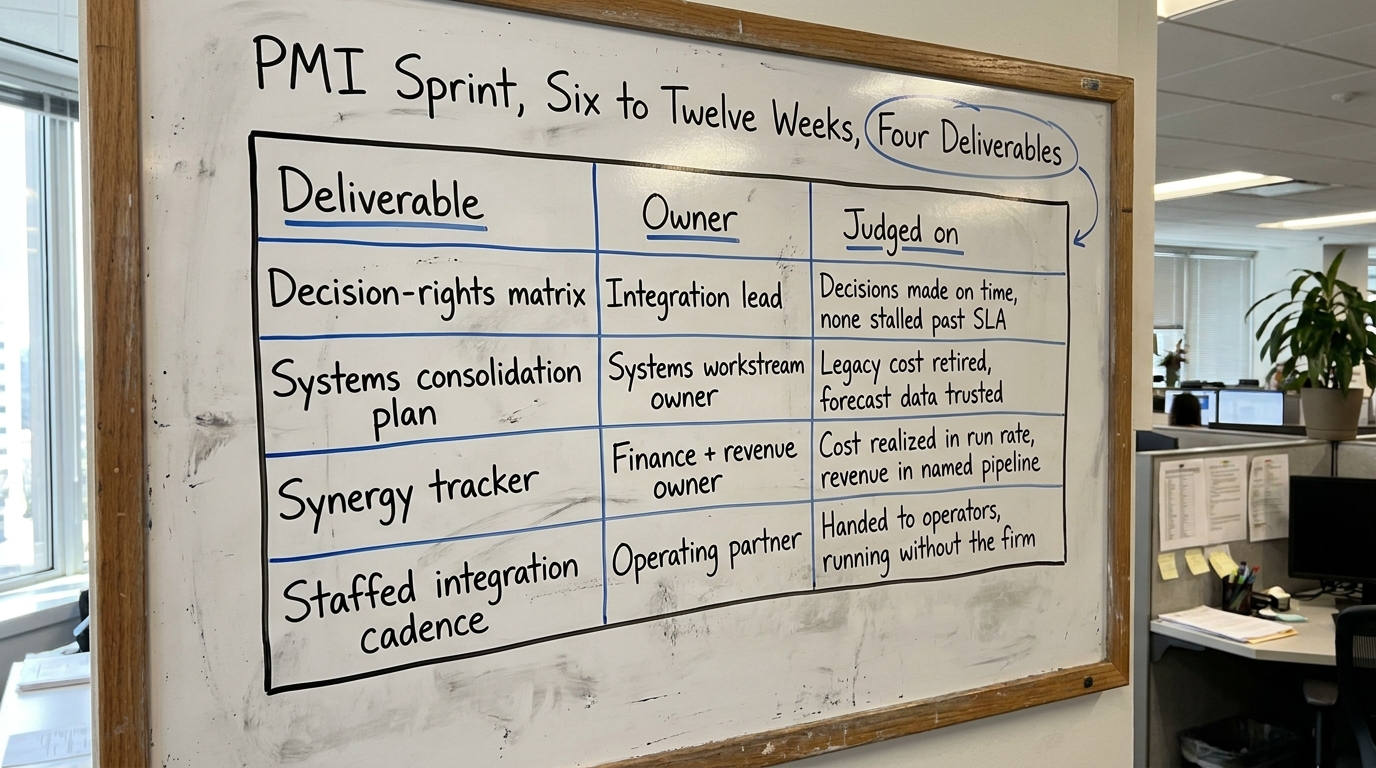
The best-run integration engagements are time-boxed and tied to specific decisions and deliverables. A focused sprint of six to twelve weeks that produces a decision-rights matrix, a systems consolidation plan, a synergy tracker, and a staffed integration cadence gives you something you can hold the firm to.
McKinsey’s and BCG’s work on integration both make the case that speed and focus in the early window drive most of the eventual value, which argues for concentrated effort rather than a slow burn. Their perspectives are collected in McKinsey’s private capital research and BCG’s private equity practice, and the through-line is that the first months are where the leverage sits.
For the broader context of how integration work fits a private-equity value creation plan, the fuller treatment is in this overview of post-merger integration consulting in private equity. The engagement shape that fits most mid-market deals is a defined PMI sprint that hands the ongoing cadence back to the operators once the structure is set.
8. How to judge the firm before you sign
A few questions separate firms that run integrations from firms that document them. Ask them in the scoping call.
- Which integration archetype do they think this is, and what changes in their approach because of it. A firm that cannot tell a carve-out from a tuck-in will run the wrong playbook.
- What they need from you before Day 1, and what they consider a precondition versus something they will build. If they will build the baseline for you, price that time.
- How they track revenue synergy specifically, and what they hand you to keep tracking it after they leave.
- What the engagement produces that your team owns and operates without them. If the answer is ongoing dependency, they are selling recurring fees rather than transferring capability.
- Who actually staffs the work, by name and seniority, versus who shows up to sell it.
The relevant AICPA and CIMA guidance on integration accounting and control is worth having your CFO check the firm’s approach against, particularly on how cost synergies flow to the run rate and how the combined entity’s reporting holds up. The professional guidance sits with AICPA and CIMA, and where the deal involves a registrant, the disclosure obligations tracked by the SEC shape what the finance workstream has to produce.
9. A checklist to run before you engage anyone
Before you sign an engagement for M&A integration consulting services, confirm you can answer each of these. If you cannot, that is the first work, and you should not pay outside day rates to have it discovered live.
- The two or three numbers the integration exists to deliver, with a baseline and a named owner for each.
- Which archetype this is, and therefore which risks the engagement has to manage first.
- Whether you are buying the integration office, functional advisory, or both, and how you will judge each.
- A decision-rights matrix that names accountable owners, escalation paths, and the decisions that need board sign-off.
- Systems and data treated as a named workstream with its own owner, budget, and risk register.
- Every revenue synergy resolved into a tracked pipeline, reviewed on the same cadence as cost.
- A defined customer experience for Day 1 and a deliberate schedule for what changes after.
- A time-boxed sprint with named deliverables your team will own once the firm leaves.
Run this list against the deal you actually have. The gap between the model and the deal as it stands is usually where the integration budget goes, and closing that gap early is cheaper than closing it in month four.
If you are approaching close, standing up the first 100 days, or watching an integration drift from plan, and you want a defined PMI sprint that leaves your operators running the cadence rather than dependent on a firm, review the private equity operating support from DevriX and its GrowthShuttle partners and bring the specific deal to the scoping conversation.