An add-on closes in six weeks and the deal team has already logged the synergy targets in the value creation plan. The operating partner is now holding a question that the model does not answer: who runs the integration, on what timeline, against which baseline, and how will anyone know at the first board meeting whether it is working. Deciding whether to bring in an M&A integration advisor private equity teams can hold accountable, rather than a firm that ships a workplan and leaves, is the difference between synergies that show up in actual results and synergies that live only in the plan.
This guide is written for the person who owns that decision inside a portfolio company or on the deal team. It assumes you already know what post-merger integration is and skips the definitions. The focus is what to decide, in what order, and how to judge the advisor once they are in the room.
1. Decide what the integration is actually for before you hire anyone
Most integrations underdeliver not because the work was hard but because nobody wrote down what “done” meant in cash terms. Bain’s annual private equity work has tracked for years how much of the return thesis in buy-and-build deals depends on integration executed on schedule, and the gap between plan and realized value is where multiple erosion hides. You can read the current view in Bain’s Global Private Energy Report.
Before an advisor is useful, the deal team needs to convert the thesis into three or four integration outcomes with a number attached to each. A cost synergy of a named amount by a named quarter. A revenue synergy tied to a specific cross-sell motion. A systems consolidation that removes a defined run-rate cost. If those are vague, the advisor will produce activity, and activity is not what the fund underwrote.
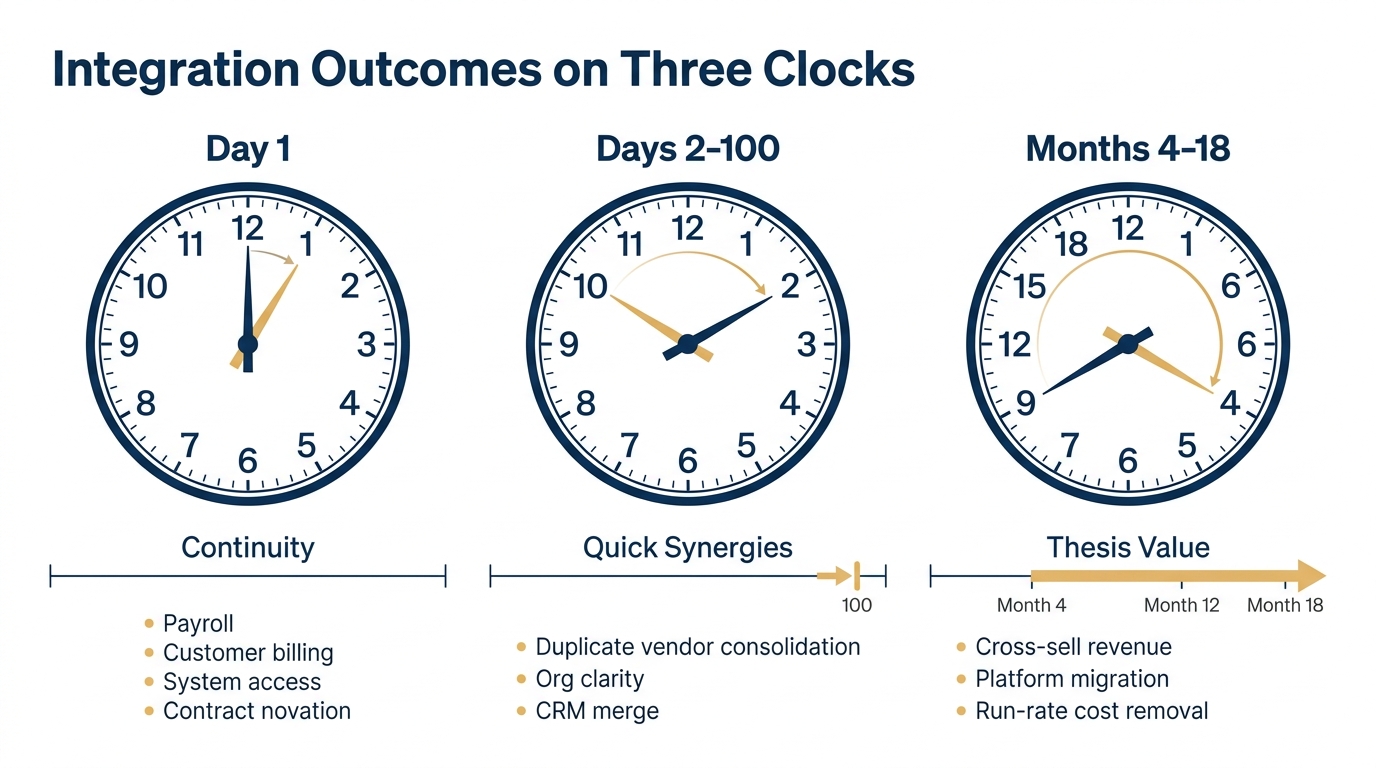
Separate what must happen by Day 1 from what can wait
Day 1 is a control and continuity problem, not a value problem. Payroll runs, customers keep buying, contracts stay honored, and nobody loses access to the systems they need. Value capture comes later and on a slower clock. Conflating the two is the most common way a portfolio executive burns the first quarter on plumbing while the synergy clock keeps running.
2. Choose the operating model: IMO, embedded advisor, or hands-off review
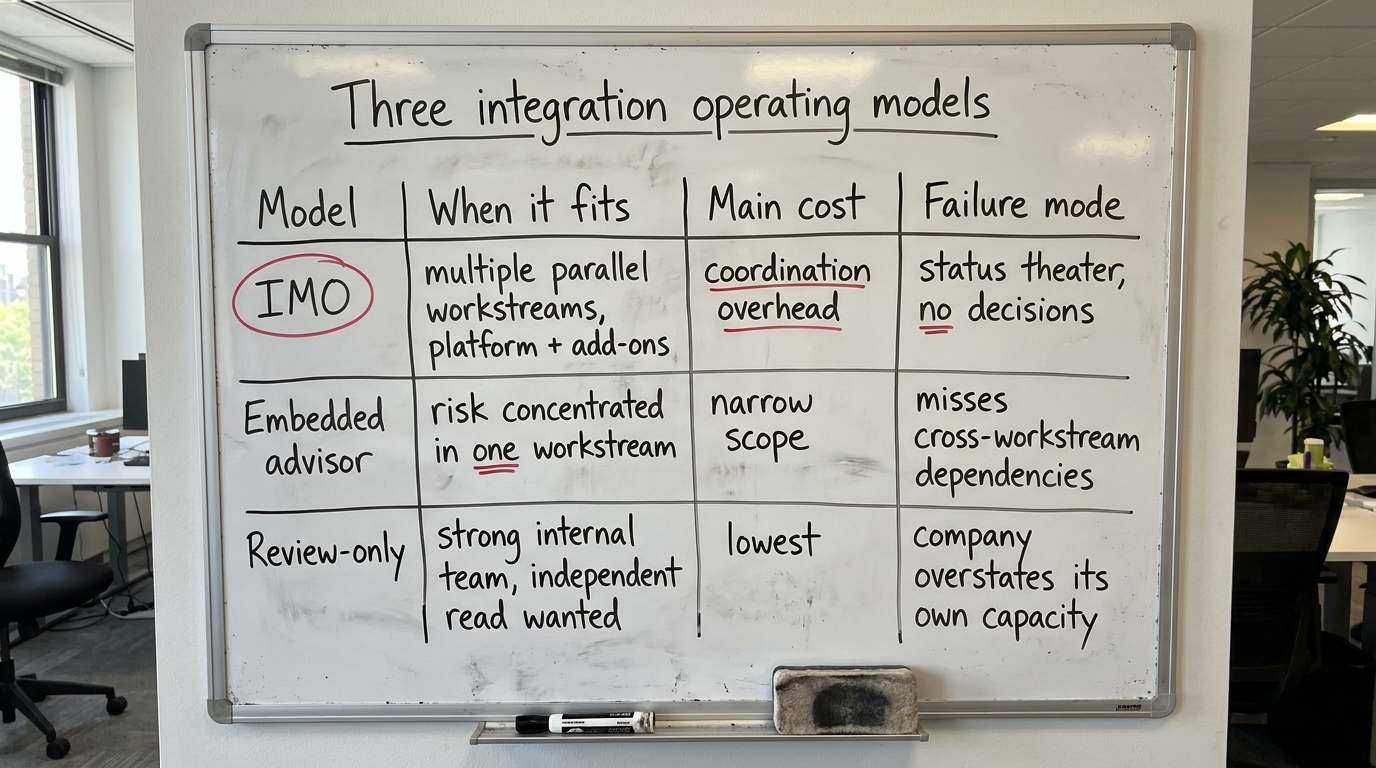
There are three ways an advisor can plug into a portfolio company, and they carry different costs and different failure modes. Picking the wrong one is expensive because you find out at the first board meeting, not before.
The integration management office
An IMO is a coordinating function that runs the workstream tracker, owns the risk register, and forces decisions to owners with dates. It works when the deal has several parallel workstreams (systems, people, commercial, finance) that need one place to reconcile. It is the right model for a platform absorbing multiple add-ons, and the tradeoff is that a weak IMO becomes a status-meeting machine that produces decks instead of decisions. The mechanics of standing one up are covered in this walkthrough on hiring an integration management office consultant.
The embedded advisor
Here the advisor sits inside a specific workstream, usually systems or commercial operations, and does the work rather than coordinating it. This fits a single add-on where the real risk is concentrated in one place, most often the CRM and revenue tooling, and where the portfolio company lacks the internal capacity to execute while still running the business.
The review-only engagement
The lightest model is an advisor who validates a plan the company will execute itself and checks progress at set gates. It is cheap and appropriate when internal capability is strong and the fund mostly wants an independent read. It fails when the company overestimates its own bandwidth, which happens more often than deal teams expect.
3. Get the baseline before the advisor writes a single plan
An integration plan with no baseline is a wish list. The advisor’s first deliverable should be a measured current state, not a target state. What does the combined cost base actually look like today, which contracts overlap, how many CRM instances exist across the two companies and which records conflict, and what does headcount by function look like versus what the deal team modeled at underwriting.
This is where technology diligence and integration meet. If the deal ran a real technology due diligence process, the systems baseline already exists and the advisor should build on it rather than re-discover it. If diligence was thin, expect the first two weeks to go to establishing what you actually bought. McKinsey’s private capital research has repeatedly made the point that integration value leaks when the acquirer never established a defensible baseline; see the body of work at McKinsey.
4. Judge the advisor on decision rights, not on the workplan
Any competent firm can produce a hundred-line integration plan. The plan is not the product. What separates an advisor worth $25K to $75K from a firm selling a slide deck is whether every line in that plan has an owner, a decision right, and a date, and whether the advisor will hold those owners to it.
Ask a direct question in the pitch: when two workstream leads disagree about sequencing, who decides, and what happens if the date slips. If the answer is “we escalate to the steering committee,” probe further, because a steering committee that meets monthly cannot arbitrate a weekly dependency. The firms that create value name the decision maker and the response to a slip before the work starts. This standard for separating substance from presentation is the whole argument in this piece on hiring a synergy realization consultant without buying a slide deck.
The risk register is the tell
A serious advisor maintains a live risk register with named owners, probability, impact, and mitigation status, and reviews it on a weekly cadence. A weak one produces a static risk slide at kickoff and never updates it. Ask to see a redacted register from a prior engagement. The format tells you whether they run integrations or narrate them.
5. Systems integration is where the money and the risk concentrate
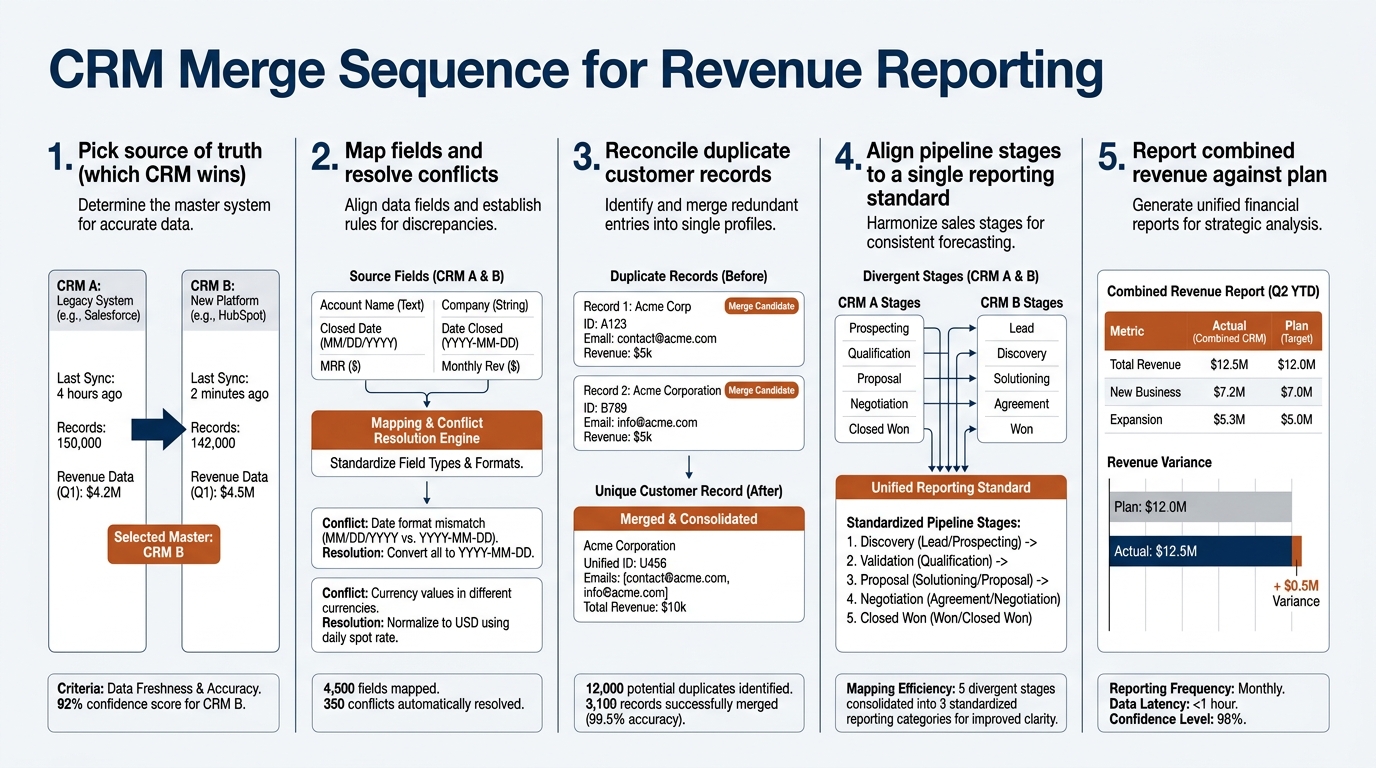
In most mid-market deals, the largest single integration dependency is the technology stack, and the CRM sits at the center of it because it touches revenue directly. Two overlapping CRMs mean two versions of the customer, two pipelines that do not reconcile, and a sales team that cannot be measured against plan until the merge is done. This is why revenue operations owners usually feel the integration first.
The sequencing here is unforgiving. You cannot report combined revenue reliably until customer records are reconciled, and you cannot reconcile records until someone has decided which system is the source of truth and which fields survive. A post-merger CRM integration consultant earns the fee by making those decisions early and defensibly, not by migrating data and hoping the duplicates sort themselves out.
For the broader stack, the discipline of judging systems work rather than accepting it on faith is laid out in this guide on how to choose a systems integration post-merger consultant and judge the work. The general principles of running the whole integration sit in this overview of post-merger integration consulting in private equity.
6. Align the timeline to real triggers, not to a generic 100-day plan
Integration timelines should hang off events that actually exist in the deal: close, Day 1, the first board meeting, the first monthly close as a combined entity, and any contractual or system migration deadline the deal inherited. An advisor who cannot map the workplan to those events is selling a template.
The first 100 days matter because that window sets the pattern the management team will follow for the rest of the hold. If the integration cadence is loose in the first quarter, it stays loose. PitchBook’s deal data and BCG’s principal investors work both document how early execution discipline correlates with hold-period outcomes; the research hubs are at PitchBook and BCG.
The first board meeting is the real deadline
Whatever the advisor promises, the practical test arrives at the first board meeting, where the operating partner has to report integration progress as actual versus plan. Design the reporting for that meeting from day one, so the advisor is building the numbers the board will ask for rather than reformatting data the night before.
7. Price the engagement against the value at risk, not against day rates
A $25K to $75K integration sprint is cheap relative to the synergy value in even a modest mid-market add-on, and comparing it to a day rate misses the point. The relevant comparison is the cost of a slipped integration: a quarter of unmeasured revenue, a duplicate ERP contract left running, a sales team demoralized by a CRM that does not work.
Scope the engagement so the fee buys a decision-forcing function with a defined output. If the proposal is priced by time and materials with no committed deliverable, you are buying activity. The Harvard Business Review’s M&A coverage has made the case that integration cost discipline is itself a source of returns; the topic hub is at HBR on mergers and acquisitions.
8. Watch for the four ways integration advisors underdeliver
The failure patterns are consistent enough to screen for in the pitch.
- Deck over decisions. The advisor produces polished status materials on a cadence but no line item ever closes. Screen by asking what closed last week.
- No baseline. The plan targets a future state without a measured current state, so nobody can prove value was created versus assumed. Screen by asking to see the baseline document.
- Orphaned dependencies. Workstreams run in parallel and nobody owns the seams between them, so systems finishes but commercial cannot use it. Screen by asking who owns cross-workstream sequencing.
- Handoff cliff. The advisor leaves with the plan half-executed and the internal team unable to continue. Screen by asking what capability transfers to the company and how.
Governance research at the Harvard Law School Forum on Corporate Governance and S&P Global’s deal analysis both reinforce that accountability structure, not planning volume, drives integration outcomes; S&P’s market intelligence hub is at S&P Global.
9. Build the reporting the fund will actually read
An operating partner needs a short, standing view of integration value in the fund’s own language: synergy captured versus planned, classified honestly as realized, run-rate, or still forecast, with the delta explained. Deal teams have been burned enough by forecast value dressed up as realized that any advisor who blurs the two should lose credibility on the spot.
Tie the reporting to the value creation plan the deal team built at underwriting, so integration progress reconciles to the thesis rather than living in a separate tracker. When a portfolio company also has a brand or commercial repositioning underway, the integration narrative and the market message need to stay consistent, which is where clear value proposition storytelling keeps the combined company saying one thing to the market. The DevriX work sits inside a broader private equity operating approach that keeps integration tied to enterprise value rather than task completion.
[Image to add: Board-ready integration scorecard | TABLE with columns: Synergy item / Planned / Captured / Classification / Owner, Row 1: Duplicate vendor ]
10. A decision checklist before you sign
Run the engagement decision against this list before the advisor starts, not after the first status meeting goes sideways.
- The three or four integration outcomes are written down with a number and a date on each.
- Day 1 continuity items are separated from value-capture items on different clocks.
- The operating model (IMO, embedded, or review-only) matches where the real risk sits.
- A measured baseline exists or is the advisor’s first deliverable, built on the technology diligence where one was done.
- Every plan line has an owner, a decision right, and a response defined for a slipped date.
- The advisor maintains a live risk register on a weekly cadence and will show a redacted prior one.
- CRM source-of-truth and field survivorship decisions are scheduled before any data migration.
- The timeline hangs off real triggers: close, Day 1, first board meeting, first combined close.
- Reporting is designed for the first board meeting and reconciles to the value creation plan.
- Synergy reporting distinguishes realized, run-rate, forecast, and enabled value.
- A capability transfer plan exists so the internal team can continue after the engagement ends.
If more than two of those are unresolved, the integration is not ready for an advisor yet, and hiring one early just moves the confusion into a paid engagement. Preqin’s and Private Equity International’s tracking of hold periods and value creation are useful context for how much of the return depends on getting this window right; their research sits at Preqin and Private Equity International.
11. What good looks like at the first board meeting
A well-run integration shows up as a one-page view the operating partner can present without caveats: continuity confirmed, the quick synergies captured or on track with dates, the systems merge sequenced with the CRM decisions made, and the thesis-level value items each classified honestly. The board should be able to see actual versus plan and the reason for any gap in one read, and the advisor should have built exactly that.
When integration goes wrong in public, through a botched migration or a customer-facing outage during cutover, it becomes a reputation problem on top of a financial one, and the response window is short; the discipline of the first 24 hours of a reputation crisis is worth having in reach before Day 1. Well-run integrations rarely need it because the sequencing was done correctly.
If you are approaching close on an add-on or standing up the integration for a platform and want the plan built as a decision-forcing sprint rather than a slide deck, route the engagement through the DevriX private equity practice and scope a PMI sprint against your specific synergy targets and timeline.