
An operating partner who signs an engagement letter with a private equity M&A consultant in the week after a letter of intent is making a bet with real consequences. If the consultant scopes the wrong workstreams, the first board meeting after close becomes a list of surprises instead of a list of decisions already made. The revenue operations leader inside the portfolio company carries that cost directly, because the commercial systems, the pipeline data and the customer records are where an under-scoped engagement shows up first, usually around day 45 when someone asks why two CRMs still disagree on the same accounts.
This guide is written for the person accountable for revenue operations in a portfolio company and for the operating partner who signs off on the advisory spend. It covers what you actually need to decide when you bring in outside help on a deal, and how to judge whether the person across the table will produce a result the sponsor can underwrite.
1. Decide what the consultant is being bought to improve
The firms that buy companies are buying measurable enterprise-value improvement. Bain’s annual report on the industry, which has tracked deal activity and value creation for years, is consistent on one point: returns increasingly come from operating improvement rather than multiple expansion or leverage. You can read the current edition at the Bain & Company Global Private Equity Report, and the pattern it describes should frame the question you ask any consultant.
So the first decision is which lever the engagement is supposed to move. A private equity M&A consultant can be pointed at revenue growth, at EBITDA expansion through cost or systems rationalization, at faster integration, at reduced operating risk, or at better management visibility ahead of the next raise. Each of those implies a different scope, a different owner inside the company, and a different definition of done.
Write the lever down before the first scoping call. If the consultant cannot restate it back to you in financial terms within the first meeting, that is a signal, not a style difference.
2. Separate the diligence consultant from the integration consultant
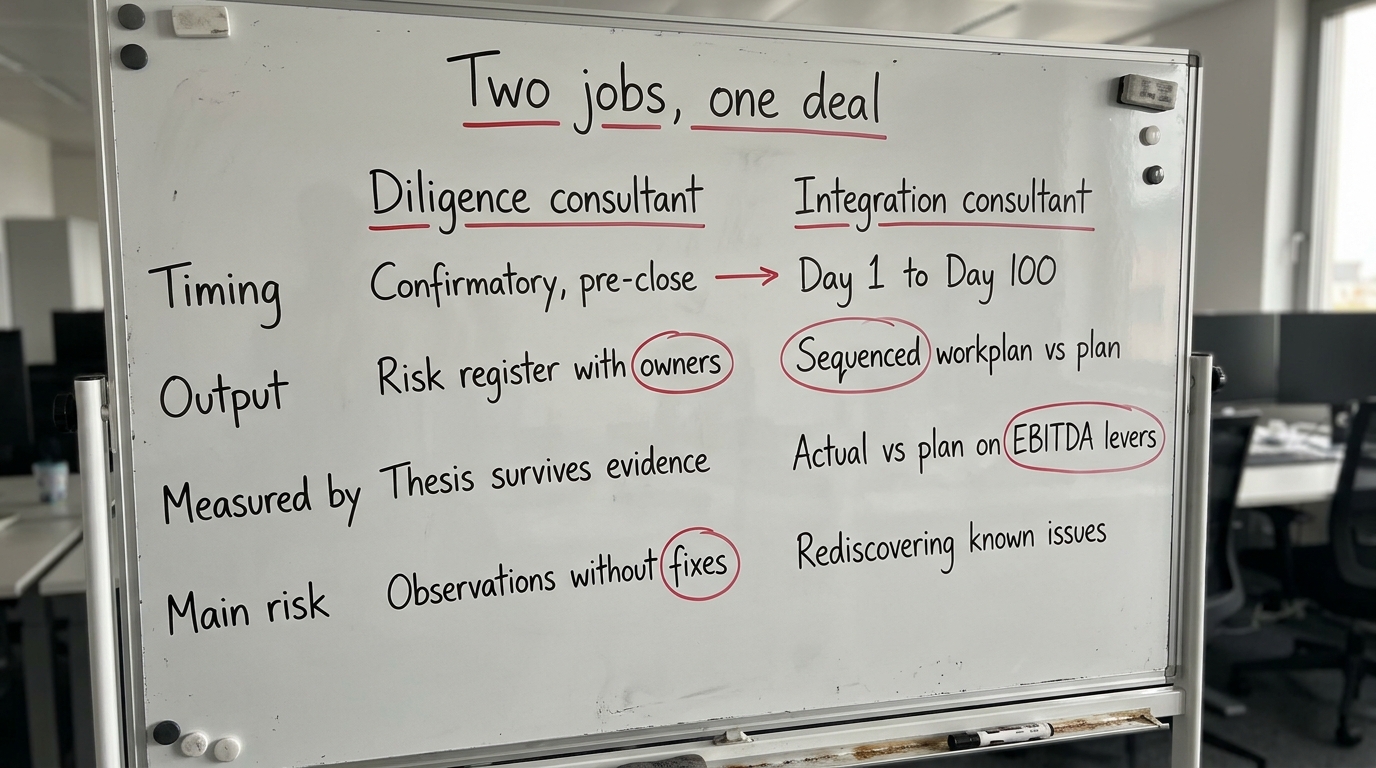
Buyers routinely conflate two distinct jobs. One job happens before you own the company, during confirmatory diligence, and produces evidence the investment committee relies on. The other job happens after close, during the first hundred days, and produces operating change. Some advisors do both competently. Many do one well and improvise the other.
The diligence job answers whether the thesis survives contact with the target’s actual systems, contracts and data. It is close in spirit to technology due diligence, and its output is a risk register with owners, not a slide deck of observations. The integration job turns that register into sequenced work during the first 100 days, with named owners and a plan measured against actuals.
Why the distinction matters commercially
A diligence consultant who found a problem has no incentive structure to fix it, and an integration consultant who inherits a vague diligence report spends the first three weeks rediscovering what should already be known. If you hire separately, demand that the diligence output is written to be handed off. If you hire one firm for both, the risk shifts to objectivity, because the team that scoped the integration also wrote the diligence that justified it.
Robust Branding’s own breakdown of this hand-off problem in hiring a post-close integration consultant without losing the first 100 days covers the sequencing in more depth.
3. Judge the consultant on evidence, not on logos
Commercial buyers of advisory are shown a reference list and a set of sector logos within the first thirty minutes. Neither tells you whether the engagement will produce the lever from section one. What tells you is how the consultant handles evidence.
Ask for a redacted example of a prior deliverable. Not a capabilities deck, an actual working document: a risk register, a 100-day plan, a synergy model with assumptions exposed. A consultant who leads with method rather than marketing tends to produce the same when the work is real. McKinsey’s published work on integration, available through its private capital research, repeatedly ties successful deals to disciplined tracking of baseline and actual, which is exactly what a working deliverable should let you see.
Three questions that separate operators from presenters
- How do you establish the baseline before you claim an improvement, and who signs off on it inside the company?
- When a workstream slips, what is the first artifact you change, and who hears about it first?
- What did you walk away from in a past engagement, and why?
The third question is the most useful, because a consultant who has never declined or descoped work has either never faced a bad fit or will not tell you when you are one.
4. Pin down decision rights before the engagement starts
The most expensive failure in post-close advisory is not bad analysis. It is unclear authority. When a consultant can recommend but not decide, and the portfolio executive can decide but is not in the room, work stalls between the two for weeks that the deal clock does not refund.
Before signing, agree in writing on who holds the decision right for each major workstream. The consultant may own the analysis for a CRM consolidation, but the RevOps leader owns the decision to migrate, and the operating partner owns the budget tolerance. Harvard Law School’s governance forum has published extensively on the governance side of this, and the principle holds down at the operating level too: see the Harvard Law School Forum on Corporate Governance for the board-level framing.
Decision rights determine whether a board meeting runs on decisions already taken rather than on a consultant presenting options nobody is empowered to choose between.
5. Scope the commercial and data workstreams explicitly
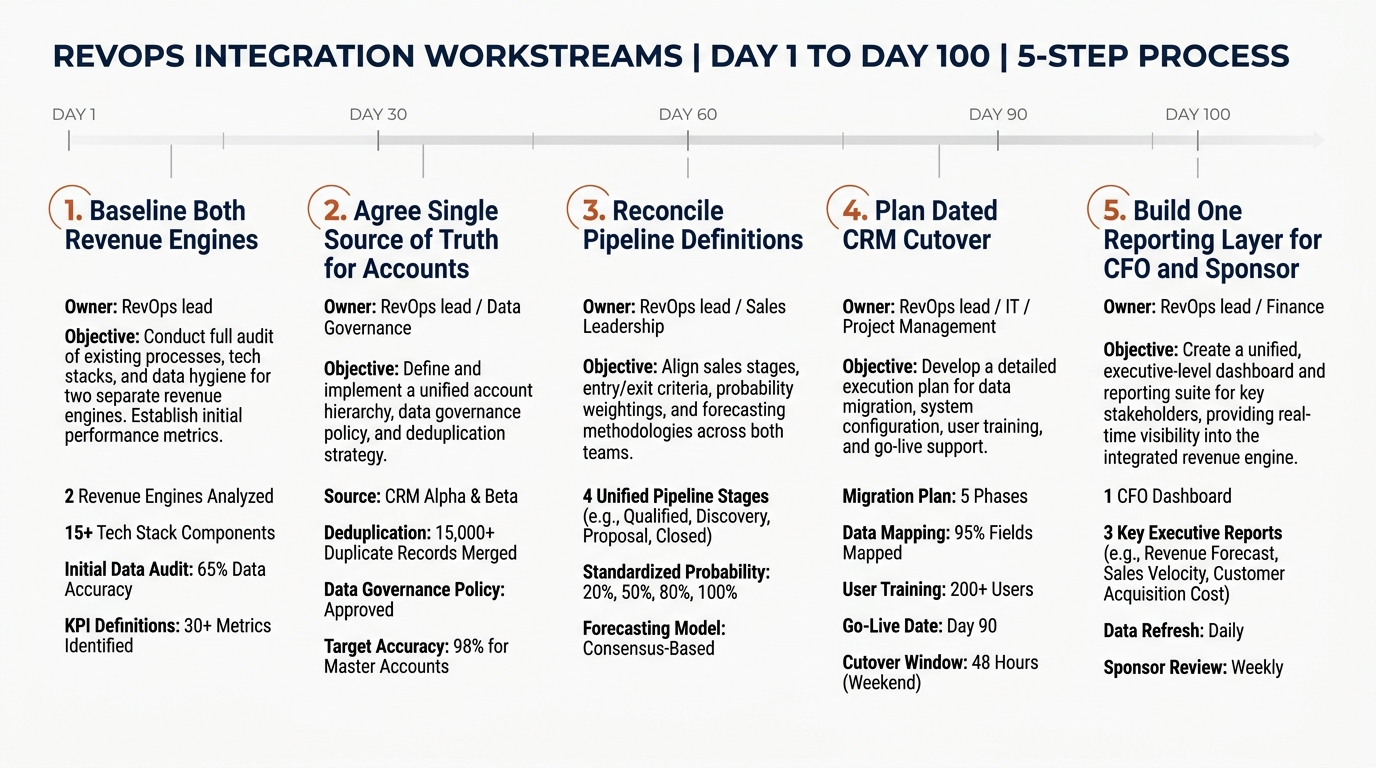
For a RevOps buyer, the workstreams that most often get under-scoped are the ones closest to the revenue engine: pipeline data, customer records, quoting, and the reporting that the sponsor uses to read the business. An add-on acquisition that keeps two overlapping CRMs is an integration dependency that will surface in the forecast long before it surfaces in a status report.
Make the consultant name these workstreams in the statement of work with their own owners and their own definition of done. Robust Branding’s guide to sequencing providers in post-merger integration is worth handing to any consultant who treats commercial systems as an afterthought.
What belongs in the data workstream
- A single agreed source of truth for accounts and contacts, with a dated cutover plan.
- Reconciliation of pipeline definitions across both entities before any number is reported as combined.
- A reporting layer the CFO and the sponsor can read without a translation meeting.
PitchBook’s deal data, available through PitchBook research and data, shows how much of mid-market activity is add-on driven, which means most portfolio executives will face exactly this record-level reconciliation more than once in a hold period.
6. Price the scope against the lever, not against the hours
A private equity M&A consultant priced on a day rate with an open-ended scope transfers all the overrun risk to the portfolio company. A consultant priced against a defined deliverable with a defined lever shares it. The second structure is harder to negotiate and worth the effort.
Robust Branding’s piece on what a PMI consulting engagement should actually deliver and how to price the scope walks through the mechanics. The short version for the buyer: tie a meaningful portion of the fee to the deliverable that the sponsor will actually judge the engagement on, and define that deliverable in a sentence a CFO would recognize.
Be realistic about what can be classified as realized value during the engagement versus what is forecast or merely enabled. A consultant who reports a CRM consolidation as an EBITDA improvement before the second system is decommissioned is reporting enabled value as realized, and a CFO who repeats that to the board inherits the correction.
7. Build the risk register the board will actually use
The single document that determines whether the first board meeting goes well is the risk register, and most of them are useless because they list risks without owners, dates or decision triggers. A good register ties each risk to a named owner, a probability the operating team actually believes, and the specific decision that would change the plan.
BCG’s work on value creation in deals, published through its principal investors and private equity practice, is consistent on the point that the gap between plan and outcome is usually visible early to the people doing the work and invisible to the board until it is expensive. The register is how you close that gap on paper before it closes on its own.
What a usable register row contains
- The risk stated as a consequence, not a condition, so the board reads impact not activity.
- A single named owner inside the company, never the consultant alone.
- The trigger that moves it from watch to action, and who makes that call.
8. Test for independence when one firm does diligence and delivery
When the same firm scoped the deal and now wants to run the integration, the objectivity problem is real and the SEC’s broader guidance on advisory independence, available at the U.S. Securities and Exchange Commission, reflects why it matters in regulated contexts. At the operating level, the test is simpler: can the firm point to a deal where its own diligence told the sponsor to walk, or to pay less, against its own commercial interest in a follow-on engagement?
If the answer is never, treat the diligence output as a sales document for the integration work and have someone independent pressure-test the baseline. S&P Global’s market intelligence, through S&P Global Market Intelligence, is a reasonable external reference point for sector baselines when the internal numbers are contested.
9. Match the engagement to the deal stage you are actually in
A consultant brought in at LOI does different work than one brought in at Day 1, and one brought in when the forecast is already missing plan does different work again. The trigger matters because it determines what evidence exists and what decisions are still open.
At confirmatory diligence, the work is evidence and risk. The Harvard Business Review’s collection on mergers and acquisitions has long documented how many deals underperform because integration planning started after close rather than before it. At Day 1, the work is sequencing and ownership. When a forecast is failing mid-hold, the work is diagnosis before any new spend, and the consultant who proposes a fix before establishing why the number moved is guessing.
For the technology dimension of this timing problem, Robust Branding’s guide on judging technology integration before it costs you a quarter and the companion piece on judging a technology integration consultant on an M&A deal are both built around stage-appropriate questions.
10. Know the market you are buying in
Advisory fees and availability move with deal volume, and a buyer who understands the cycle negotiates better. Preqin’s data on alternative assets, at Preqin, and the trade coverage in PE Hub and Buyouts give a RevOps leader enough context to know whether the firm pitching them is in a seller’s market for their time or competing hard for the mandate. That context changes what you can ask for in scope and in pricing structure.
None of this is investment or valuation advice, and a portfolio executive should treat market data as context for the commercial negotiation rather than as a basis for the deal thesis itself.
11. A checklist before you sign the engagement letter
Run the prospective private equity M&A consultant against this before committing budget. If more than two answers are vague, the engagement is under-specified and the cost of that vagueness lands after close.
- The lever the engagement moves is written down in financial terms, and the consultant restated it accurately.
- Diligence work and integration work are scoped as distinct jobs, with a defined hand-off if one firm does both.
- You have seen a redacted working deliverable from a live engagement.
- Decision rights for each major workstream are assigned in writing before Day 1.
- The commercial and data workstreams are named explicitly, with owners and a dated cutover plan.
- A meaningful part of the fee is tied to the deliverable the sponsor will judge, not to hours.
- Value in the reporting is classified as realized, run-rate, forecast or enabled, and nobody is reporting enabled value as realized.
- The risk register lists consequences, named owners and decision triggers.
- If one firm does both diligence and delivery, you have an independent check on the baseline.
- The engagement is structured for the deal stage you are in.
A consultant who clears this list will not make the first board meeting comfortable. They will make it a meeting about decisions already taken, which is the only kind worth having that early in a hold.
If you want an advisory partner who scopes commercial and technology integration against the enterprise-value lever and reports against actuals, review how DevriX and GrowthShuttle structure private equity engagements and bring a live deal to the conversation.