The forecast that gets a portfolio company into trouble after an acquisition is almost never the revenue plan. It is the integration plan sitting underneath it, the one that assumes two CRMs merge cleanly, that order-to-cash keeps flowing on Day 1, and that the combined pipeline is legible by the first board meeting. When that plan is wrong, the synergy case slips a quarter or two, and the operating partner spends the first hundred days explaining variance instead of building on it. Choosing a technology integration consultant for an M&A deal is a bet on whether that plan holds. This guide is for the operating partner or portfolio executive who already has budget approved and now has to decide who to hire and how to judge the work they deliver.
The stakes are commercial, not technical. A weak integration owner will produce activity, tickets closed and systems touched, while the deal thesis waits. A strong one connects every workstream to a number in the model. Below is how to tell the difference before you sign and while the work is running.
1. Decide what the integration is actually protecting before you scope the role
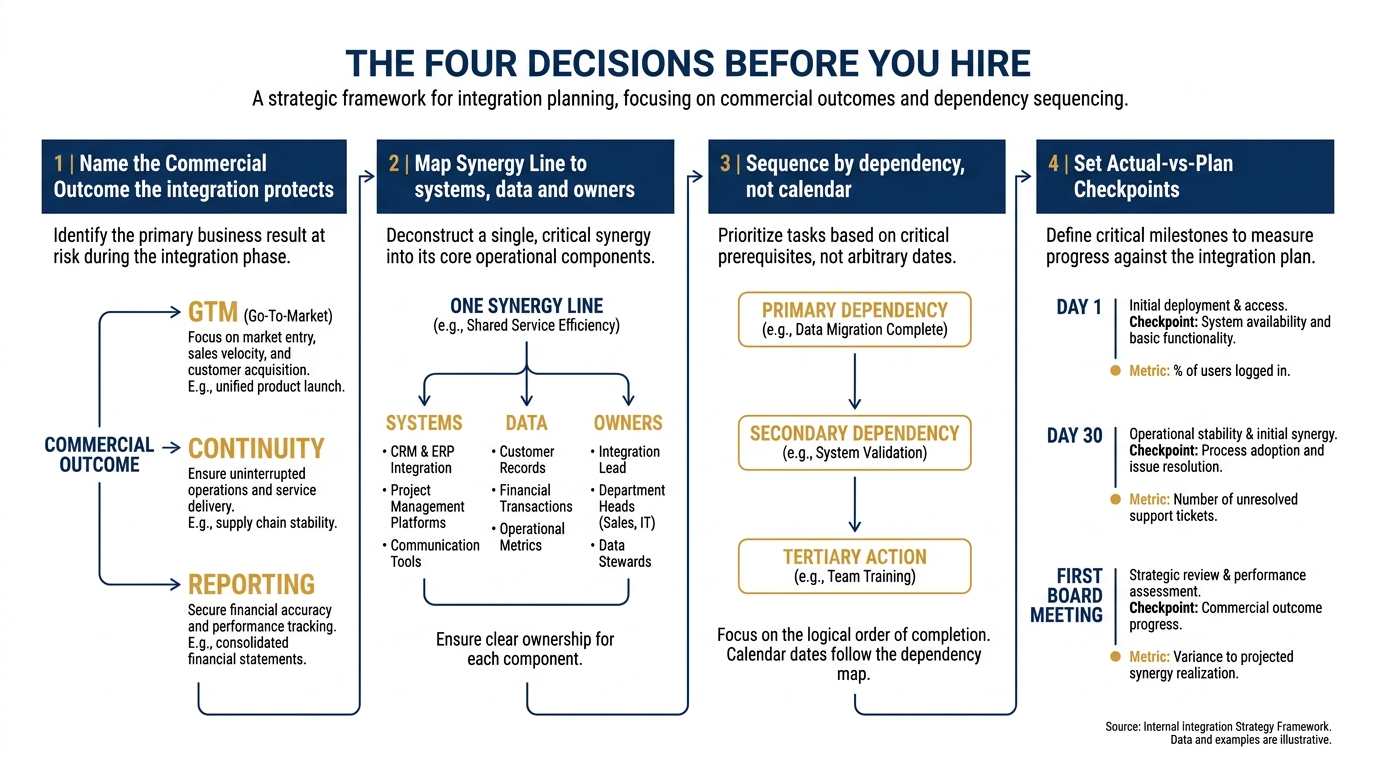
Every acquisition has one or two commercial outcomes the integration exists to protect. The outcome drives what kind of M&A integration consulting you are buying. In a buy-and-build, the combined go-to-market motion is usually the priority (one pipeline, one source of revenue truth, one quoting process). A carve-out requires business continuity, keeping the acquired unit running while it separates from the seller’s systems. A platform acquisition often centers on reporting, giving the sponsor visibility that supports the next add-on.
Name that outcome first, because a consultant strong in data migration is not the same hire as one strong in RevOps redesign, and neither is the same as a program manager who coordinates twelve vendors. Bain’s annual private equity report has tracked for years how integration execution separates deals that hit their return case from ones that stall, and the common thread is a clear line from integration work to the value driver. If you cannot state that line in a sentence, you are not ready to scope the role.
The mistake here is scoping around the systems. The org buys “we need to merge Salesforce instances” and hires accordingly, when the real question was whether the combined sales team could forecast reliably by quarter two. Scope around the commercial outcome, then let the systems work fall out of it.
2. Separate the integration plan from the deal model
The synergy numbers in the investment committee memo are assertions until someone maps them to operational steps with owners and dates. That mapping is the first real test of a technology integration consultant on an M&A deal. Ask a candidate to take one synergy line, say cross-sell of the acquirer’s product into the target’s base, and walk it back to the systems and data changes required to make it measurable. A serious candidate will name the customer master problem, the product catalog reconciliation, the attribution logic, and the reporting that lets the CFO see cross-sell revenue separately from base revenue.
A weaker one will describe a CRM migration and assume the revenue follows. Harvard Business Review’s body of work on mergers has repeatedly made the point that integration failures are usually planning failures surfacing late, not execution surprises. The plan that survives contact with the actual data is the one to pay for.
This is also where the connection to your technology due diligence matters. The diligence should have flagged the state of the target’s data, the integration dependencies, and the technical debt that will slow a merge. If the consultant’s plan ignores what diligence already found, that is a signal they are building from a template rather than from the deal.
3. Sequence the first hundred days around dependencies, not a calendar
Integration plans that fail on schedule almost always fail because someone sequenced by wishful calendar rather than by dependency. You cannot consolidate reporting before the customer records reconcile. You cannot migrate quoting before the product catalog is agreed. A good integration owner builds the plan backward from the outcome and forward from the dependencies, and the two meet in a schedule that has slack where the risk is highest.
The first 100 days are where this discipline shows or does not. McKinsey’s private capital research has long argued that the earliest weeks set the trajectory of value creation, and the reason is dependency management: the decisions made in week two constrain what is possible in month four. Judge a candidate on whether their plan reads as a sequence of dependencies or a list of parallel tasks with the same due date.
What a dependency-driven plan looks like
- A named owner for every workstream, on your side, not just the consultant’s.
- A risk register that identifies the two or three items that can slip the whole program, with mitigation owned by someone.
- Explicit “actual vs plan” checkpoints tied to Day 1, Day 30 and the first board meeting, with specific thresholds and remediation triggers documented before work begins.
- A statement of what is deliberately being deferred, so the team is not pretending to do everything at once.
The list of what is deferred matters as much as the list of what is happening. An integration owner who cannot tell you what they chose not to do in the first hundred days has not made choices; they have made a wish list.
4. Judge the CRM and revenue-system work as a revenue problem
Most integration value for a growth-focused portfolio company runs through the revenue systems, so this deserves its own scrutiny. A post-merger CRM integration is where the combined commercial picture either becomes real or stays fragmented across two systems that never quite agree. The consultant’s job is to produce one pipeline the leadership team trusts, one definition of a qualified opportunity, and one revenue number the CFO can put in front of the board.
Test the candidate on the hard parts. How do they handle two different sales stage definitions? What is their approach when the two teams have incompatible ideas of what “closed won” means? How do they reconcile duplicate accounts where the same customer bought from both entities? These are RevOps decisions with revenue-recognition consequences, and a consultant who treats them as data-cleanup tasks will hand you a merged system that nobody trusts.
The test of success is simple and commercial: after the work, can the revenue leader forecast the combined business with the same confidence they had for the standalone business? If the answer is no, the integration is incomplete regardless of how many records moved.
5. Insist on measurement that ties to enterprise value
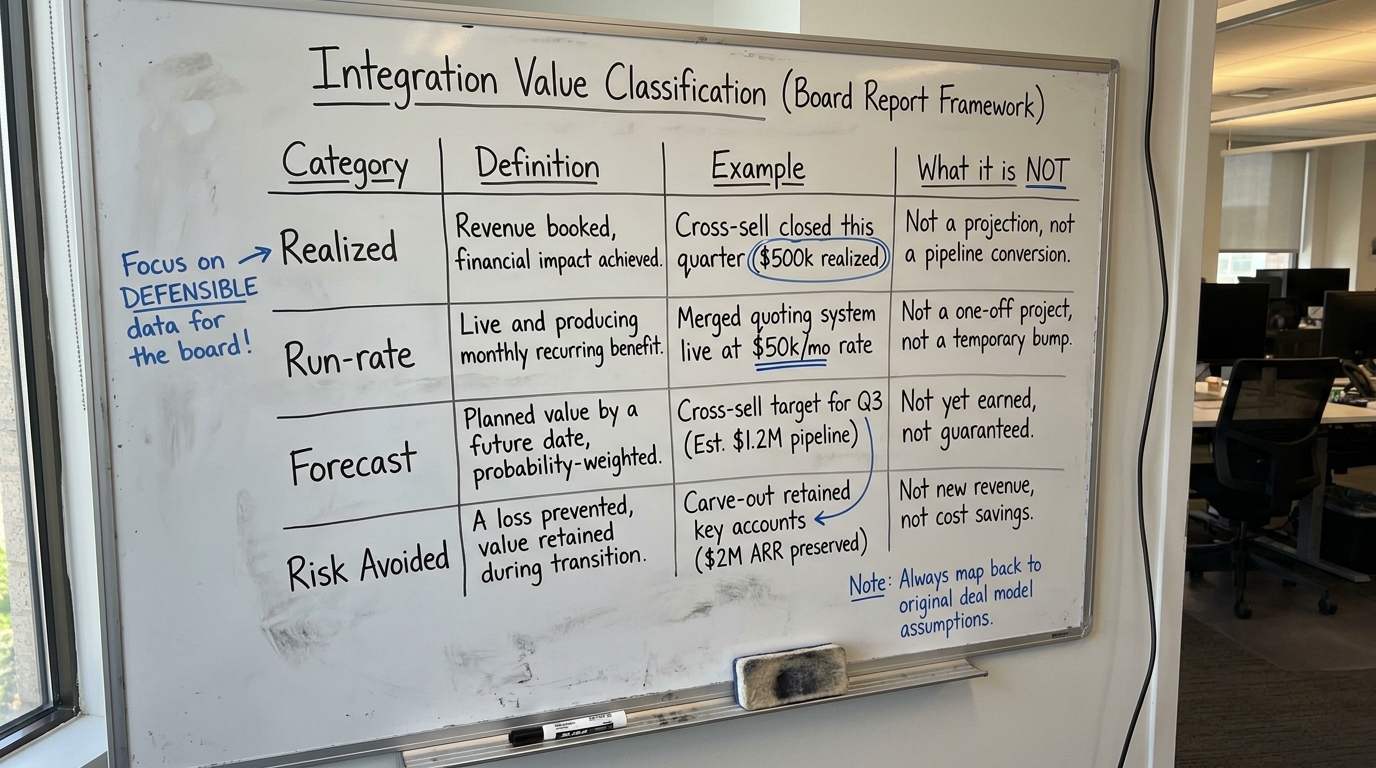
An integration consultant who reports in tickets and milestones is reporting activity. The reader accountable for the outcome needs the work classified against the value it produces. There is a real difference between value already realized (the cross-sell revenue is booked), run-rate value (the process is live and producing at a monthly rate), forecast value (the plan says it will produce by Q3), and risk avoided (the carve-out did not lose customers during separation). Conflating these is how a board gets told a number is done when it is a projection.
Ask the consultant to report in exactly those terms. It changes the conversation from “we are 70% through the migration” to “we have secured this much of the synergy case, this much is run-rate, and here is what is still forecast.” PitchBook’s data and research on how sponsors track value creation shows how much the discipline of separating realized from projected value matters when a fund reports to its own investors, and the same discipline should run down into the portfolio company.
The connection to enterprise value is the whole point. A PE-backed buyer did not purchase a systems merge; it purchased faster integration, cleaner reporting, and a shorter path to the next add-on or to exit. Every workstream on the plan should map to one of those. If a workstream cannot be tied to revenue growth, EBITDA, cash flow, reduced operating risk or management visibility, ask why it is being funded now rather than later.
6. Set the decision rights before Day 1, not during it
The integration decisions that stall are the ones where nobody agreed in advance who decides, and these are not technical questions. A consultant cannot answer them alone, but a good one forces them onto the table before Day 1 rather than letting them surface as fights in month three. The questions include which CRM survives, whose finance process wins, and which product naming stays.
The operating partner’s job is to establish the decision rights: who owns each call, who is consulted, and who is simply informed. The consultant’s job is to surface the decisions early and refuse to build past an unmade one. When you are deciding what to settle before hiring a PMI consultant, decision rights sit near the top, because a consultant working inside an ambiguous governance structure will either stall waiting for approvals or make choices that get reversed later, and both are expensive.
The Harvard Law School Forum on Corporate Governance has published extensively on how governance clarity affects deal outcomes, and the portfolio-level version is the same principle at smaller scale: clear decision rights turn integration debates into decisions with dates.
7. Judge the consultant on the handover, not just the launch
The failure mode that costs the most is dependency on the consultant. A firm that builds a merged system only it can operate has sold you a subscription. The measure of a good technology integration consultant on an M&A deal is what the internal team can run after they leave, which means the engagement has to include knowledge transfer, documentation, and a named internal owner for each system from the start.
Ask directly how the engagement ends. A serious answer names the internal owners, the documentation that will exist, the training that will happen, and the point at which the consultant’s involvement steps down to support rather than delivery. When you evaluate how to choose a systems integration consultant and judge the work, the exit plan is a better predictor of long-term value than the launch plan, because the launch is a single event and the operating capability has to last.
A synergy realization engagement that ends with a presentation and no operating handover has produced a plan. The plan was the easy part; the value appears when the internal team runs the merged process without the consultant present.
8. Time the hire to the deal, not to a template
When to bring the integration owner in depends on the deal shape, and getting the timing wrong is common in both directions. Bring them in too late, at close, and the first hundred days are spent building a plan that should have existed at signing. Bring them in too early, before the thesis is firm, and you pay for planning that gets thrown out when terms change.
For most buy-and-build platforms, the useful window opens at LOI or during confirmatory diligence, when the systems reality is knowable but the plan can still shape the deal. For a carve-out, earlier is better, because separation planning drives the transition services agreement and the timeline for standing up independent systems. The judgment on when to bring in an integration advisor and what to judge them on is worth making deliberately rather than defaulting to “after close.”
BCG’s work on principal investors and integration has made the case that the acquirers who plan integration alongside diligence, rather than after it, see cleaner value capture, and the mechanism is timing: decisions made while the deal is still forming are cheaper than decisions made after commitments are set.
9. Run the diligence on the consultant with the same rigor as the deal
The reader running private equity deals already knows how to diligence a target. Apply a lighter version of that to the consultant. Ask for the evidence behind their claims. When they say they have done a CRM consolidation, ask what the baseline was, what changed, and how the outcome was measured. A consultant who can produce a baseline and a method is a different proposition from one who produces logos.
S&P Global Market Intelligence and Preqin both maintain the kind of deal and performance data that has trained the market to expect evidence, and the same standard should apply to a vendor asking for a $25,000 to $75,000 engagement. Hire someone who thinks about their own work the way the operating partner thinks about the portfolio, in baselines, owners and measured outcomes.
Broader post-merger integration in private equity has a wide literature, and reading across it makes the pattern clear: the integrations that create value are the ones where someone owned the connection between the technical work and the financial result. The reading on post-merger integration consulting in private equity lays out the same principle applied across functions.
10. The nine checks, condensed
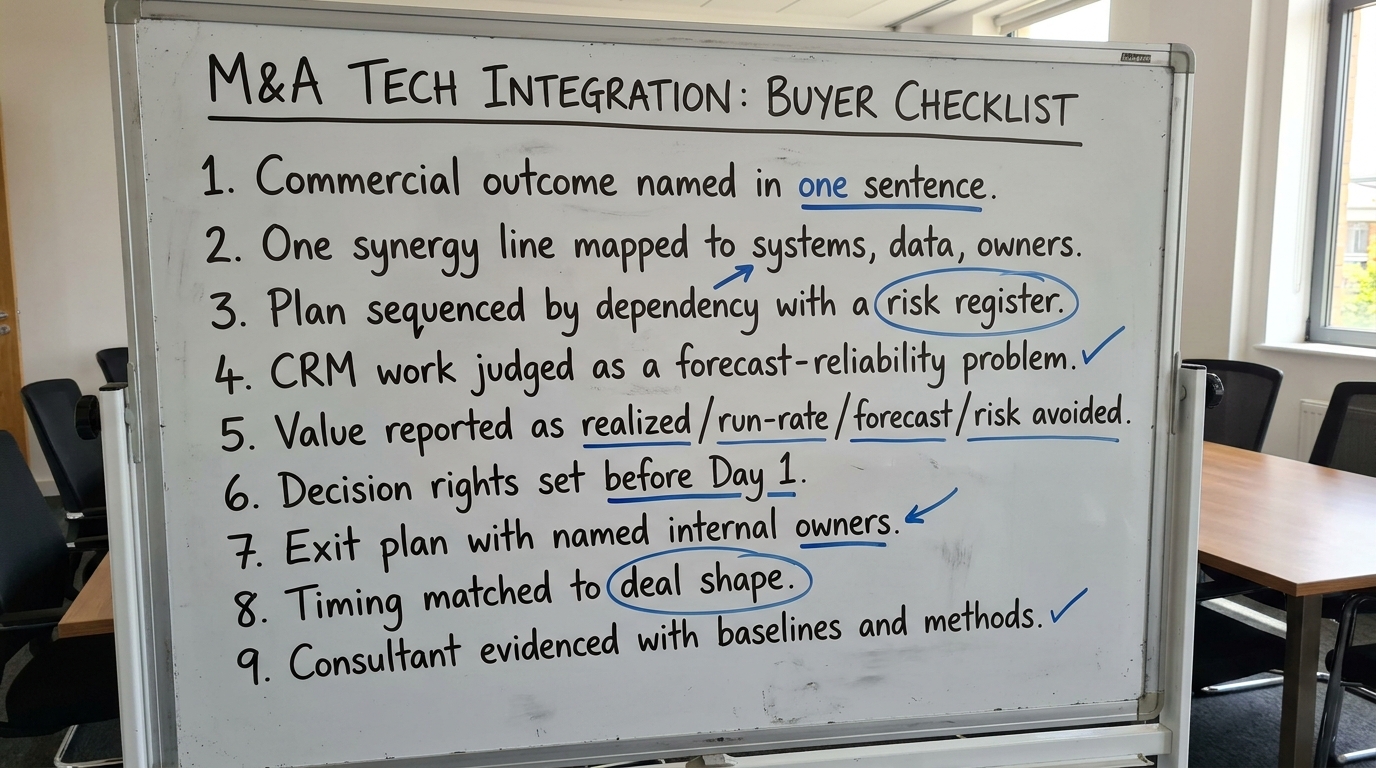
Before signing, the operating partner or portfolio executive should be able to answer all of the following. If more than two are open, the scope is not ready.
- Outcome: Can you state in one sentence the commercial result this integration protects?
- Mapping: Has the consultant mapped at least one synergy line to the systems, data and owners required to make it real?
- Sequence: Is the plan built on dependencies, with a risk register naming the two or three items that can slip the program?
- Revenue systems: Will the revenue leader be able to forecast the combined business as confidently as the standalone?
- Measurement: Is value reported as realized, run-rate, forecast or risk avoided, never blended?
- Decision rights: Is it clear who owns each contested integration call before Day 1?
- Handover: Does the engagement end with named internal owners and documentation that allow the portfolio company to operate the merged systems without the consultant present?
- Timing: Is the hire timed to the deal shape rather than defaulted to post-close?
- Evidence: Can the consultant show baselines and methods behind their claims?
None of these are technical questions, which is the point. The reader does not need to evaluate the code or the data pipeline personally. They need to evaluate whether the person running the integration thinks in the same terms the deal was underwritten in, and whether the work stays tied to the numbers that justified the acquisition. Related craft-level material, from value proposition storytelling for the combined entity to operational details like typography standards and PPC testing discipline, matters later, once the systems and reporting are sound. It does not substitute for getting the integration itself right first.
Get the nine checks answered and the engagement is scoped around enterprise value rather than around activity. That is the whole difference between an integration that supports the thesis and one that quietly delays it.
If you are scoping the integration work behind a live acquisition and want a partner who runs it against the deal model rather than a template, review the DevriX private equity offer and bring the specific deal to the conversation.