Roughly six weeks after close, an operating partner usually discovers the two companies do not share a chart of accounts, the acquired sales team is still quoting off spreadsheets, and the synergy number in the model has no owner. That is the moment most deal teams start shopping for a post-close integration consultant, and it is already late. The decision you make about who runs integration, and what you hold them to, sets whether the value case in the investment committee memo becomes actual EBITDA or a footnote in next year’s review.
This guide is for the person accountable for that number in a portfolio company: the operating partner, the newly installed CEO, or the CFO who inherited a plan they did not write. It covers what to decide before you sign anyone, and how to judge the work once it starts. It assumes you already know the standard vocabulary and skips the definitions.
1. Decide what the consultant is actually accountable for
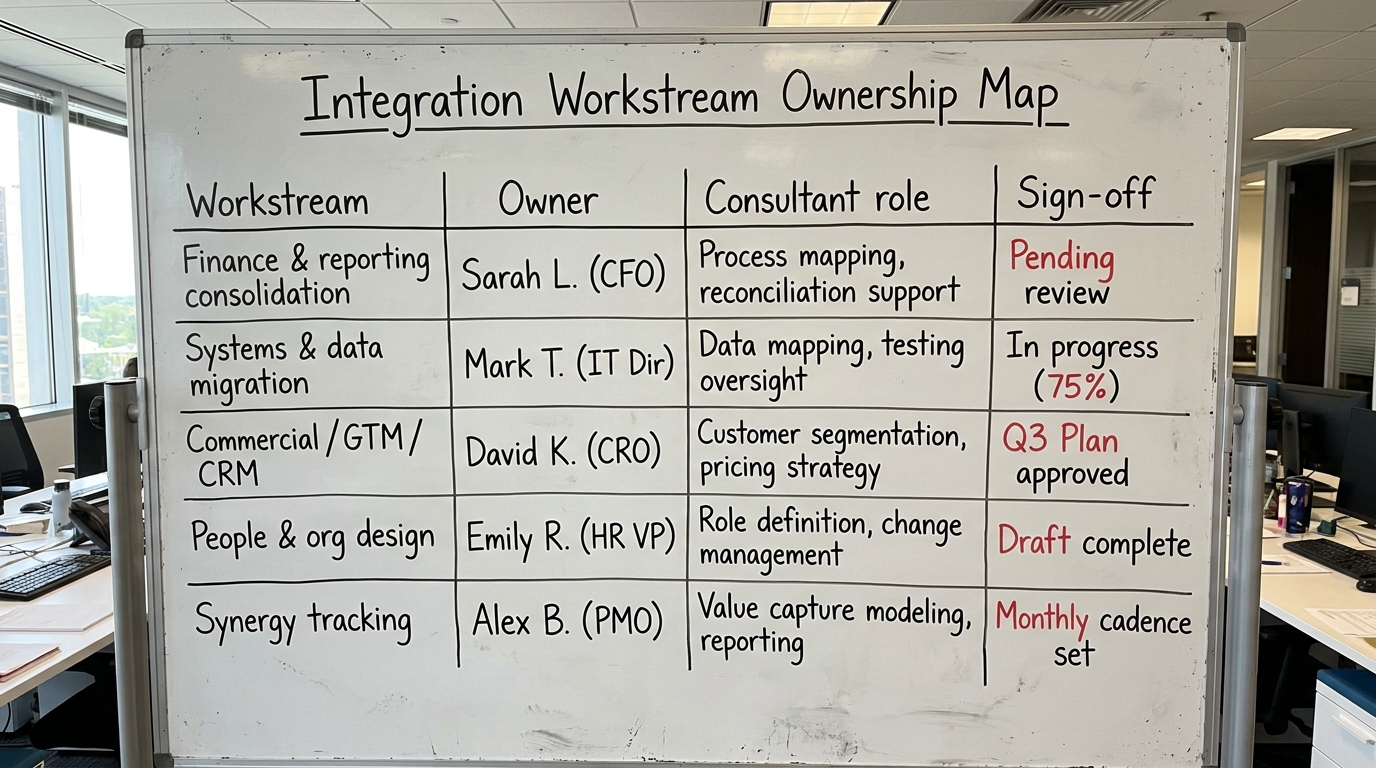
The most common mistake is hiring an integration consultant to “run the integration” without naming which parts of it they own and which stay with the management team. Integration spans finance and reporting consolidation, systems and data migration, commercial (GTM, pricing, CRM), people and org design, and the tracking layer that ties all of it back to the deal model.
A consultant who is strong at commercial integration is frequently weak at ERP consolidation, and the reverse is also true. Before you scope anyone, write down which of those workstreams you are buying help with and which your own people will carry. Bain’s annual private equity work has consistently found that value creation planning done during diligence, rather than after close, separates the deals that hit their return case from the ones that drift. You can review that pattern in Bain’s Global Private Equity Report.
The practical decision here is a decision rights map. For each workstream, name the owner, the consultant’s role (lead, support, or advise only), and who signs off. If you cannot fill that table in, you are not ready to hire.
The companion piece on what to decide before you buy M&A integration consulting services walks through this scoping step in more detail, and it is worth doing before the first vendor call.
2. Tie the engagement to the value case, not to activity
A post-close integration consultant should be able to restate your investment thesis back to you in operating terms within the first week. If the deal was underwritten on cross-sell between the two customer bases, the integration plan has to name the CRM state, the data cleanup, and the sales motion that make cross-sell possible, and it has to carry a date and a euro figure.
Be wary of proposals that lead with hours, tickets, workshops, and steering committee cadence. Those are inputs. What you are buying is measurable enterprise-value improvement: revenue you can attribute to the combined entity, cost you took out, cash you freed, or risk you removed before the next diligence round. McKinsey’s research on private capital and integration has repeatedly linked disciplined synergy tracking to realized returns rather than modeled ones.
Ask any candidate to classify every synergy line as realized, run-rate, forecast, or enabled. A consultant who lets a forecast number read as money already in the bank is either careless or selling. The guide to hiring a synergy realization consultant without buying a slide deck covers how to keep that distinction honest in reporting.
3. Match the hire to the deal type and the calendar
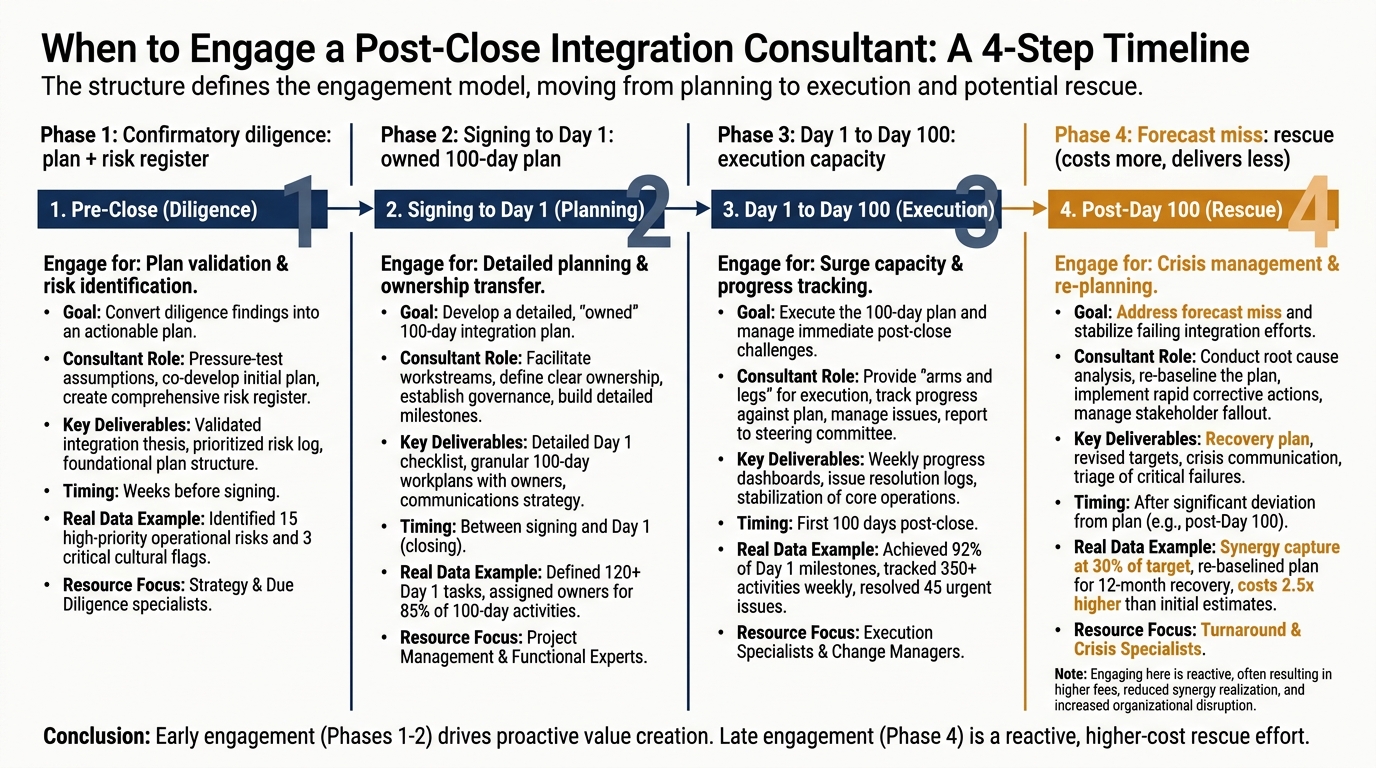
Timing changes the brief. An operating partner who brings in a consultant during confirmatory diligence is buying a plan and a risk register. One who brings them in at Day 1 is buying execution capacity. One who waits until the forecast is already missing is buying a rescue, which costs more and delivers less.
The cleanest results come from engaging before close, so the consultant’s first 100-day plan is ready to run on the morning after signing. DevriX’s view on the first 100 days is that the plan has to exist as an owned document with dates and owners before Day 1, not get drafted in week three while the acquired team waits for direction.
Add-ons versus platform builds
A bolt-on into an existing platform is mostly a systems-and-data problem with a short commercial tail. A merger of two roughly equal businesses is an org-design and culture problem with a long finance tail. The same consultant rarely does both well. For guidance on the trigger and the judging criteria, see when to bring in an M&A integration advisor and what private equity should judge them on.
4. Judge the systems and data plan before you judge the slides
Most integration value stalls on data. Two CRMs with overlapping accounts, two ERPs with different fiscal calendars, and two HR systems with different job architectures will each block a synergy line until someone reconciles them. A credible consultant treats systems and data as the critical path, not a technical afterthought handed to IT.
Ask what order they migrate in and why. The right sequence is driven by the value case: if reporting reliability is what the CFO needs for the first board meeting, finance consolidation comes first; if cross-sell drives the model, CRM and customer data lead. The systems integration post-merger consultant guide lays out how to read a migration plan critically, and the post-merger CRM integration consultant piece goes deeper on the commercial-data case specifically.
This is also where technology due diligence pays off after close. The findings from diligence, the technical debt, the integration dependencies, the license and data-ownership constraints, should feed straight into the integration plan. If the consultant has not read the diligence output, they are rebuilding a map that already exists.
What a weak data plan looks like
- No named owner for master data (customers, products, vendors) in the target-state system.
- A migration date with no cutover rehearsal or rollback position.
- Deduplication treated as a one-time cleanup rather than an ongoing governance rule.
- Reporting parity promised for Day 1 with no interim manual bridge for the first close.
5. Insist on a baseline you can measure against
You cannot claim synergy realization without a baseline, and a surprising number of integration plans never establish one. Before anything changes, the consultant should capture the two entities’ actuals: headcount by function, cost by category, revenue by customer and product, working capital, and the state of the pipeline. That baseline is what turns “we improved margin” into “margin moved from X to Y against plan.”
The AICPA and CIMA maintain guidance relevant to purchase accounting and post-close financial reporting that a CFO will care about during the first consolidated close; their materials are at AICPA & CIMA. The point for an operating partner is narrower: the reporting baseline and the value baseline have to be set in the first weeks, because after that the two businesses blur together and the counterfactual is gone.
Analysis from PitchBook and from S&P Global Market Intelligence on holding periods and value creation makes the same practical case: firms that can attribute performance to specific operating moves defend their story better at exit. A baseline is what makes attribution possible.
6. Read the risk register they hand you, not the summary
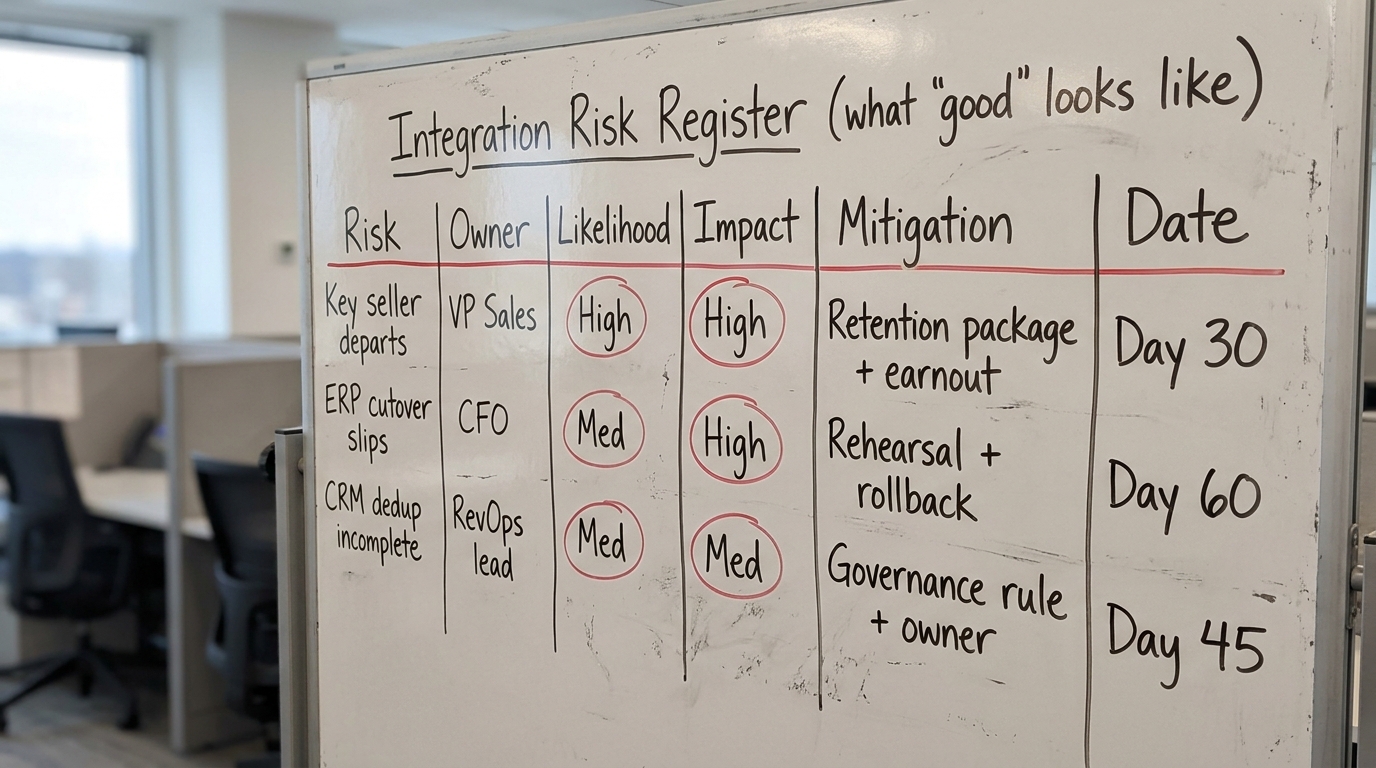
A serious integration consultant produces a risk register that a board member could open and understand: each risk named, an owner assigned, a likelihood and impact rated, and a mitigation with a date. If the risks are generic (“cultural misalignment,” “system complexity”) with no owner and no trigger, the consultant is listing categories rather than managing exposure.
Retention risk frequently gets underweighted. Key people at the acquired company decide within the first months whether to stay, and their departure can quietly erase a chunk of the deal case, especially in businesses where relationships or technical knowledge sit with individuals. The Harvard Business Review M&A collection has a long record of documenting how people and integration decisions drive whether deals hit their targets.
Governance and disclosure risks belong on the same register when they apply. The Harvard Law School Forum on Corporate Governance is a reasonable reference point for the corporate-governance side of integration, and where securities matters are in play, the SEC is the primary source rather than a consultant’s summary. Take legal and disclosure questions to counsel; the consultant’s job is to surface them, not to rule on them.
7. Set the reporting cadence to the board’s clock
The first board meeting after close is where the integration consultant’s work becomes visible to the people who wrote the investment case. Design the reporting to that clock. The board wants actual versus plan on synergies, the status of the critical-path workstreams, the top three risks with owners, and any change to the value or timing of the thesis.
Weekly internal tracking should roll up into that board view without a separate reporting exercise. If the consultant runs one system for the working team and reinvents the numbers for the board deck, you will get two versions of the truth and lose a week each cycle reconciling them. One source, two levels of detail.
For the commercial side of the story, how you frame the combined value proposition to customers and staff matters as much as the internal number; the value proposition storytelling guide is useful when the two brands go to market together for the first time. And if the combination triggers customer or reputation noise, the first 24 hours of a reputation crisis playbook is worth having on the shelf before you need it.
8. Price the engagement against scope, not against a day rate
A focused post-close integration engagement, scoped to a defined set of workstreams and a fixed window, typically sits in the $25K to $75K range for a portfolio company that already has some internal capacity. The scope is a PMI sprint with a defined end state. Where a proposal is priced as a rolling monthly retainer with no defined end state, you are buying presence, not outcomes.
Judge price against the decision rights map from section one. A consultant leading three workstreams costs more than one advising on one. What should not vary is the deliverable structure: a plan with owners and dates, a baseline, a synergy tracker with realized-versus-forecast classification, and a risk register. Those come with any competent engagement regardless of size.
Broader market context on fees, holding periods, and value creation pressure is well covered by BCG’s principal investors and private equity practice, by Preqin on the fundraising and returns environment, and by trade coverage in Private Equity International, Buyouts, and PE Hub. Read those for the environment; read the proposal for the specifics.
9. A checklist before you sign
Run a candidate through this list before committing budget. If more than two answers are soft, keep looking.
- Can they restate the investment thesis in operating terms, with the synergy lines that carry it?
- Have you filled in the decision rights map, one owner and one consultant role per workstream?
- Does the plan classify every synergy as realized, run-rate, forecast, or enabled?
- Is there a systems and data migration sequence tied to the value case, with cutover and rollback positions?
- Have they read the technology and diligence findings, or are they starting the map over?
- Is there a written baseline for cost, revenue, headcount, and working capital before anything changes?
- Is the risk register specific, owned, dated, and does it include key-person retention?
- Does the reporting roll up to the board view from one source of numbers?
- Is the engagement scoped to a defined window and end state, not an open retainer?
The connective tissue across all nine points is the same: an integration consultant earns the fee by turning the value case into owned, dated, measured work, and by telling you the truth about what is realized versus what is still a forecast. For the wider view on how this fits a fund’s operating model, the overview of post-merger integration consulting in private equity puts the roles in context.
10. When to bring this in-house versus buy it
If the fund runs a repeatable playbook across a portfolio and has operating partners with capacity, some of this work stays internal, and the consultant fills a specific gap: a systems migration, a CRM consolidation, a first consolidated close. If the acquiring management team is thin or the deal is the platform’s first add-on, buying the full sprint usually protects the first 100 days better than stretching people who also have to run the business.
The judgment call is honest capacity, not org-chart headcount. A CFO who is closing the books, managing the lender relationship, and rebuilding the finance stack does not have room to also own a migration plan, whatever the title says. Naming that gap early is cheaper than discovering it at the second board meeting.
If you want a partner that runs integration as measurable enterprise-value work rather than a slide deck, review how the DevriX and GrowthShuttle private equity team structures a PMI sprint against the value case, and bring the diligence findings and the deal thesis to the first conversation so the plan starts from what you already know.