
Most integration plans assume the provider stack comes along quietly. It does not. When a platform buys an add-on, the acquired company arrives with its own marketing agency, SEO vendor, CRM contractor, analytics consultant and a web team that has quietly become load-bearing. Providers M&A integration for private equity is the work of deciding which of those relationships survive, which get cut, and in what order, before duplicate retainers and broken reporting erode the first two quarters of the hold. The person accountable for revenue operations in the portfolio company usually owns the mess and rarely owns the mandate to fix it fast.
This guide is written for that person and for the operating partner standing behind them. It assumes budget and a signed deal, and the scope is actual provider decisions that protect revenue continuity, remove cost, and keep the value-creation plan on its original clock.
1. Name the commercial consequence before you touch a single contract
The reason provider integration gets deferred is that it looks like procurement housekeeping. It is not. Two companies running two marketing agencies, two CRM administrators and two reporting stacks means the combined entity is paying twice for capability it needs once, while producing numbers the board cannot reconcile. That shows up in the model as margin that never arrives and a forecast nobody trusts.
Bain’s annual private equity report has tracked for years how much of return now depends on operating improvement rather than multiple expansion, which puts cost and revenue mechanics inside the hold period under real scrutiny. You can read the current edition through Bain & Company’s Global Private Equity Report. The practical reading for an operator is simple: duplicate provider spend and unreliable reporting drag the exact lever the thesis depends on.
Before you review contracts, write the consequence in one line per workstream. Example of the framing, not a real deal: “Two demand-gen agencies, combined fee of 18,000 per month, overlapping on paid search, producing two attribution models the CFO cannot merge.” Once the consequence is stated in money and in reporting terms, the decision has an owner and a deadline.
2. Build the provider inventory you will actually act from
Before close where diligence access allows, and inside the first week after it where it does not, assemble a single inventory of every external provider touching revenue operations across both companies. This is the baseline. Without it, every later decision is a guess.
What belongs in the inventory
- Provider name, the workstream they serve, and the internal owner who manages them today.
- Contract value, billing cadence, renewal date and notice period.
- Termination terms and any auto-renewal clause that triggers in the first 100 days.
- What the provider actually holds: ad accounts, domain registrations, analytics properties, CRM admin rights, source code, content libraries.
- Dependency rating: can the company run next month without them, or does revenue reporting break the day they stop.
That last column is the one teams skip and regret. A small SEO contractor who also happens to own the Google Analytics property and the Search Console verification is a single point of failure. McKinsey’s work on integration, available through McKinsey’s private capital research, consistently points to early clarity on dependencies as the difference between integrations that hold their timeline and those that slip.
Drew’s work mapping search keywords to owned properties on our own PE program is a reminder of how buried these dependencies get. Vendors accumulate access over years, and nobody keeps a register. The acquired company will tell you they have “an SEO guy.” The inventory tells you that person holds the verification token for a domain generating a third of inbound pipeline.
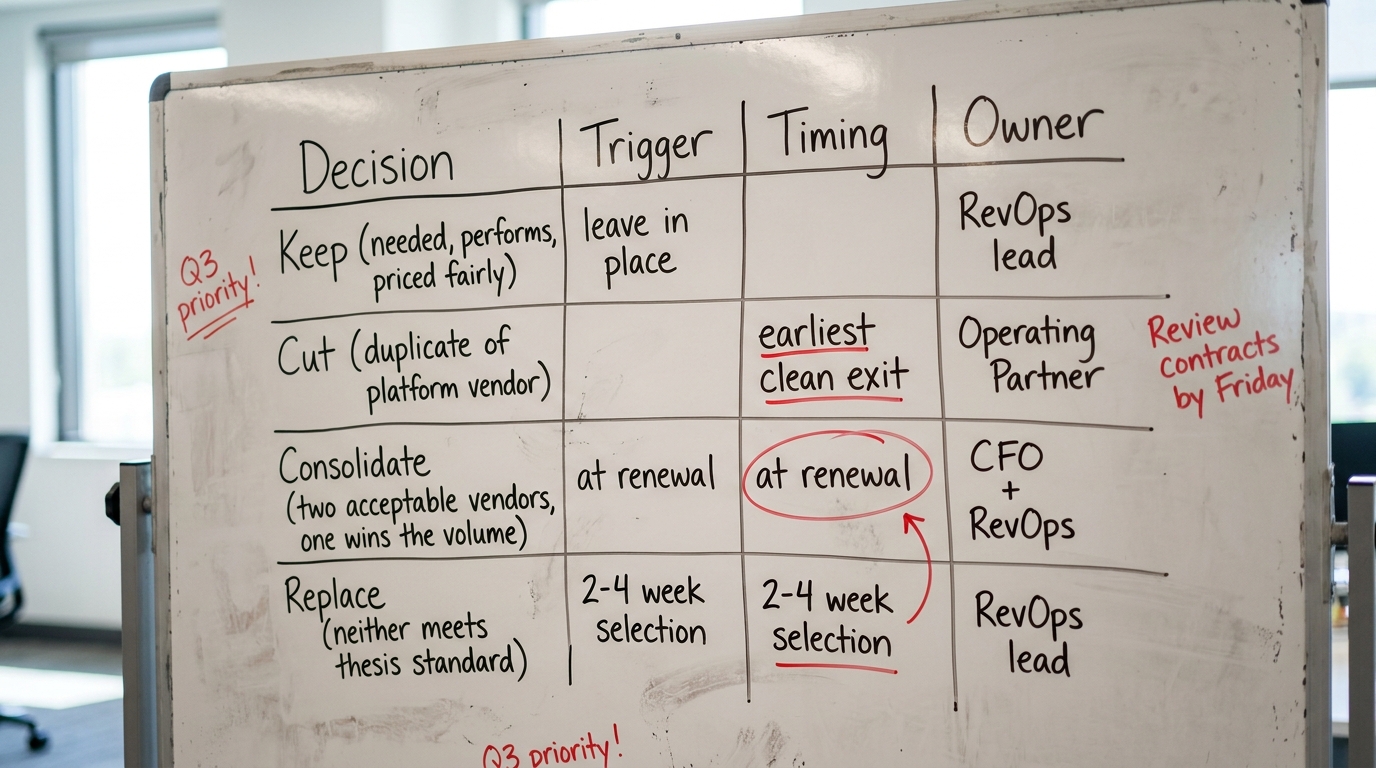
3. Sort providers into keep, cut, consolidate and replace
With the inventory built, every provider lands in one of four decisions. Make the call explicitly and record who made it, because a provider left in limbo keeps billing.
The four decisions
- Keep. The provider serves a workstream the combined entity still needs, performs well, and prices fairly against the market. Leave them alone and move on.
- Cut. The workstream is duplicated and the platform’s existing provider covers it. Terminate on the earliest clean date the contract allows.
- Consolidate. Two providers do similar work acceptably; you pick one to serve the combined volume, usually at a better rate given the larger account.
- Replace. Neither incumbent meets the standard the thesis requires, so you run a short selection and move both to a new provider.
Resist the instinct to cut everything the add-on brought and route it through the platform’s vendors by default. Sometimes the acquired company’s provider is the better one. The sorting exercise is about capability and continuity, and the right answer is occasionally to keep the smaller company’s agency and retire the platform’s.
For a deeper treatment of ordering these moves so you do not break reporting mid-quarter, this companion piece on how to sequence providers in post-merger integration for a private equity portfolio company works through the sequencing logic in detail.
4. Protect what the providers hold before you change anything
The single most expensive mistake in providers M&A integration for private equity is terminating a vendor before securing what they control. Access, assets and institutional knowledge leave with the contract unless you move first.
Secure these before any termination notice goes out
- Account ownership. Transfer admin rights on ad platforms, analytics, CRM and marketing automation to an internal owner or the retained provider. Do this while the outgoing vendor is still cooperative.
- Domains and DNS. Confirm the portfolio company, not the agency, is the registrant of record on every domain. Agencies holding client domains is common and fixable only before the relationship sours.
- Content and creative. Pull final files, source files and content libraries into company-owned storage.
- Data history. Export reporting history before you lose the login. A new provider cannot rebuild two years of baseline you failed to save.
This is the same discipline that technology diligence applies to code and systems, and the overlap is real. Treat provider-held marketing assets with the rigor a good technology due diligence process applies to engineering, because an ad account or a domain is an operating asset that can be lost as surely as a repository. The Harvard Law School Forum on Corporate Governance regularly publishes practitioner work on integration and control risk, and the pattern holds: value leaks through poorly managed transitions, not just bad deals. Their archive is at the Harvard Law School Forum on Corporate Governance.
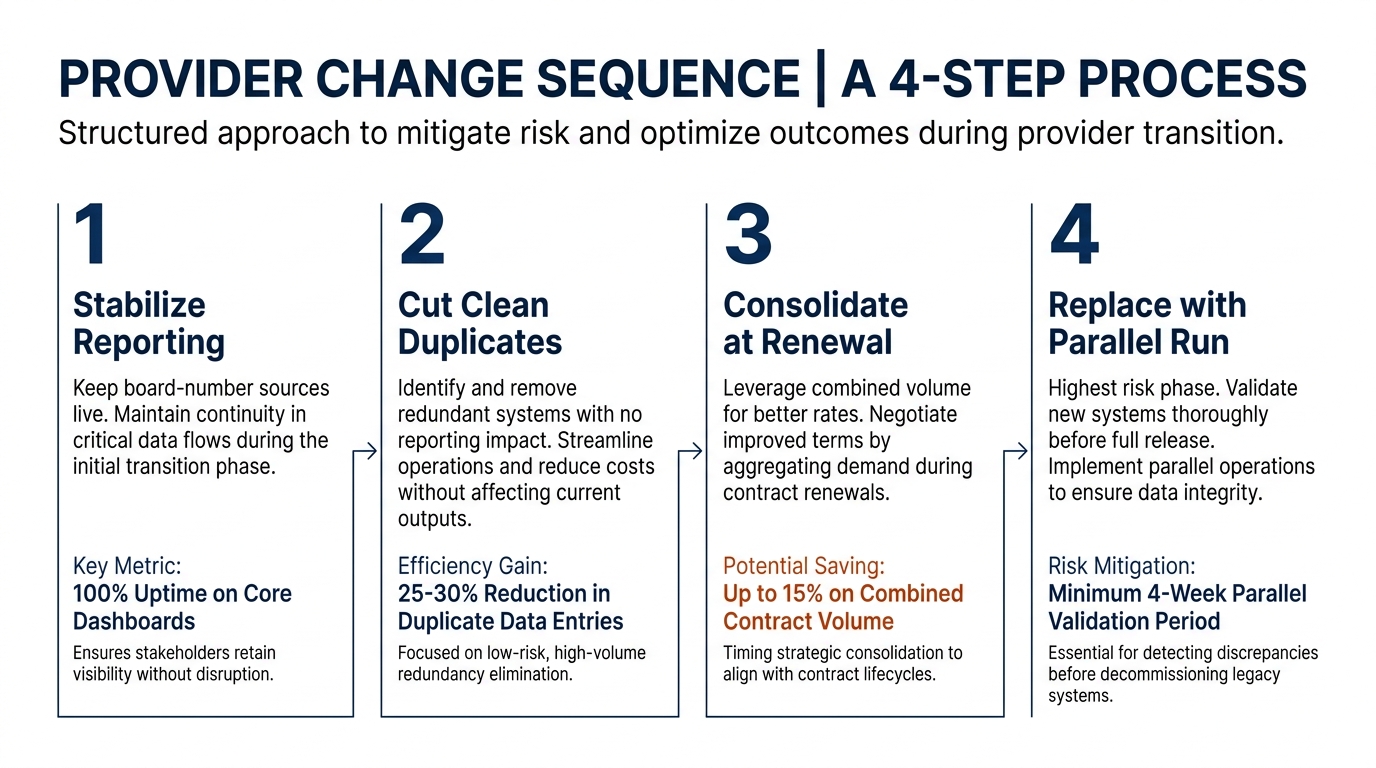
5. Sequence the changes so reporting never goes dark
The combined entity’s board will want numbers at the first meeting. If you cut the analytics provider and the CRM contractor in the same week, you hand the CFO a quarter with no reliable data. Sequence the moves so there is always a working reporting line.
A workable order
- First, stabilize reporting. Keep whatever produces the numbers the board sees until a replacement is live and validated against the old output.
- Second, cut the clear duplicates that do not touch reporting, such as a second PR retainer or an overlapping design shop.
- Third, run consolidations where the combined volume earns a better rate, timing the switch to a renewal boundary.
- Last, run replacements, which carry the most execution risk and need a parallel run before the old provider is released.
The principle is to never remove the only source of a number the business depends on without a validated replacement already producing it. This connects directly to the broader first 100 days plan, where reporting continuity and quick cost wins have to coexist without one sabotaging the other.
For teams weighing how aggressively to compress this timeline against the risk of a stalled quarter, the analysis in how to judge technology integration for private equity before it costs you a quarter covers the same tension on the systems side.
6. Decide what the provider integration should actually cost and deliver
If you bring in an external firm to run this integration rather than handling it internally, judge the engagement on outcomes, not activity. A provider integration workstream earns its fee by removing duplicate cost, closing access and asset risk, and delivering a clean reporting line, on a schedule tied to the deal clock.
What a credible scope looks like
- A completed provider inventory with dependency ratings, delivered in the first two weeks.
- A keep/cut/consolidate/replace decision log with named owners and dates.
- Secured account ownership, domains and data history before any terminations.
- A sequenced change plan that preserves board reporting throughout.
- A quantified saving, stated as realized where contracts are already terminated and as run-rate where notice periods still run.
Be precise about that last distinction. A saving from a contract you have given notice on but are still paying through the notice window is run-rate, not cash in hand this quarter. Presenting it as realized overstates the first-quarter result and damages the operator’s credibility with the board. For a fuller breakdown of how to scope and price this kind of engagement, see what a PMI consulting engagement should actually deliver, and how to price the scope.
PitchBook and S&P Global both publish data on deal multiples and hold periods that frame why cost timing matters, available through PitchBook’s research and S&P Global Market Intelligence. The shorter the intended hold, the less patience the model has for savings that only land in year two.
7. Judge the people running it the way you would judge any integration lead
Whether the work sits with an internal RevOps lead or an outside consultant, the quality of the person matters more than the methodology. The right lead asks about dependencies and reporting continuity before they ask about logos and retainers.
Signals that the lead is credible
- They build the dependency map before proposing cuts, rather than slashing spend to show early savings.
- They secure access and assets before serving notice. Waiting until afterward risks locked systems, withheld credentials, and a multi-week stall on integration work that the timeline already cannot absorb.
- They can state which savings are realized and which are run-rate without being prompted.
- They sequence around the board calendar instead of a generic 100-day template.
- They tell you when keeping the acquired company’s provider is the better call, even when it is less tidy.
The due-diligence habits that separate strong integration leads from weak ones carry over from the technology side almost unchanged. Two companion pieces are worth reading before you hire: how to judge a technology integration consultant on an M&A deal and how to hire a post-close integration consultant without losing the first 100 days. Both apply directly to provider work.
Harvard Business Review’s archive on mergers and acquisitions, at HBR’s M&A topic hub, reinforces the same point across decades of case work: integration failures trace to execution and people far more often than to the underlying deal logic.
8. Watch the cross-border and compliance edges
When the platform and the add-on operate across the US, UK and EU, provider consolidation collides with rules that differ by market. A single consolidated marketing provider has to run campaigns that comply with the strictest applicable standard, which is typically GDPR if any user base touches the EU, regardless of where revenue concentrates.
Loyalty and advertising rules are a common trap here, because what passes in one market can be a violation in another. The differences are laid out in this review of US, UK and EU loyalty ad standards, and they matter the moment you ask one agency to serve all three regions. Consolidation that ignores jurisdictional rules trades a small saving for a compliance exposure the deal team will not thank you for.
Data handling carries the same risk. When you transfer analytics and CRM access during provider changes, confirm the receiving provider’s data processing terms cover every market the combined entity operates in. The AICPA and CIMA publish practitioner guidance relevant to controls and reporting integrity through AICPA & CIMA, and the SEC’s materials at the U.S. Securities and Exchange Commission are the reference point where disclosure and reporting reliability intersect with these changes.
9. Keep a risk register the board can read
Every provider decision creates a risk until it closes. An open termination with an unsecured ad account is a risk. A consolidation waiting on a renewal date is a risk. Track them in one register the operating partner and CFO can see, with each item carrying an owner, a trigger date and a status.
Entries that belong on it
- Auto-renewal clauses firing inside the first 100 days that need notice served now.
- Any revenue-reporting source scheduled for change before its replacement is validated.
- Access or domains still held by a provider marked for termination.
- Consolidations where the combined volume depends on a rate not yet contracted.
- Cross-border campaigns moving to a single provider without confirmed multi-market compliance.
BCG’s work on principal investors and post-merger value creation, at BCG’s private equity practice, and the deal reporting across Private Equity International, Buyouts and PE Hub, all describe the same recurring failure: value planned in the model that never materializes because an execution risk was tracked informally and then forgotten. A visible register is the cheapest insurance against that outcome. Preqin’s data on fund performance, at Preqin, sits behind why that gap between planned and realized value draws so much attention from LPs.
10. The decision checklist
Before the first board meeting, an operator running provider integration should be able to answer yes to each of these.
- A single provider inventory exists across both companies, with dependency ratings and internal owners.
- Every provider has a recorded decision: keep, cut, consolidate or replace, with a named owner and a date.
- Account ownership, domains and data history are secured before any termination notice went out.
- Changes are sequenced so a validated source of every board number stays live throughout.
- Savings are reported split between realized and run-rate, never blended.
- Auto-renewals firing in the first 100 days have notice served or a deliberate decision to keep.
- Cross-border consolidations meet the strictest applicable market standard.
- A risk register with owners and trigger dates is visible to the operating partner and CFO.
Provider integration removes duplicate cost and fixes the reporting gaps that stall board meetings. The work itself is not strategic, but the order matters: done early, it clears margin drag and gives the board numbers it can trust from the first meeting. Done late or carelessly, it extends the integration calendar by a quarter the thesis could not spare and leaves the CFO presenting two sets of books because the platforms have not merged.
If you are scoping this work for a platform and its add-ons and want a team that runs provider and private equity integration against the deal clock rather than a generic template, review the provider integration offering from the DevriX and GrowthShuttle private equity practice and bring the inventory and decision log into the first scoping conversation.