When a portfolio company closes an add-on, the IT integration workstream is usually the one that decides whether the first year of the thesis holds or slips. A deal partner can model synergies to the decimal, but if two ERP instances, three CRM tenants and a tangle of overlapping licenses do not come together on a schedule that finance can forecast against, the synergy case stops being real and starts being a hope. IT integration in M&A is where that gets settled, and the operating partner or portfolio company executive sitting over it needs to make a short list of decisions early, before the integration team starts spending.
This guide is for the person accountable for revenue operations and systems in a PE-backed company who has an add-on approaching close, a Day 1 to survive, or a first board meeting where someone will ask why the two businesses still run on separate stacks. It is written for a buyer with budget and a decision right who needs to name what you actually decide, in what order, and how to judge whether the plan in front of you will survive contact with the operating reality.
1. Why IT integration decides whether the synergy case survives
Most deal theses in the mid-market lean on two or three integration-dependent assumptions: a combined go-to-market motion, a consolidated back office, and a single source of truth for reporting. Each of those depends on systems coming together. If the CRM data from the acquired company never merges cleanly into the platform, the cross-sell line in the model is not reachable on the timeline the partners underwrote.
Bain’s annual private equity report has tracked for years how value creation has shifted away from financial engineering toward operational improvement, and reporting systems and GTM data are a large part of that operating work. You can review that trend line in Bain & Company’s Global Private Equity Report. The practical consequence is that the IT integration plan controls how several of the synergy lines in the deal model become realizable.
The commercial question for the operating partner is narrow. Which synergy lines depend on which systems coming together, and by when? Everything else in the integration plan is secondary to answering that with evidence, not assertion.
2. Start the inventory in diligence, not after close
The single most common way IT integration goes sideways is a buyer who treats the systems landscape as something to examine after the ink dries. By then the forecast already assumes a level of integration nobody has validated. The inventory belongs in confirmatory diligence, alongside the technology due diligence workstream, so the integration cost and timeline are priced before close rather than discovered after it.
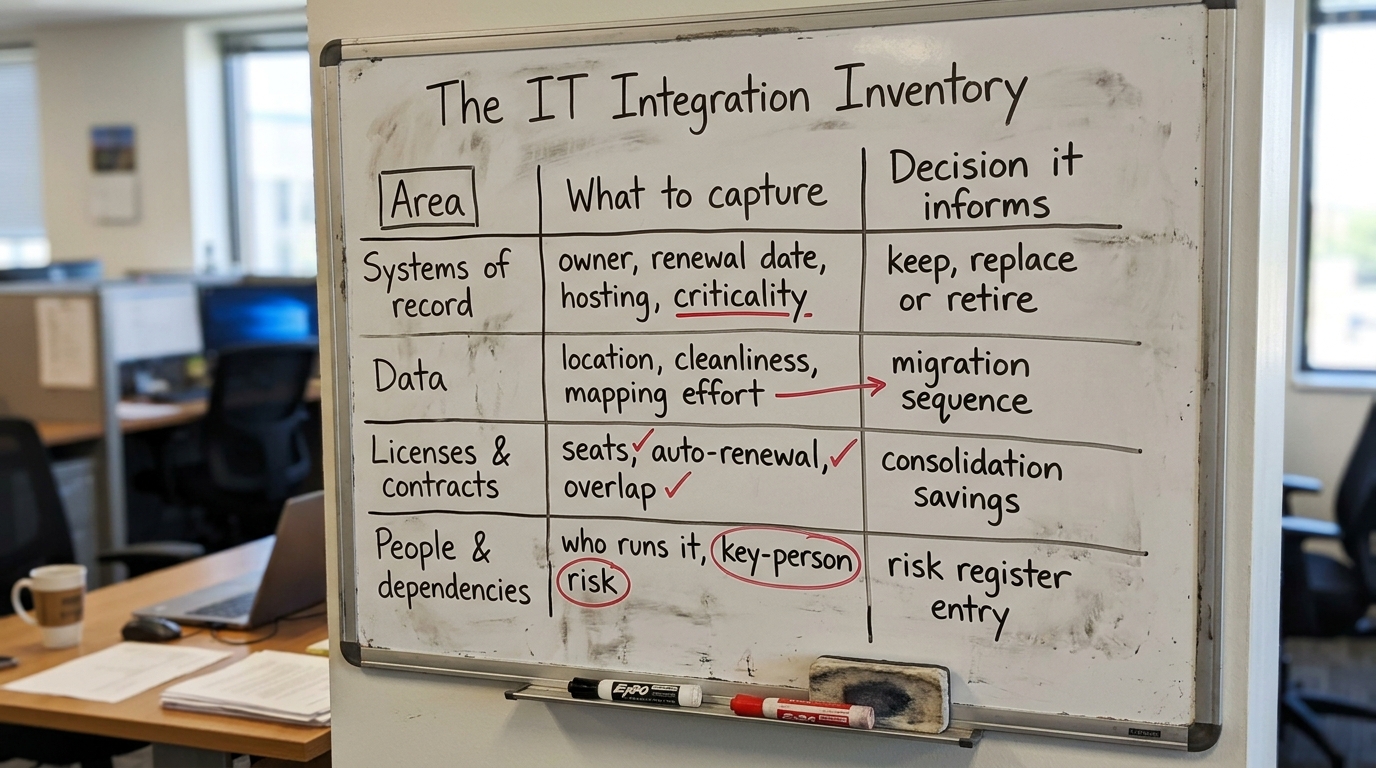
A usable IT inventory for M&A covers four things, and each produces a decision:
- Systems of record on both sides: ERP, CRM, finance, HRIS, martech, data warehouse. For each, the owner, the contract renewal date, the hosting model, and whether it is business-critical.
- Data: where the customer, product and transaction records live, how clean they are, and what it will take to map one company’s model onto the other’s.
- Licenses and contracts: seat counts, auto-renewal clauses, and overlaps that create immediate consolidation savings or termination penalties.
- People and dependencies: who actually runs each system, which are held together by one contractor, and which carry a key-person risk that needs to be on the register before Day 1.
The output produces a baseline the integration plan and the forecast both reference, so that actual-versus-plan means something later. For a structured way to scope this work and judge the people doing it, the walkthrough on scoping and judging private equity due diligence consulting is a useful companion.
3. The four decisions an operating partner actually owns
Below the detailed project plan sits a small set of decisions that belong to the operating partner and the portfolio company executive, not to the IT project manager. Delegating these downward is how integrations drift.
Which systems survive, which get retired
For every overlapping system, somebody has to decide keep, replace, retire, or run in parallel for a defined window. This is a commercial decision with a cost attached, not a technical preference. The acquired company’s CRM might be objectively better, but if the thesis depends on combined reporting next quarter, the cost of migrating onto the buyer’s platform may still be the right call. State the reason, because the reason is what gets audited in the first board review.
The integration depth you are paying for
Full integration onto one stack is expensive and slow. Light-touch coexistence is cheap and fast but leaves two sets of numbers that never fully reconcile. The right depth is set by what the thesis needs, not by what the engineers would enjoy building. McKinsey’s private capital research has consistently made the point that integration scope should follow the value case; their work is collected at McKinsey. If a synergy line does not require two systems to merge, do not merge them this year.
The sequence and the Day 1 minimum
Not everything integrates at once. The decision is what must work on Day 1 (email, payroll, the ability to invoice, security access) versus what can follow over the first 100 days and beyond. Getting the Day 1 minimum wrong is how a close turns into a visible operational failure in week one.
Who holds the decision rights
When a conflict surfaces between the two IT teams, who decides? Name the owner before the conflict, not during it. In most portfolio companies this sits with the buyer’s systems leader, with the operating partner as escalation. The decisions a portfolio company executive owns before Day 1 are worth reading as a checklist against your own governance.
4. How to read an IT integration plan and spot the weak ones
When a plan lands on your desk, a few tests separate a real one from a document that will not survive the quarter.
A credible plan ties every workstream to a synergy line or a risk it retires. If a workstream cannot name why it exists in commercial terms, it is activity looking for a budget. A weak plan leads with hours, tickets and features. A strong plan leads with the financial consequence of each phase and treats the technical work as the means.
Check how the plan handles data migration, because that is where timelines slip. Ask for the record counts, the match rate expected between the two customer databases, and the fallback if the match rate comes in low. A plan that assumes clean data has not looked at the data. The S&P Global Market Intelligence coverage of deal execution, available through S&P Global, is a reasonable external reference point for how often integration assumptions prove optimistic.
Finally, check for a named owner on every line and a dependency map. Integration dependencies are where one late workstream stalls three others. If the plan has no dependency view, nobody has thought about the critical path. The guide on buying M&A integration consulting that protects the deal thesis covers how to hold a provider to this standard before you sign.
5. Sequencing the work so the business keeps running
The hardest constraint in IT integration during M&A is that the combined business has to keep invoicing, shipping and reporting while the systems move underneath it. Sequence is everything, and the sequence follows the thesis rather than the org chart.
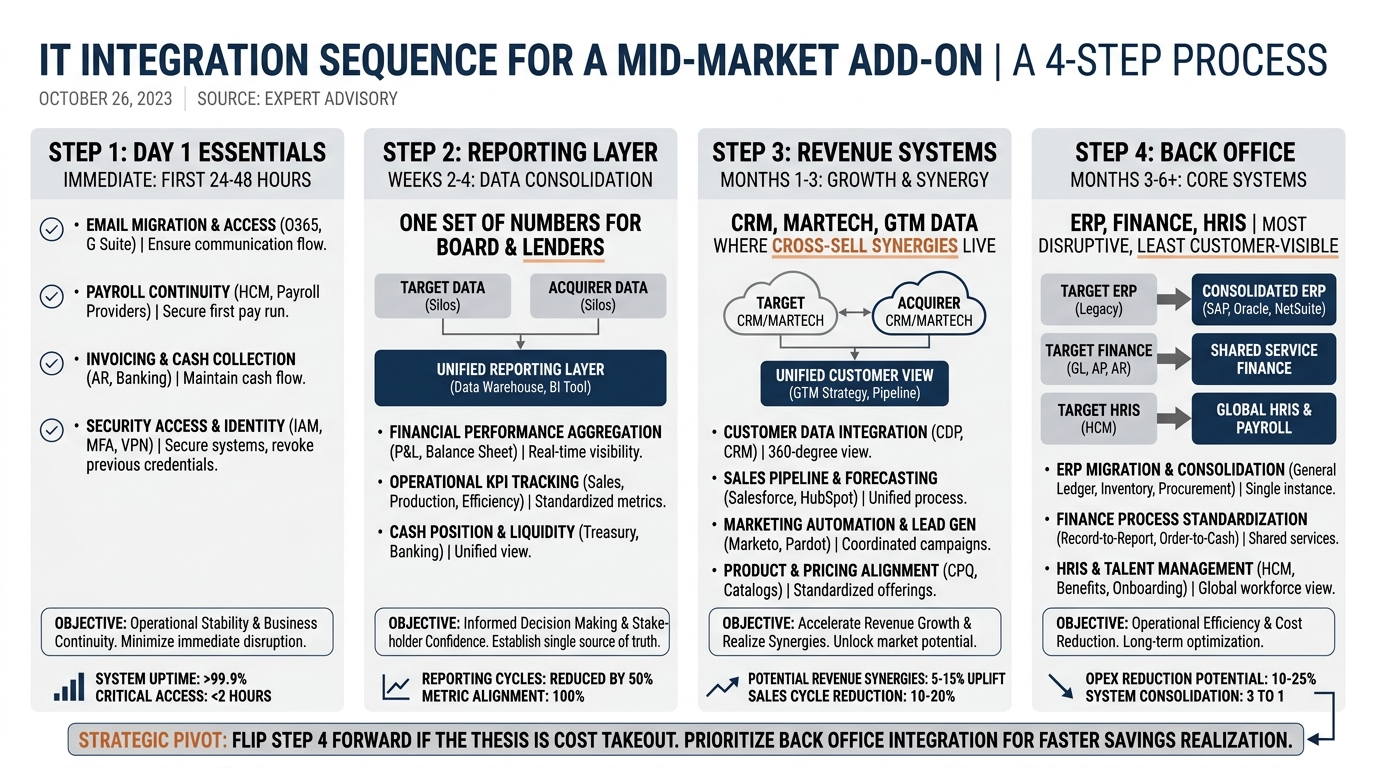
A workable order in most mid-market deals runs roughly like this. Stabilize the Day 1 essentials first, so nothing breaks at close. Then consolidate the reporting layer, because the board and the lenders need one set of numbers early. Then tackle the revenue systems (CRM, martech, the GTM data model) because that is where most cross-sell and retention synergies live. Back-office consolidation (ERP, finance, HRIS) often comes last because it is the most disruptive and the least visible to customers.
The default sequence places ERP near the end. If the thesis is built on back-office cost takeout, ERP consolidation moves forward. Sequence by where the value is, then check the order against a dependency map. Robust Branding’s walkthrough on sequencing providers in post-merger integration goes deeper on ordering the external vendors that touch each phase.
6. The reporting problem most integrations underestimate
Combined financial and operational reporting is where integrations most often disappoint the board, because it looks simpler than it is. Two companies rarely define a customer, a bookings number or a churn rate the same way. Merging the systems does not merge the definitions, and a dashboard built on two incompatible definitions produces numbers nobody trusts.
The RevOps work here is governance before it is technology. Before the data merges, somebody has to agree on the shared definitions: what counts as an active customer, how revenue is recognized across the two entities, which attribution model the combined business uses. This is unglamorous and it is the difference between a board pack that holds up and one that gets re-litigated every month.
Two formats usually serve the audience best. Finance keeps its model in Excel on the same underlying data, and leadership gets dashboards with the exceptions flagged. The Harvard Law School Forum on Corporate Governance publishes useful material on reporting and oversight expectations in sponsor-backed companies, collected at corpgov.law.harvard.edu. The practical message is that reporting consolidation is a decision about definitions, owned by finance and RevOps together, that the systems then implement.
7. Build, buy, or rent the integration capability
The capability question is one the operating partner has to answer explicitly, because the default of “the internal IT team will handle it” is often wrong for an add-on that lands while the team is already at capacity.
There are three honest options. Staff it internally, which works when the systems leader has slack and the integration is small. Hire for it, which makes sense when the portfolio company will do repeated add-ons and needs a permanent integration muscle. Or rent it for the duration of the integration, which fits a one-off or a gap before a key hire lands. Each has a cost and a risk profile, and the wrong choice shows up as a stalled workstream three months in.
When renting, the test is whether the provider arrives having done the outside-in work and understands the business model, or whether they need constant correction. A provider built for SaaS applied to a distributor or a clinic group is a predictable source of rework. Robust Branding’s guidance on hiring M&A integration when the deal clock is already running and on hiring a PE M&A consultant who earns their fee before the next board meeting both address how to judge a provider on evidence rather than a pitch.
8. Pricing the scope and holding it to a deliverable
IT integration spend is easy to let run, because every open workstream can justify more hours. Price the scope against deliverables and dates. A phase without named outputs and deadlines should not have a contract.
Benchmark the price against what an entry engagement should actually cost in 2026, which is tens of thousands for a scoped first phase rather than a six-figure open-ended project that takes months to show anything. PitchBook’s deal and valuation data, at PitchBook, and the broader M&A coverage from Harvard Business Review both provide external grounding for how integration cost and timeline track against deal size. For a clear view of what a post-merger integration engagement should deliver and how to price each piece, the Robust Branding piece on what a PMI consulting engagement should actually deliver breaks the scope into priceable units.
Structure the first engagement so the champion can sell it internally with low risk: read-only access first, a defined and anonymizable artifact, a staged plan with exit points. That is how an operating partner buys integration work without committing to a number before the scope is understood.
9. A decision checklist before you approve the plan
Before you sign off on an IT integration plan for an add-on, the following should each have a clear answer. If any of them does not, the plan is not ready and approving it transfers the risk to your next board meeting.
- Synergy mapping: every integration workstream names the synergy line or the retired risk it serves. No orphan workstreams.
- Inventory baseline: systems, data, licenses and people are documented on both sides, with owners and renewal dates, from diligence rather than guesswork.
- Keep/replace/retire: a decision for every overlapping system, with the commercial reason stated.
- Depth set by thesis: integration scope follows the value case, and nothing is merged this year that the thesis does not require.
- Day 1 minimum defined: the short list of what must work at close is explicit and tested.
- Sequence by value: the order follows where the synergies live, held against a dependency map with a critical path.
- Reporting definitions agreed: shared definitions for customer, revenue and churn are settled before the data merges.
- Capability decided: build, hire or rent is a named choice with a cost.
- Scope priced to deliverables: each phase names what it produces and when, benchmarked against current-era build costs.
- Owners and decision rights: every line has a named owner and conflicts have a named escalation.
Run that list against any plan in front of you. The gaps are your risk register, and they are far cheaper to close in the planning stage than in month four. For the broader context of how this fits the value-creation agenda across a portfolio, the research hubs at BCG’s principal investors practice and the ongoing coverage at Private Equity International are both worth keeping on the shelf.
10. Running the integration without stalling the thesis
Approval opens the work. The integration holds its value when the operating partner keeps the cadence tight: a weekly actual-versus-plan review on the critical-path workstreams, a standing dependency check, and a short escalation path when a line slips. Integrations rarely fail in one dramatic event. They erode when three workstreams each slip two weeks and nobody connected the dependency until the reporting consolidation was already late.
The practical discipline that protects the thesis is covered in detail in the Robust Branding guide on running providers’ M&A integration without stalling the thesis, which treats the governance cadence as the real work rather than the plan itself. The plan is a snapshot; the cadence is what keeps actual close to plan while the business keeps running underneath it.
IT integration in M&A rewards the operating partner who treats it as a value lever with a small number of owned decisions, priced to deliverables and sequenced by where the synergies live. The portfolio companies that get this right decided early, kept the sequence tied to the thesis, and held the cadence long enough for the systems to catch up with the deal model.
If you are approaching a close or sitting over an add-on integration now and want the inventory, sequence and scope pricing built against your specific thesis rather than a generic template, review how the DevriX private equity practice structures IT and GTM integration for portfolio companies and bring it the systems landscape you are working with.