An add-on closes, the deal partner books the synergy case in the model, and then the portfolio company executive who has to actually deliver it discovers the target runs a different CRM, prices on a spreadsheet nobody owns, and books revenue on a fiscal calendar that does not line up with the platform. That gap between the model and the operating reality is where an add-on acquisition integration consultant either earns their fee or quietly bills against a plan that was never going to work. The decision to bring one in is not academic. It changes whether the synergy shows up in the next two quarters or slips a year and drags the multiple with it.
This guide is for the operating partner or portfolio company executive who already has budget approved and needs to decide what the engagement should cover, who owns which decision, and how to tell competent integration work from expensive documentation. It assumes you know what an add-on is and why the platform bought it. The question is execution.
1. Decide what the consultant is actually being hired to move
The first mistake is scoping the engagement around activity rather than the number in the deal model. An add-on thesis usually rests on two or three specific value drivers: cross-sell into the platform’s customer base, cost takeout from consolidated back office, procurement leverage, or a faster route to a capability the platform could not build in time. Each of those has a different critical path, a different owner, and a different failure mode.
Before you read a single proposal, write down the synergy figure by driver and the quarter it is expected to land. If the cross-sell case assumes the add-on’s product is sellable through the platform’s sales team by Q2, then CRM data migration, product training, and quota changes are on the critical path, and everything else is secondary. A consultant who cannot map their workstreams back to those specific numbers is selling you a generic PMI template. Bain’s annual work on private equity performance has consistently tied returns to operational value creation rather than multiple expansion, which is exactly the part an integration consultant is paid to protect.
For a deeper treatment of the pre-purchase scoping decision, the companion piece on what to decide before you buy M&A integration consulting services walks through the same discipline applied earlier in the process.
2. Separate the platform integration from the add-on integration
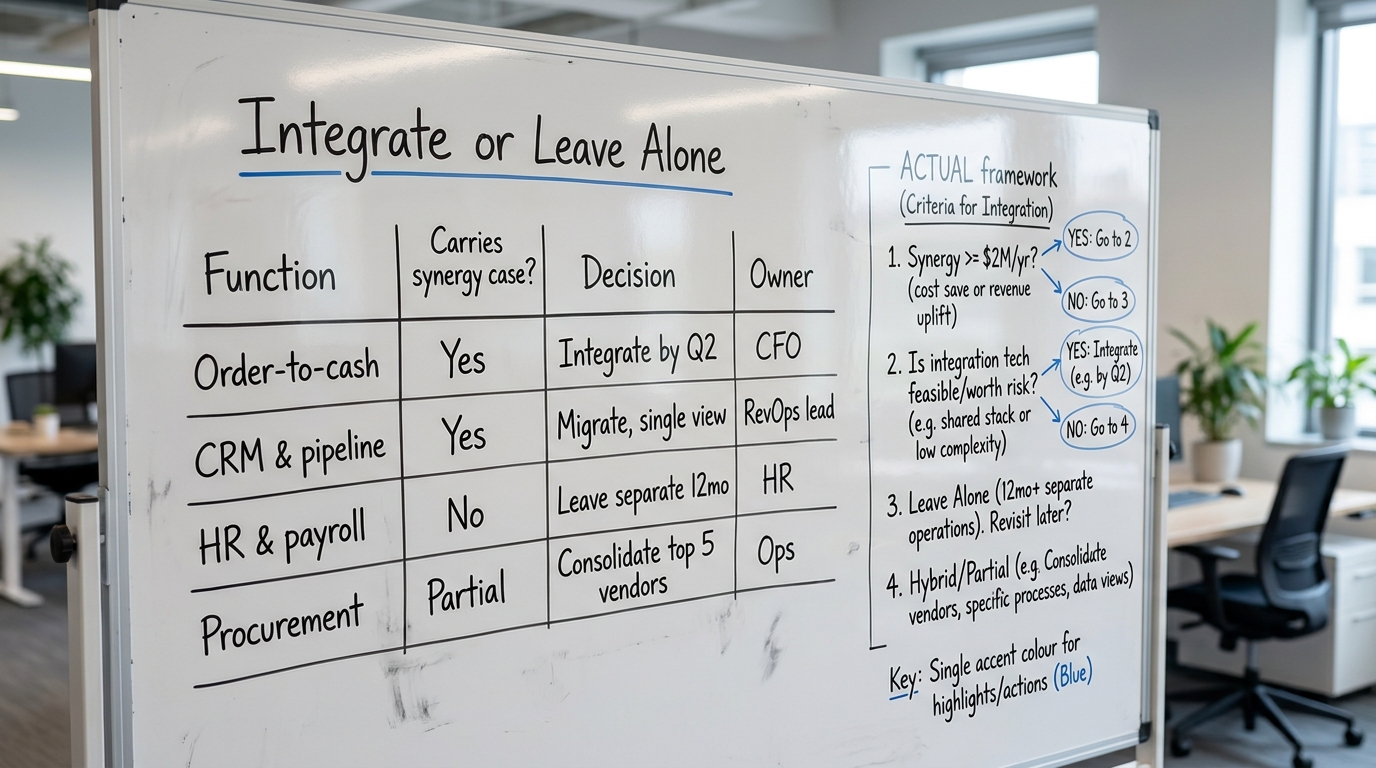
A platform acquisition and a bolt-on are not the same integration job, and a consultant who treats them the same will overspend on one and underdeliver on the other. Platform deals usually justify a full functional integration across finance, HR, systems, and go-to-market. A small add-on rarely does. The right answer for a $15M revenue bolt-on is often to integrate the two things that carry the synergy case (say, the order-to-cash system and the sales motion) and deliberately leave the rest alone until it becomes a constraint.
This is a judgment call, and it is the single most valuable thing an experienced add-on acquisition integration consultant brings. They should be willing to tell you what not to integrate, and to defend that recommendation against the reflex to standardize everything. McKinsey’s research on integration has long argued that clarity on integration scope early in the process separates deals that hit their synergy targets from those that stall in perpetual harmonization work.
If the target is being folded fully into the platform, the deeper systems question deserves its own read. The guide on post merger integration consulting in private equity covers the platform-scale version of this decision.
The under-integration risk
Leaving systems separate has a cost too. Two CRMs mean no single view of the combined pipeline, which means the board sees an incomplete revenue picture at exactly the moment the thesis is being tested. The consultant’s job is to price that trade-off honestly, not to default to either extreme.
3. Know which decisions you are keeping and which you are delegating
Integration failures are usually decision-rights failures before they are execution failures. A consultant can run the workstreams, but the portfolio company executive keeps a short list of decisions that cannot be outsourced: which management team runs the combined commercial function, what the target’s customers are told and when, which brand survives, and what happens to overlapping roles.
Get this explicit in the first week. Write a one-page decision map: for each material decision, name the owner, the people consulted, and the date by which it must be made. The consultant should build and maintain that map, but they do not own the decisions on it. When an integration drifts, it is almost always because a decision on that list sat unassigned while the workstream around it kept moving.
The Harvard Law School Forum on Corporate Governance has published extensively on governance and oversight in acquisitions, and the recurring theme is that unclear accountability, not weak strategy, is what erodes deal value after close.
4. Judge the consultant on evidence they can produce before they start
Commercial buyers get shown polished PMI methodologies. The methodology is not the differentiator. What separates a useful add-on acquisition integration consultant from an expensive one is whether they can describe, concretely, what they will produce in the first thirty days and how you will know it is right.
- A synergy tracker tied to the deal model, showing baseline, target, actual, and variance by driver, updated on a fixed cadence.
- A systems inventory for both companies that names the systems of record and the integration dependencies between them.
- A risk register that lists the integration risks, their owners, and the trigger that would move each from watch to action.
- A Day 1 readiness checklist covering payroll, customer communications, access, and legal entity mechanics.
If a firm cannot show you a redacted version of these artifacts from prior work, you are their pilot. The related piece on when to bring in an M&A integration advisor and what private equity should judge them on goes deeper on the judgment criteria that hold up across deals.
5. Treat the CRM and revenue systems as the first hard test
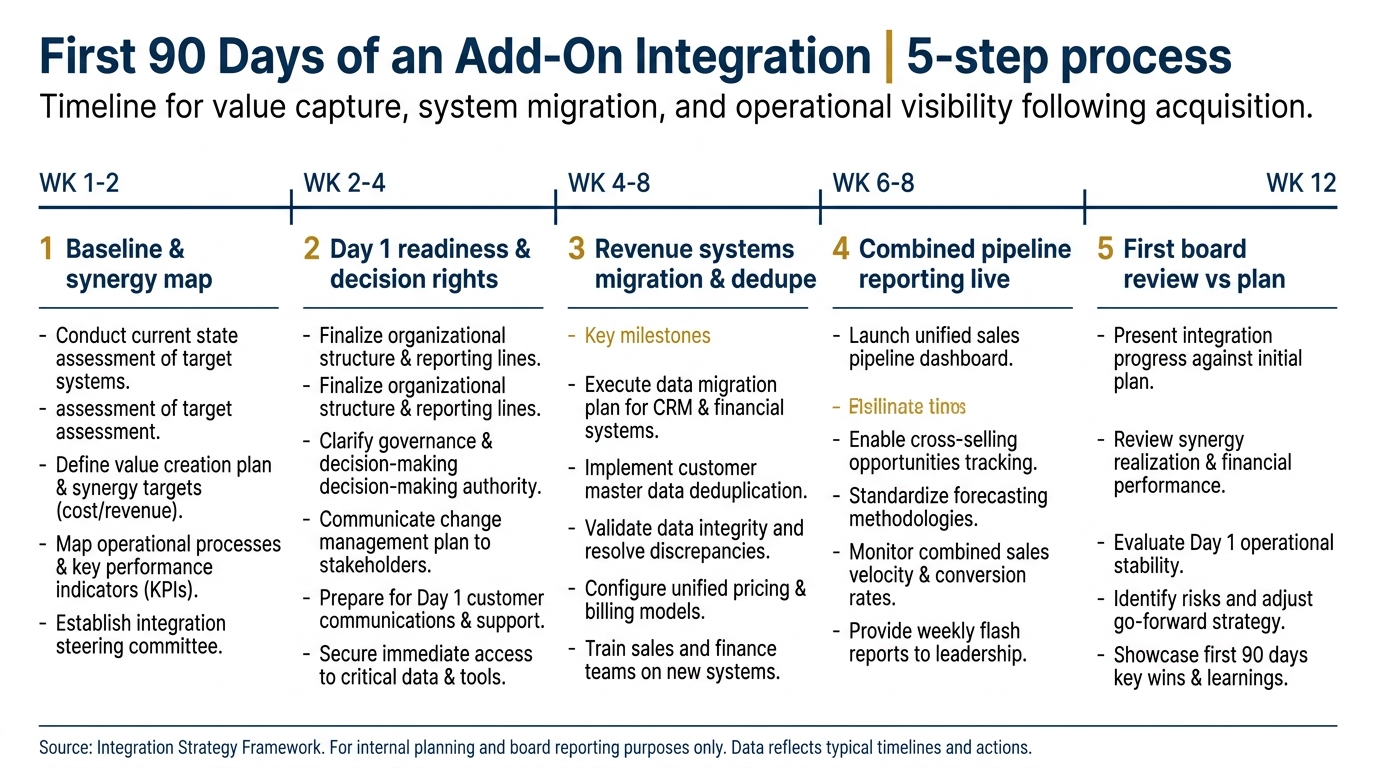
For most add-ons where the thesis is cross-sell, the revenue system integration is where the plan meets friction first. Two pipelines, two definitions of a qualified lead, two sets of product SKUs, and two commission plans do not merge cleanly, and the data migration usually surfaces problems nobody flagged in diligence.
This is the workstream where a generalist integration consultant most often overpromises. Ask specifically how they handle field mapping between the two CRMs, how they will dedupe overlapping accounts, and what the reporting looks like on the day both teams start selling the combined catalogue. The dedicated guide on hiring a post merger CRM integration consultant covers the technical questions worth asking before you sign.
Whoever runs this should coordinate with the platform’s technology due diligence findings if that work was done pre-close, because the integration plan should inherit the risks diligence already identified rather than rediscover them at cost.
Do not let reporting lag the sell motion
If the sales teams start selling the combined offer in month two but the consolidated pipeline reporting is not ready until month five, the board and the deal partner spend three months guessing. Sequence the reporting build ahead of the go-to-market change, not behind it.
6. Insist on a synergy tracker that ties to actual, not to activity
The most common way integration work goes wrong quietly is that the reporting drifts from the deal model. The consultant reports meetings held, systems touched, and milestones cleared, while the actual financial synergy against the model goes unmeasured. Six months in, the workstream looks busy and the number has not moved.
Require, from the start, that every synergy claim is classified as realized, run-rate, forecast, or at risk. Realized means it is in the actuals. Run-rate means the change is in place and the annualized effect is calculable. Forecast means it is expected but not yet delivered. At risk means a dependency is slipping. A tracker that blends these into one optimistic total is worse than no tracker, because it lets everyone believe the case is on plan when it is not.
PitchBook’s deal and value-creation data and S&P Global’s market intelligence both underline how much of the return in add-on strategies depends on realized operational improvement rather than the price paid, which is precisely why the realized-versus-forecast distinction matters more than the headline synergy figure.
7. Match the engagement shape to the size of the add-on
A $10M bolt-on does not need a twelve-month integration management office. A platform-scale acquisition might. The engagement shape should scale with the size and complexity of what is being integrated, and a consultant who proposes the same structure regardless of deal size is anchoring on their standard fee, not your problem.
For a focused add-on where the work is concentrated in one or two systems and one go-to-market change, a short, defined sprint of six to twelve weeks with clear deliverables usually beats an open-ended retainer. That structure forces the scoping discipline from section one and gives you a natural checkpoint to decide whether to extend. The DevriX PMI and initiative sprint model in the $25K to $75K range is built for exactly this shape of add-on, where the value is in fast, sequenced execution rather than a standing office.
BCG’s work on principal investors and integration makes a related point: the discipline of time-boxing integration work tends to produce faster synergy capture than open-ended programs, because deadlines force the decision-rights questions to the surface.
8. Watch for the failure patterns before they cost a quarter
Certain patterns predict a stalled integration, and a portfolio company executive can spot them early if they know what to look for.
The synergy realization theatre
Weekly decks that grow in polish while the tracked financial synergy stays flat. The guide on how to hire a synergy realization consultant without buying a slide deck is worth reading before the first status meeting so you know which questions cut through the presentation.
Systems harmonization for its own sake
The team migrates functions that never touched the synergy case because standardizing felt tidy, and the budget for the revenue-critical work runs short. The read on how to choose a systems integration post merger consultant and judge the work covers how to keep systems work tied to value.
Customer and brand missteps
An acquired customer base learns about the deal from a botched email or a confusing rebrand before anyone has decided the message. If the add-on brings a customer base worth cross-selling, the communication plan is part of the integration, and a mishandled first touch can undo the cross-sell case. The first 24 hours of a reputation crisis reads differently when it is a customer base you just paid for.
9. Tie the integration plan to the first hundred days and the exit
The integration plan is not a standalone document. It should slot into the platform’s broader value-creation plan and, for the platform itself, into the first 100 days discipline that most sponsors run on new investments. The add-on’s synergy case is a line item in the platform’s story to the eventual buyer, and a diligence team on exit will test whether the reported synergy actually landed.
That is a reason to keep the synergy tracker honest from day one. Harvard Business Review’s coverage of mergers and acquisitions has repeatedly shown that acquirers overstate synergy at announcement and underdeliver in practice, and a sponsor selling a buy-and-build platform will be asked to prove the difference. A consultant who documents realized synergy cleanly is protecting the exit multiple, not just running the project.
None of this is a reason to over-invest in an add-on that does not warrant it. The value proposition still has to be legible to the combined customer base, and the work on value proposition storytelling for SMEs is a useful check on whether the combined offer actually holds together commercially.
10. A checklist for the decision
Before signing an engagement, the operating partner or portfolio company executive should be able to answer yes to each of these.
- The synergy case is written down by driver, with a target figure and a landing quarter for each.
- The scope names what will be integrated and, explicitly, what will be left alone and for how long.
- A decision map exists naming the owner and deadline for every material decision the consultant does not own.
- The consultant has shown redacted versions of the artifacts they will produce: synergy tracker, systems inventory, risk register, Day 1 checklist.
- The revenue systems migration plan addresses field mapping, deduplication, and combined pipeline reporting, and the reporting is sequenced ahead of the go-to-market change.
- Every synergy claim in the tracker is classified as realized, run-rate, forecast, or at risk, never blended.
- The engagement shape and fee match the size of the add-on rather than a standard template.
- The plan connects to the platform’s value-creation plan and produces documentation that will survive exit diligence.
If a firm resists any of these, that resistance is the diligence result. The best integration consultants welcome being held to a tracker that ties to the model, because it is the evidence they will point to when the platform sells. A firm that would rather show you a methodology than a number is telling you which one they have.
11. Where this fits in the broader value-creation picture
Add-on integration is one workstream inside a portfolio company’s private equity value-creation agenda, and it competes for management attention with organic growth, cost programs, and the platform’s own systems roadmap. The reason to run it with discipline is that a botched integration does not just miss its own synergy target, it consumes the management bandwidth that the rest of the plan needs. Preqin’s data on private capital and the coverage in Private Equity International both point to buy-and-build as a dominant strategy in the current market, which means the quality of add-on integration is increasingly what separates platforms that compound value from those that accumulate complexity.
The right consultant makes the integration boring in the best sense: the number moves on schedule, the decisions get made on time, and the board review shows actual against plan with no surprises. That is the outcome to buy, and everything in the sections above is a way of testing whether a firm can deliver it.
If your platform has an add-on approaching close or one already stalled against its synergy plan, route the engagement through the DevriX private equity practice to scope a time-boxed PMI sprint against the specific synergy drivers in your deal model.