
The integration plan a portfolio company signs in the first month usually decides whether the next four quarters hit plan. When a platform buys an add-on, the two companies rarely share a CRM, an ERP, a data warehouse, or a way to bill customers. Technology integration for private equity is the work of collapsing those systems into one operating spine without breaking revenue while you do it. The operating partner or portfolio executive accountable for the number is the person who has to decide what gets integrated, in what order, and how success gets measured. Get the sequence wrong and the deal team watches actual slip against plan for reasons no one flagged in diligence.
This guide is written for a buyer with budget approaching close or inside the first 100 days. It covers the decisions that matter, who owns them, and how to judge the work while it is still cheap to change course.
1. Start with the revenue systems, not the org chart
Most integration timelines lead with the visible reorganization: reporting lines, office consolidation, a new logo on the deck. That work is real, but it rarely moves enterprise value in the first year. The systems that touch how the combined company quotes, sells, delivers, and bills are the ones that carry commercial risk if they stall.
For a RevOps buyer, the practical priority list is short. The CRM decides whether the combined sales team can see one pipeline. The billing and ERP layer decides whether you can invoice on time and forecast cash. The data warehouse or reporting stack decides whether the board sees actual against plan without three analysts reconciling spreadsheets. Everything else can usually wait a quarter.
Bain’s annual private equity report has tracked for years how value creation has shifted toward operational improvement rather than multiple expansion, which puts the operating systems squarely in scope. You can read the current edition through Bain & Company’s Global Private Equity Report. The point for the integration lead is that the systems carrying revenue are the ones the deal team depends on to make the thesis work.
This ordering matters most in the first 100 days, when the team has attention and political capital and has not yet spent either on the wrong workstream.
2. Decide the target state before you touch a single system
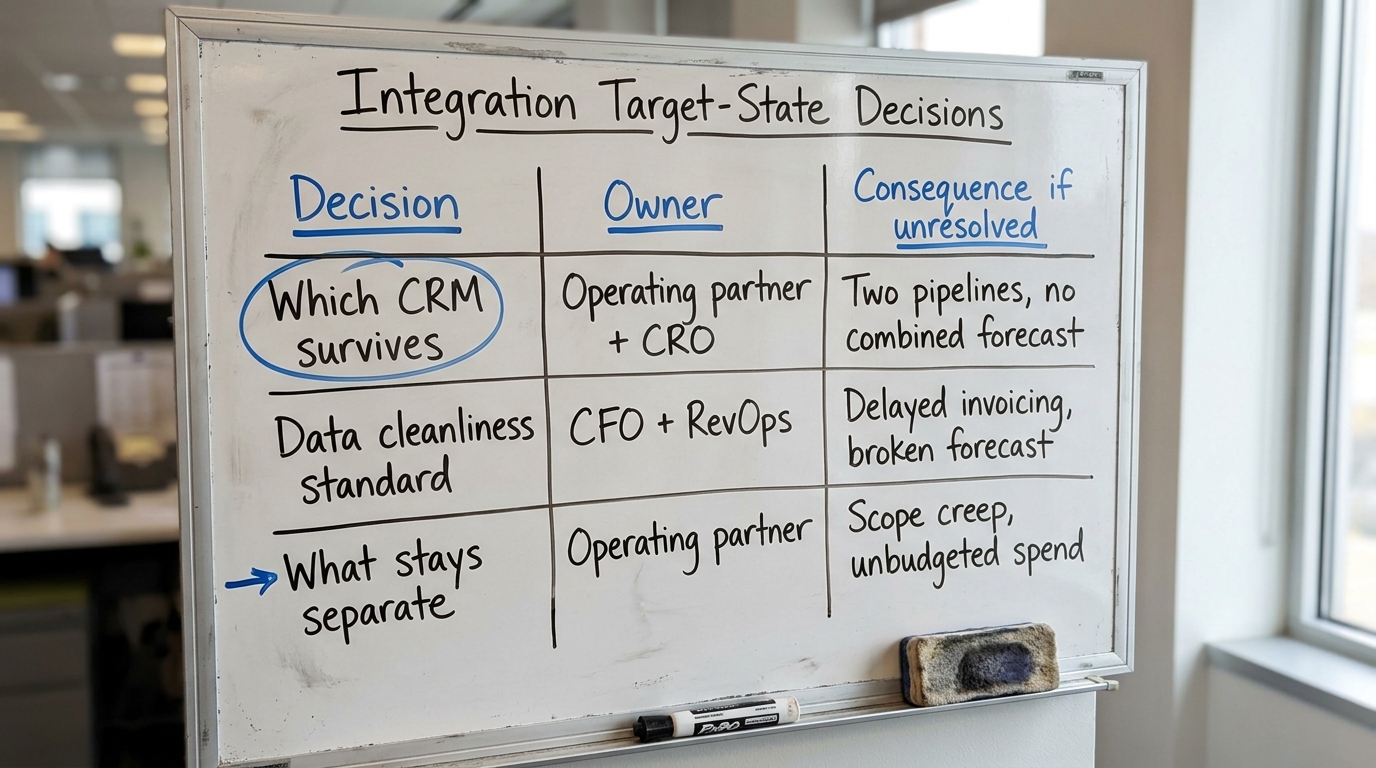
The most expensive integration mistakes come from starting migration work before anyone has decided what the end state is. Three questions settle most of it, and each has an owner who should be named on paper.
Which platform survives
When two companies run different CRMs, one of them usually wins and the other migrates in. The default should be the platform that carries the larger or more complex revenue motion, not the one the acquiring company happened to buy first. The deal partner and the operating partner share this decision because it affects cost, timeline, and which sales team absorbs the disruption.
How clean the data has to be
A migration is only as good as the records that survive it. Deciding the acceptable state of the data, deduplicated, with owners assigned and history preserved where it matters, has to be settled up front. The CFO cares because dirty billing data delays cash. The CRO cares because dirty pipeline data breaks the forecast.
What integrates versus what stays separate
Not every system needs to merge. Two brands may keep separate storefronts and marketing stacks on purpose while sharing one back-office. Naming what stays separate is as important as naming what merges, because it caps the scope and the spend. A useful discipline here is covered in the site’s guide on what to decide before you buy M&A integration consulting services, which frames scope as a set of owned decisions rather than a vendor’s proposal.
3. Run technology due diligence as a source of the plan, not a checkbox
By the time confirmatory diligence closes, the integration lead should already have most of the raw material for the plan. The technology due diligence workstream is where you learn what the target actually runs, what is held together by one contractor, where the licenses expire, and which systems have no owner. Treating that report as evidence for the integration plan, rather than a document filed after signing, saves the team weeks.
The gap most teams find is between what the target said it runs and what shows up in the actual system inventory. A CRM described as “Salesforce” turns out to be Salesforce plus four unsanctioned tools three teams depend on. McKinsey’s private capital research has documented how often post-close surprises trace back to under-scoped diligence rather than execution failure; their work is collected at McKinsey. The lesson for the buyer is to fund the diligence deep enough that the integration plan inherits a real inventory.
When diligence surfaces something material, it belongs on the risk register with an owner and a decision date, not in a footnote. A license that expires in the first 90 days is an integration dependency, and the team should treat it like one.
4. Sequence the workstreams so revenue never goes dark
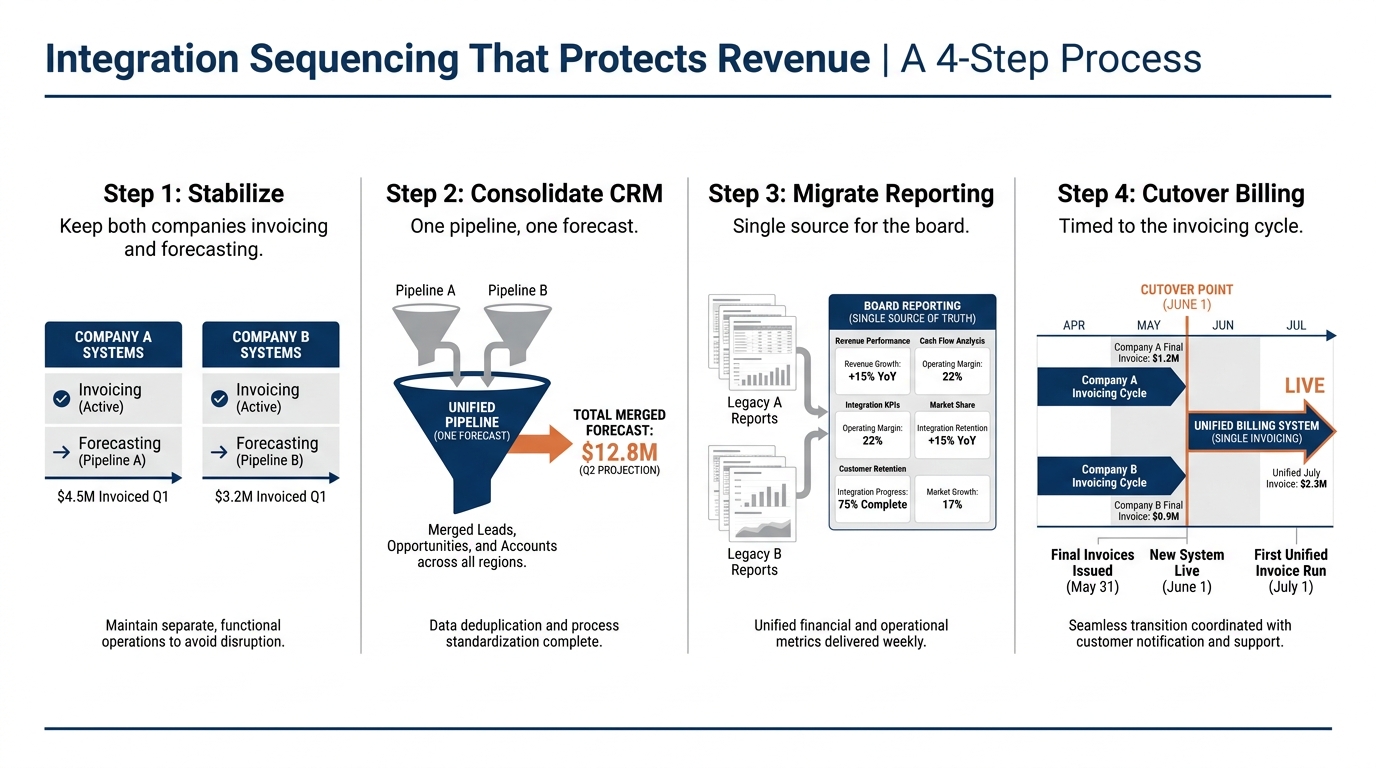
The order of operations is where good integration leads earn their fee. The governing rule is that no cutover should put the ability to sell, deliver, or collect at risk at the same time. Sequencing spreads that risk across weeks instead of concentrating it in one weekend.
Stabilize before you migrate
The first job after close is usually not migration at all. It is making sure both companies can keep operating on their existing systems while the plan runs. Nothing gets moved until the combined team can still invoice, still forecast, and still support customers on day one. This is the substance of the first 100 days, and rushing past it to a flashy consolidation is how teams break the number.
Migrate the CRM before the reporting layer
Reporting that pulls from two CRMs will always disagree with itself. Consolidating the pipeline first gives the reporting stack a single source to draw from, which is why CRM migration usually precedes the analytics work. The site’s guidance on choosing a post-merger CRM integration consultant is worth reading before this step, because CRM migration is where most integrations quietly lose data.
Sequence billing against the cash calendar
Billing cutovers should be timed around the invoicing cycle, not the project plan’s convenience. Moving billing mid-cycle is how a portfolio company misses a month of invoices and then explains a cash miss to the board that had nothing to do with the business.
5. Set the measures the board will actually ask about
Activity metrics are easy to produce and easy to ignore. Tickets closed, systems touched, and features shipped tell the board nothing about whether the integration is working. The measures that belong in a board pack tie to revenue, cash, and risk.
- Forecast reliability. Can the combined company produce one pipeline forecast, and does it hold against actual within a tolerance the CFO set?
- Invoicing continuity. Did any customer go unbilled or get billed late because of a cutover?
- Time to combined reporting. How many days after close can the board see actual against plan without manual reconciliation?
- Retained pipeline. How much open pipeline survived the CRM migration intact, with owners and history?
Harvard Business Review’s collection on mergers and acquisitions has repeatedly made the case that integrations fail on measurement discipline more than on strategy. For the RevOps buyer, the useful move is to agree these measures with the deal team before the work starts, so nobody relitigates the definition of success at the first board meeting.
6. Name the owners and the decision rights
Integrations stall when everyone assumes someone else owns a decision. Each of the systems in scope needs a named owner inside the portfolio company, not just at the sponsor, because the sponsor is not there on the day a migration script fails at 2 a.m.
The pattern that works assigns a single accountable owner per workstream, gives them the decision right for their system, and reserves a small number of decisions, platform choice, data standard, cutover timing, for a steering group that includes the operating partner. Everything else pushes down. When a portfolio company tries to run integration by committee, the timeline slips because no one can say yes.
The judgment of who inside the company can carry this, and who needs outside help, is covered well in the site’s discussion of when to bring in an M&A integration advisor and what private equity should judge them on. The short version is that internal owners keep the decision rights, and outside help supplies capacity and pattern recognition, never the accountability.
7. Decide when outside help earns its cost
Not every integration needs an advisor, and the ones that hire the wrong one waste both money and the first quarter. The test is whether the portfolio company has the internal capacity to run migration workstreams while also running the business. A management team that is already stretched will not deliver a clean CRM migration on nights and weekends, and pretending otherwise is how integrations drift.
When outside help is warranted, judge it on execution evidence, not slideware. A firm that sells a synergy model without a migration plan is selling the wrong thing. The site’s guide on how to hire a synergy realization consultant without buying a slide deck and the companion piece on what to decide before hiring a PMI consultant for a portfolio company both frame the same test: can the firm show you the actual work product, or only the promise of it?
For the technical side specifically, the criteria in how to choose a systems integration post-merger consultant and judge the work are the ones to apply. BCG’s work on principal investors, collected at BCG, has argued that operational partners add the most value when they bring repeatable playbooks rather than bespoke strategy for every deal, which is the right thing to buy for.
8. Watch the common failure modes
A handful of failure patterns show up across integrations often enough to plan against them.
The big-bang cutover
Moving everything at once concentrates risk in a single weekend. When it works, it saves time. When it fails, it takes revenue systems down with no fallback. The phased approach costs more calendar time and far less downside, which is usually the right trade for a portfolio company that has to keep hitting a number.
Data loss nobody catches until the forecast breaks
Records lost in migration often go unnoticed until the pipeline forecast comes in short and no one can explain why. Reconciling record counts before and after every migration step is dull and it is the control that catches this. The site’s post-merger integration consulting in private equity overview treats this control as non-negotiable, and it is.
Scope that grows because nothing was declared out
An integration with no explicit list of what stays separate will expand until it consumes the budget. Naming the systems that are deliberately left alone is the cheapest scope control available.
PitchBook’s data on deal activity and holding periods, available through PitchBook, shows how compressed the value-creation window has become, which raises the cost of every quarter lost to a preventable integration failure. S&P Global Market Intelligence, at S&P Global, publishes the same pressure from the credit side.
9. A checklist for the integration lead
Before the migration work starts, the accountable executive should be able to answer yes to each of these.
- The target-state decisions (which platform survives, data standard, what stays separate) are made and have named owners.
- The technology due diligence report has been read as the source of the integration plan, and material findings are on the risk register with decision dates.
- The workstream sequence stabilizes both companies before any migration, and no single cutover risks selling, delivering, and collecting at once.
- CRM migration precedes reporting consolidation, and billing cutover is timed to the invoicing cycle.
- Success is measured on forecast reliability, invoicing continuity, time to combined reporting, and retained pipeline, agreed with the deal team in advance.
- Every system in scope has one accountable owner inside the portfolio company, and steering decisions are reserved to a small group including the operating partner.
- The decision on outside help is made on capacity and execution evidence, not on a synergy deck.
- Record counts get reconciled before and after every migration step.
An executive who can work through this list has an integration plan grounded in evidence rather than optimism, which is the difference between a quarter that holds and one the board asks about. For the wider context of how sponsors think about this work, the private equity resources are a useful reference, and the corporate governance perspective at the Harvard Law School Forum on Corporate Governance covers how boards oversee it.
10. Where this fits your value-creation plan
Technology integration is one of the few workstreams a portfolio company controls entirely and can execute in the window a deal team gives it. Done in the right order, with named owners and revenue-based measures, it protects the number through the disruption and gives the board clean visibility months earlier than the reconciliation-by-spreadsheet alternative. Done as a big-bang cutover with no declared scope and no migration controls, it does the opposite.
If your platform is approaching close or already inside the first 100 days and the integration plan needs the execution capacity to run it, route the work to the DevriX private equity team to scope a PMI or integration sprint against your actual systems and timeline.