
By the time a portfolio company executive is asked to stand up integration, the LOI is signed, the financing is committed, and the value creation plan already includes synergies that no one has yet owned. The decision to hire M&A integration for private equity rarely fails because the market lacks providers. It fails because the buyer specifies the wrong scope, hires on the wrong timeline, and discovers in the first board meeting that the person running integration has no decision rights over the systems that actually move EBITDA.
This guide is for the operating partner or portfolio company executive who holds the integration budget and the accountability, not for someone deciding whether integration matters. It walks through what to decide before the first invoice, how to judge candidates against the value creation plan, and where the usual hiring process leaks a quarter of value before anyone notices.
1. Decide what you are actually buying before you shortlist anyone
Integration is not one service. A portfolio company executive who writes a vague brief gets vague proposals, and vague proposals price in the risk the vendor cannot see, which the buyer then pays for. The first task is to separate the work into scopes that have owners and measurable outcomes.
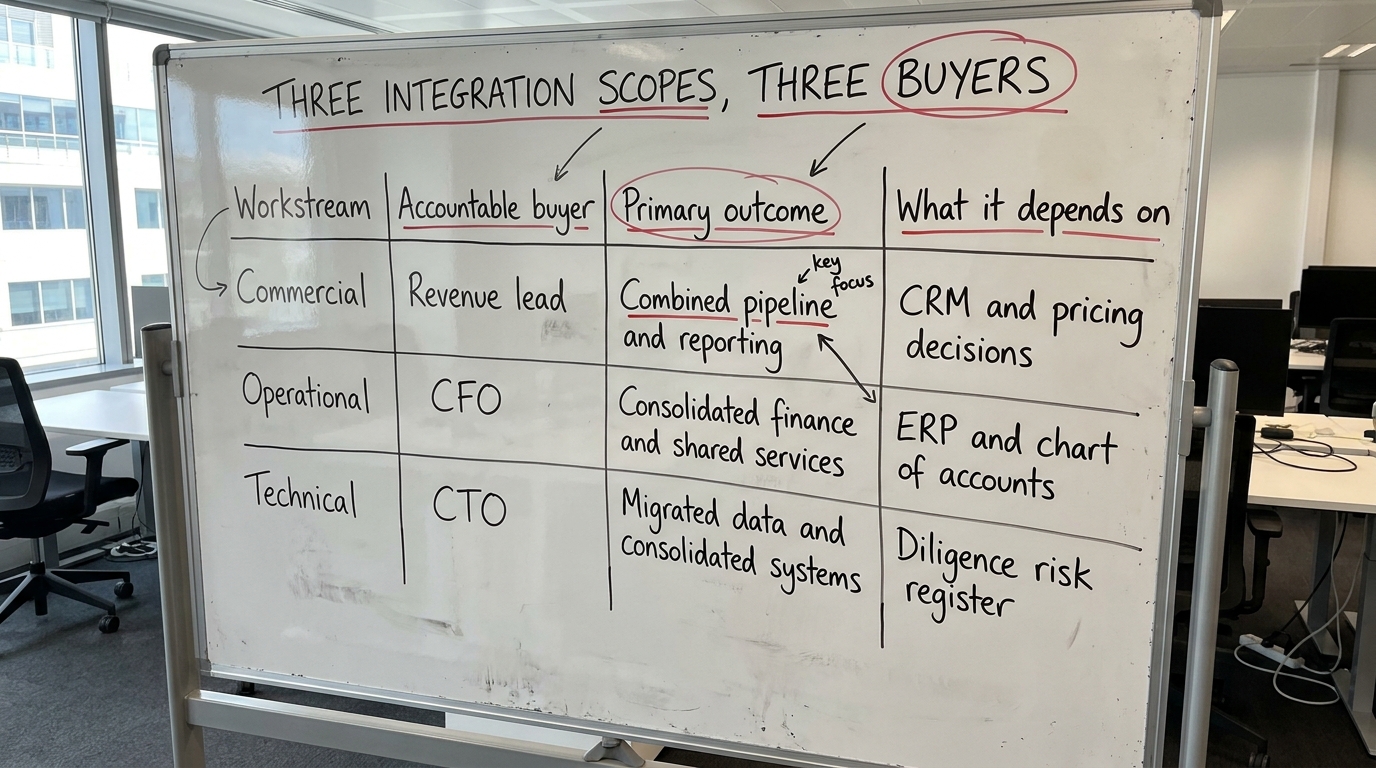
At minimum, most private equity integrations split into three distinct workstreams, each with a different buyer and a different success test. Commercial integration (go-to-market, pricing, CRM, revenue reporting) answers to the person accountable for revenue. Operational integration (finance consolidation, ERP, shared services) answers to the CFO. Technical integration (data migration, system consolidation, security) answers to the CTO and runs through technology due diligence findings.
When a single provider claims to own all three, the buyer should ask which one they will actually staff with senior people and which they will subcontract. The answer usually reveals where the engagement will underdeliver.
Write the brief against the value creation plan, not the org chart
The synergies in the model are the specification. If the authors projected a cross-sell uplift by month nine, the integration brief has to name the CRM consolidation, the shared pricing book, and the combined reporting that make cross-sell measurable. A provider who cannot tie their workplan line by line to the synergy targets is selling activity, and activity is the failure mode that quietly burns the first year.
2. Match the hiring timeline to the deal clock, not the calendar
The single most expensive mistake in how firms hire M&A integration for private equity is starting the search after close. By Day 1 the two management teams are already making decisions (which email system, which pricing, which quota plan) that become expensive to reverse. Bain’s annual private equity report has tracked for years how much of a deal’s return depends on early operational execution, and the integration lead who arrives in week three inherits choices they would never have made.
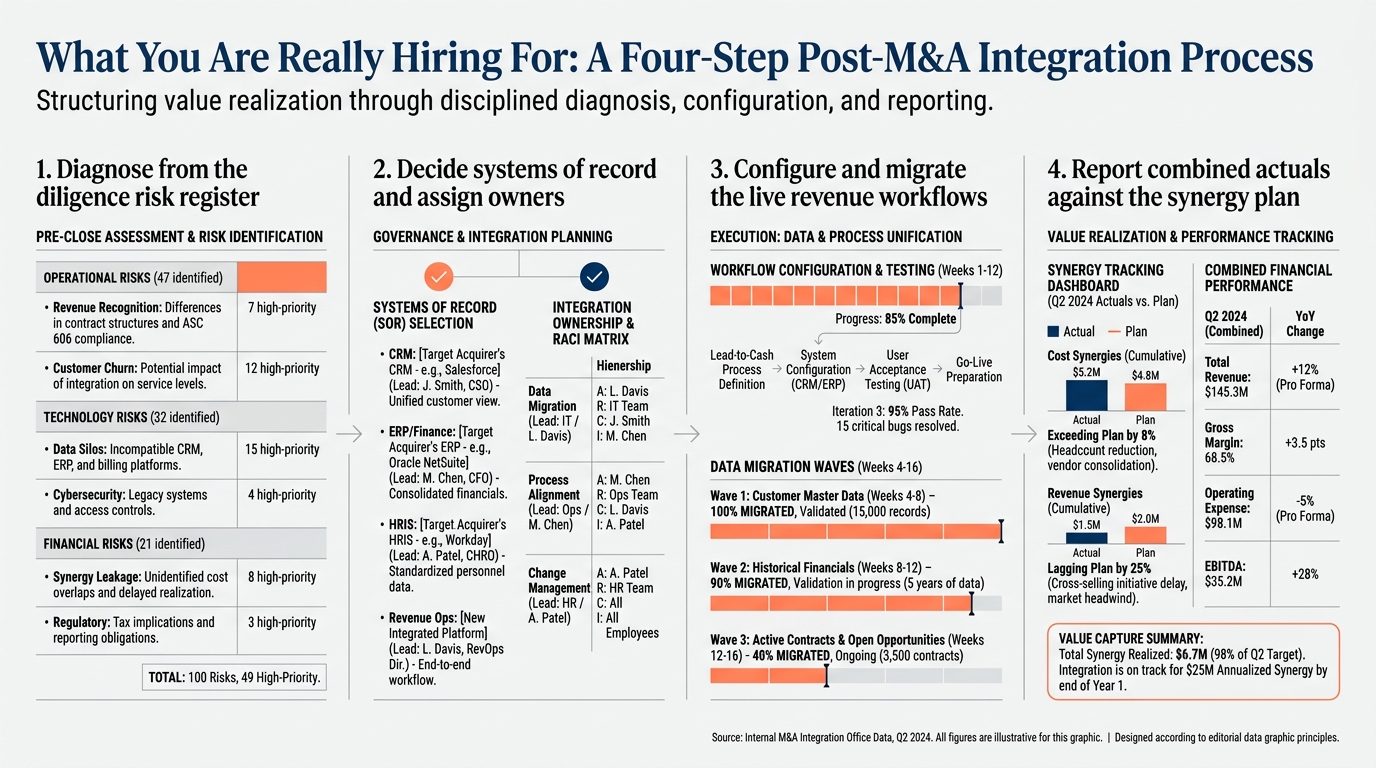
The practical sequence is to run the integration search in parallel with confirmatory diligence. The person who will own integration should read the diligence findings while they are fresh, because the risk register produced during diligence is the integration plan’s opening inventory. For a fuller treatment of why the first weeks decide the year, the breakdown of the first 100 days is worth reading before the search even begins.
Three trigger points that should each start a conversation
- At LOI: draft the integration scope and decide whether the capacity exists in-house. This is a planning conversation, not a hire.
- During confirmatory diligence: shortlist providers and let the strongest candidate review the diligence outputs under NDA. The quality of their questions is the real interview.
- Two to three weeks before close: the integration lead is contracted and building the Day 1 plan, not negotiating a statement of work while the clock runs.
3. Judge decision rights before you judge the resume
A strong integration lead with no authority produces excellent status decks and no movement. Before comparing candidates, the portfolio company executive has to decide what the integration lead can decide alone, what they recommend, and what escalates to the board. Candidates will tell you, often without being asked, whether they are comfortable owning outcomes or whether they default to advising.
This distinction separates genuine integration leadership from a documentation exercise. The question of how to hire a post-close integration consultant without losing the first 100 days comes down to whether the person can make a call on a disputed system choice on a Tuesday, or whether every disagreement becomes a steering committee item two weeks later.
The three decisions you must assign on Day 1
Name the owner for each of these before anyone starts. Leaving them ambiguous is what produces the integration that runs six months long.
- System of record for customer and revenue data. Which CRM, which pricing book, which reporting line survives.
- Who holds the integration budget and can reallocate it between workstreams without a new approval cycle.
- Who arbitrates when commercial and technical timelines conflict, which they will, usually around data migration.
4. Separate the people who plan from the people who deliver
Many providers sell integration as a strategy engagement: a diagnostic, a 100-day plan, a governance structure, and then a handoff. That model fits firms with deep in-house execution capacity. For a portfolio company that does not have spare operational bandwidth, buying a plan without delivery leaves the hardest part unowned.
A revenue operations buyer should be especially alert here. The CRM consolidation, the lead routing, the combined funnel reporting, and the migrated historical pipeline are not strategy deliverables. They are build-and-configure work that requires people who touch the systems. Guidance on how to judge technology integration for private equity before it costs you a quarter applies directly, because the gap between the plan and a working system is exactly where a quarter disappears.
Ask who configures the first live workflow
A concrete test during evaluation: ask the provider to walk through the first revenue workflow they would stand up in the combined entity, naming the system, the fields, the data source, and the person doing the configuration. Candidates who answer at the level of “we would align the teams on a unified process” are selling the deck. Candidates who answer with the actual CRM object model are selling delivery.
5. Price the scope so you can tell overruns from scope creep
Fixed-fee integration proposals that cover an undefined scope transfer no risk to the buyer, because the provider will either pad the price or renegotiate when reality arrives. Time-and-materials with no ceiling transfers all the risk to the buyer. The useful structure sits between: a defined scope with named deliverables, priced by workstream, with an explicit change mechanism for the discoveries that always surface.
A portfolio company executive should insist on seeing the scope broken into the same three workstreams from section one, each priced separately. This makes it possible to see which workstream is overrunning and whether the overrun is the provider’s estimation error or genuine new scope the deal surfaced. The detailed treatment of what a PMI consulting engagement should actually deliver and how to price the scope is the right companion when the proposals come in.
Tie payment to outcomes you can verify
Where the value creation plan names a measurable synergy (a consolidated reporting system live by a date, a single CRM with migrated data, a combined pricing book in use), tie a payment milestone to that verified outcome rather than to the calendar. Harvard Business Review’s body of work on mergers and acquisitions, available through its M&A topic hub, repeatedly returns to the same point: integrations that measure against the original synergy case outperform those that measure against activity.
6. Test the provider against your diligence findings, not a generic case study
A case study proves the provider did something somewhere. It does not prove they can handle the specific risk your diligence surfaced. The sharper evaluation is to hand the shortlisted provider the sanitized technology and operational findings from diligence and ask what they would do first, what they would sequence, and what they would flag to the board.
This converts the interview from a sales pitch into a working session. The provider who reorders your assumed sequence for a defensible reason is usually the stronger hire. The framework for how to judge a technology integration consultant on an M&A deal is built around exactly this kind of live test rather than reference checks alone.
Sequencing is where most plans quietly fail
The order in which systems and providers come online determines whether early decisions constrain later ones. Migrating customer data before the system of record is decided means migrating twice. The detailed logic of how to sequence providers in post-merger integration for a private equity portfolio company is worth reviewing before approving any workplan, because a provider who gets the sequence wrong will present it with full confidence.
7. Build the governance that lets the board see actual against plan
The board reads integration through a single lens: is the combined business tracking to the value creation plan. That requires reporting that shows actual synergy realization against the model, classified honestly into what is realized, what is run-rate, what is still forecast, and what is now at risk. An integration lead who reports percent-complete on tasks is giving the board the wrong instrument.
McKinsey’s private capital research and BCG’s work on principal investors both document how integration value erodes when governance measures effort instead of financial outcome. The reporting cadence should be set at the first board meeting and should map every line to a synergy in the original model. McKinsey’s broader research is collected at its insights site, and BCG’s principal investor and private equity practice publishes parallel findings at bcg.com.
Four states for every synergy line
- Realized: in the actuals, verifiable in the financials this period.
- Run-rate: the mechanism is live and the next full period will reflect it.
- Forecast: planned, with a named owner and a date, but not yet in motion.
- At risk: a dependency slipped, and the synergy needs a decision to recover.
Letting forecast value read as realized is the reporting error that produces the awkward conversation three quarters later. Pitchbook and S&P Global Market Intelligence both maintain deal and performance datasets, accessible through PitchBook research and S&P Global, that a disciplined operating partner can use to sanity-check whether an integration’s reported pace is plausible against comparable deals.
8. Decide between building in-house and buying the capacity
A portfolio company with existing operational depth and a repeatable integration playbook may be better served building the capability. Most lower-middle-market portfolio companies do not have spare senior operators sitting idle, and pulling the revenue lead off the number to run integration costs more in missed plan than the provider fee saves.
The honest version of the make-or-buy decision asks what the internal team would stop doing to run integration, and whether that tradeoff is worth it. Bain’s global private equity report has consistently found that holding periods and value creation expectations leave little room for a slow internal ramp. Where internal capacity is thin, buying a team that has run the sequence before protects the number more reliably than redeploying people who have not.
When partnership capacity is part of the plan
Integration often requires standing up new commercial partnerships quickly, and those fail for predictable reasons. The analysis of why local partnerships fail and how SMEs fix them is relevant when the integration plan includes channel or partner revenue that has not yet been built.
9. Check the governance and compliance edges early
Revenue operations buyers sometimes treat compliance as the CFO’s and counsel’s problem, but integration touches it directly. Combining customer databases across jurisdictions, merging loyalty and marketing programs, and consolidating pricing all carry regulatory exposure. The differences in US, UK and EU loyalty and ad standards matter the moment two combined entities share a customer list across borders.
On the finance and controls side, the AICPA and CIMA materials at aicpa-cima.com set expectations for how consolidated reporting and controls should be handled, and the SEC’s own guidance at sec.gov is the reference point where disclosure or reporting obligations attach. The Harvard Law School Forum on Corporate Governance, at corpgov.law.harvard.edu, regularly publishes practitioner analysis on deal governance worth scanning before an integration plan is locked. None of this is legal advice, and the integration lead should name counsel as a dependency rather than absorbing the question.
10. The checklist before you sign
Run the shortlist and the proposed engagement against these before committing budget. Each item maps to a failure mode this guide has described.
- Scope is split into commercial, operational and technical workstreams, each priced and each with a named accountable buyer.
- The workplan ties line by line to the synergies in the value creation plan, not to a generic integration template.
- The search ran in parallel with diligence, and the integration lead has read the risk register.
- Decision rights are assigned for system of record, budget reallocation, and timeline arbitration.
- The provider configures and delivers, not only diagnoses and hands off.
- Payment milestones tie to verified outcomes where synergies are measurable.
- The provider was tested against your actual diligence findings, and improved on your assumed sequence for a reason.
- Board reporting classifies every synergy as realized, run-rate, forecast or at risk.
- The make-or-buy decision names what internal people would stop doing if they ran it themselves.
- Compliance dependencies are named, with counsel and finance owners attached.
A provider who passes all ten is rare, and worth paying for. A provider who passes six and is honest about the other four is a stronger hire than one who claims to pass all ten without evidence.
If the integration ahead touches combined systems, revenue reporting and the data that proves the synergy case, the team that handles that execution end to end is built for exactly this work. See how the DevriX private equity practice scopes and delivers integration tied to the value creation plan, and bring them the diligence findings while they are still fresh.