An add-on closes in six weeks, and the operating partner has already been handed a slide that says “systems integration: 90 days.” That timeline is a guess dressed as a plan. Post merger technology integration is not a task the target’s IT lead can quietly execute in the background. It is a sequence of commercial decisions with owners, deadlines, and money attached, and most of them belong to the deal team and the portfolio company executive rather than to a vendor. Get the decisions wrong and you carry two accounting systems into the next board meeting, double the license spend, and a sales team that cannot see the combined pipeline.
This guide is for the person accountable for revenue operations after a deal signs. It assumes budget authority and no need for definitions of standard terms. The point is to make the calls faster and defend them when actual results start diverging from plan.
1. Why the integration timeline slips before anyone touches a system
The common failure is treating technology integration as a downstream consequence of the deal rather than a workstream with its own decision rights. Bain’s annual private equity report has documented for years that value creation increasingly depends on operational improvement rather than multiple expansion, and technology sits underneath most of those improvements. When the systems plan is vague, the whole value-creation plan inherits the vagueness.
Consider an illustrative scenario. A platform on NetSuite acquires a competitor running QuickBooks and a homegrown order system. Nobody decides in week one whether the target moves to NetSuite or stays separate, so the finance team keeps two closes, the combined entity cannot produce a single P&L on demand, and the first board meeting after close opens with an apology instead of a number. None of that required a technical failure. It required an unmade decision.
The work you do during technology due diligence should already have surfaced the integration cost, the license overlap, and the data model mismatch. If it did not, the integration plan starts from a worse baseline than it should.
2. The five decisions that actually drive the plan
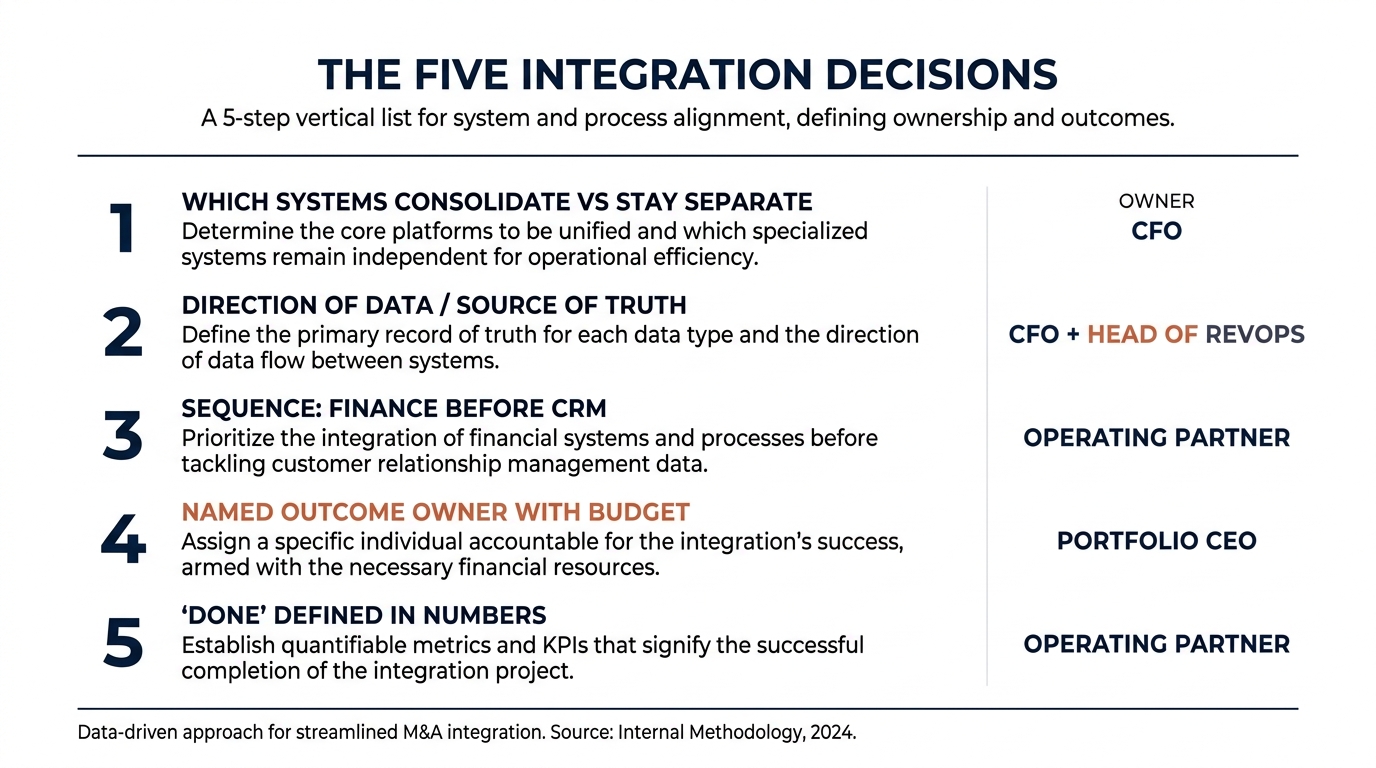
Before anyone scopes a migration, five decisions determine cost, timeline, and risk. Make them explicitly, assign an owner to each, and write down the date each is due. Everything else is execution.
Which systems consolidate and which stay separate
Not every system needs to merge. The finance stack and the system of record for revenue almost always do, because the fund needs one consolidated view. A warehouse management system in a business you plan to run at arm’s length may not. The default assumption of full consolidation is expensive and often unnecessary, so the executive should force the question system by system rather than accepting a blanket “we’ll integrate everything.”
Which direction the data flows
When two systems merge, one becomes the source of truth and the other is retired or subordinated. Deciding the direction late is what produces months of parallel running. Decide it early, and decide it on the basis of data quality and process maturity, rather than on which side has the louder IT lead.
What the sequence is
Finance and CRM rarely move at the same time, and trying to do both in the first quarter usually breaks one of them. The sequence is a real decision with revenue consequences: a botched CRM cutover during a selling season costs pipeline visibility exactly when the value-creation plan needs it most.
Who owns the outcome
The owner is a named executive with budget authority, not a project manager and not a vendor. The vendor owns delivery of a defined scope. The portfolio company executive owns whether the integration produced the commercial result the deal thesis assumed.
What “done” means in numbers
“Integrated” is not a milestone. “Single monthly close completed in NetSuite by day 75, no parallel QuickBooks close after that date” is a milestone. Define done as measurable states, or the plan has no finish line and the spend has no ceiling.
3. Sequence finance before revenue systems, and know why
The reason to move the finance stack first is that the fund’s reporting depends on it and the covenant math depends on it. Until the combined entity can produce one close, forecast reliability stays low and the CFO is defending numbers built from two ledgers stitched together in a spreadsheet. Research from the American Institute of CPAs and the Chartered Institute of Management Accountants on close processes and controls sets a reasonable standard for what a defensible combined close actually requires, and it is more than a data export.
Revenue systems come next because they carry more operational risk to the business during cutover. A CRM migration touches the sales team’s daily work, the pipeline the board is watching, and the customer records marketing runs campaigns against. Moving it under time pressure, in parallel with the finance cutover, is how a portfolio company loses a quarter of pipeline visibility. The detailed mechanics of a CRM cutover are worth treating as their own workstream, and a post merger CRM integration consultant engagement should be scoped separately from the finance work rather than bundled into one heroic migration.
There are exceptions. If the target’s finance system is stable and its CRM is actively losing data, the sequence flips. The executive makes that call on evidence rather than on a fixed rule.
4. Set the baseline before you touch anything
You cannot judge whether an integration worked without knowing where you started. Record the baseline in the first two weeks: current license spend across both entities, the number of systems performing the same function, the time to produce a monthly close today, and the fields that do not map between the two data models. This is the actual-versus-plan reference you will use at every board meeting for the next year.
The baseline is also where you find the fast money. License overlap between two mid-market stacks is routinely five to six figures annually, and cutting duplicate contracts is realized savings you can book without a single risky migration. McKinsey’s private capital research repeatedly points to this kind of cost discipline as a reliable early source of EBITDA improvement, and it is available in the first 60 days if someone actually counts the contracts.
Put the mismatches on a risk register with owners and dates, the same way the deal team tracks every other integration dependency. A data model that will not reconcile becomes the reason the sales forecast will be wrong three quarters from now, which is why it belongs on the register today.
5. Decide build, buy, or leave alone for each gap
Once the systems map is clear, each gap gets one of three answers. Retire the redundant system and consolidate onto the survivor. Buy an integration or a connector where two systems must talk but neither is going away. Or leave a system alone because consolidating it costs more than it returns. The discipline is refusing to let “integrate everything” be the default, because full consolidation is the most expensive path and rarely the one the deal thesis actually required.
BCG’s work on principal investors makes the same general point about technology and operating value: the returns come from targeted improvements tied to the thesis, not from wholesale platform rebuilds that consume the hold period. An operating partner should be suspicious of any plan that proposes to re-platform the entire combined business inside year one, because that plan is usually optimizing for engineering tidiness rather than enterprise value.
When the decision genuinely requires outside capacity, judge the provider on how they scope, not on the deck they present. The difference between a firm that will hand you a slide and one that will deliver a running system is covered well in this walkthrough on how to hire a synergy realization consultant without buying a slide deck.
6. Judge the work with numbers, not status colors
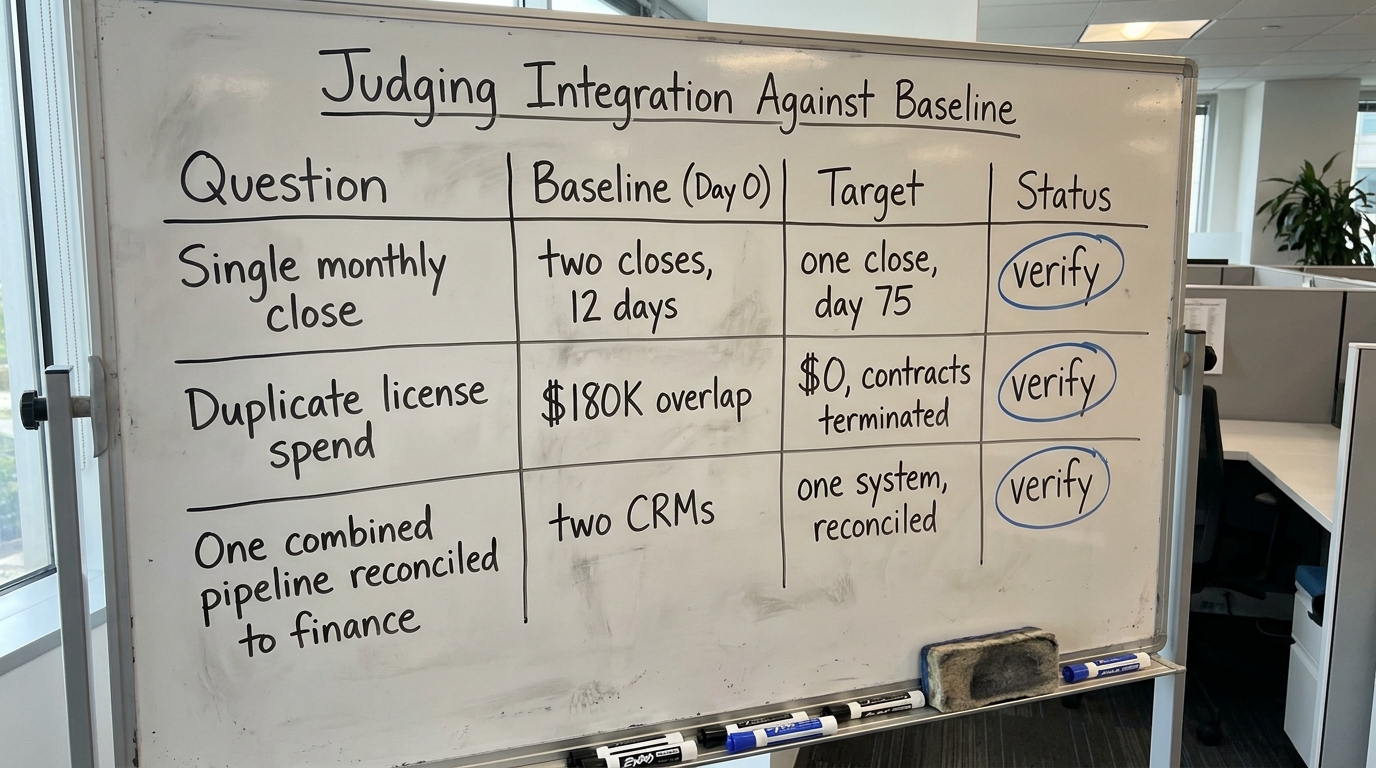
A green project status tells you the vendor feels good about the vendor’s own plan. It tells you nothing about enterprise value. Judge the integration against the baseline you recorded and against the specific numeric milestones you defined. Three questions cut through most status theater.
- Can the combined entity produce a single monthly close on the target date, with no parallel legacy close still running?
- Has the duplicate license spend actually been cut, with contracts terminated rather than merely flagged?
- Can the sales team see one combined pipeline in one system, and does that pipeline reconcile to the finance numbers?
Each of those is a state you can verify, not an opinion you have to trust. Classify what has actually landed as realized value, what is contracted and scheduled as run-rate, and what still depends on a future cutover as forecast. Keeping those three categories separate is what stops a green dashboard from disguising a plan that has quietly slipped a quarter.
For a fuller treatment of how private equity should evaluate integration work in general, the guide on post merger integration consulting in private equity is a useful companion, and the piece on how to choose a systems integration post merger consultant goes deeper on judging the work itself.
7. Time the technology work to the deal calendar
The decisions above do not all belong to the same moment. They map to real triggers, and knowing which decision is due when keeps the plan honest.
Before the LOI and during confirmatory diligence
This is where the integration cost gets estimated and the license overlap gets counted, so the price and the value-creation plan reflect reality. If the systems mismatch is severe enough, it belongs in the diligence findings and possibly in the price. The Harvard Law School Forum on Corporate Governance’s collection on deal execution treats integration and post-close execution risk as diligence items rather than afterthoughts, and the reasoning applies here.
The first 100 days
The baseline gets recorded, the finance sequence starts, and the duplicate contracts get cut here. Most of the realized early value comes from this window, which is why the first 100 days plan should name the technology owner and the numeric milestones explicitly rather than leaving them as a line item.
The first board meeting and beyond
By the first board meeting the combined entity should be able to produce a single financial view, and the revenue-system sequence should have a committed date even if it has not started. The board wants to see actual against plan on the specific milestones, not a status color.
Deciding when to bring in outside help is its own call, and the framing in when to bring in an M&A integration advisor is worth reading before the scope conversation, alongside the checklist in what-to-decide-before-you-buy-M&A-integration-consulting-services.
8. The cost of doing nothing is not zero
Leaving systems separate feels like the low-risk choice because it avoids a migration. The recurring cost is real. Two finance systems mean a slower, less reliable close and higher audit cost every period. Two CRMs mean the combined sales motion cannot be measured, cross-sell cannot be tracked, and marketing spends against duplicated and conflicting customer records. Those are recurring drags on EBITDA and forecast reliability, and they compound over a hold period.
PitchBook and Preqin data on hold periods and exit timing both point to holds that have lengthened in recent years, which means an unresolved integration drags on the P&L for longer than the fund modeled. S&P Global Market Intelligence coverage of deal activity makes the same underlying point from the transaction side: the businesses that show clean, consolidated numbers at exit command better attention from buyers than those still running two of everything. A buyer at exit will discount for the operational risk that two unmerged stacks represent, so the “do nothing” path often costs multiple points that never show up in a quarterly report until the sale process.
9. What good governance of the technology workstream looks like
The integration should live on the same operating cadence as the rest of the value-creation plan, reporting into private equity operating reviews rather than sitting in an IT status meeting nobody senior attends. Harvard Business Review’s M&A coverage has long argued that integration failures are governance failures more often than technical ones, and the pattern holds for technology specifically.
Good governance means the named owner reports actual against the numeric milestones at every operating review, the risk register carries the unresolved data mismatches with dates, and every scope change gets priced against the deal thesis rather than waved through. The clearer the combined entity’s story is, the easier every downstream commercial motion becomes, which is one reason getting the customer data model right connects directly to the kind of value proposition storytelling a combined business can credibly put in front of its market.
10. The decision checklist before you scope a migration
Run this before anyone writes a migration statement of work. If you cannot answer a line, that gap is the next decision, not the vendor’s problem.
- Every system in both entities is mapped, with a documented decision to consolidate, connect, or leave alone.
- The source of truth is chosen for each merging system, on the basis of data quality rather than internal politics.
- The sequence is set, with finance ahead of revenue systems unless evidence says otherwise, and each cutover has a committed date.
- A named executive with budget authority owns the commercial outcome, distinct from the vendor who owns delivery.
- “Done” means measurable states, with dates: single close by day X, duplicate licenses terminated by day Y, one reconciled pipeline by day Z.
- The baseline is recorded: current license spend, duplicate systems, close time, unmapped fields.
- Realized, run-rate, and forecast value are tracked separately so a dashboard cannot disguise a slipped plan.
- The workstream reports into operating reviews with actual against plan, not into an isolated IT status.
The executive who can answer all eight has an integration plan. The one who cannot has a slide that says “90 days,” and the gap between those two is where hold-period value quietly leaks out. The same discipline that protects a technology cutover, incidentally, protects a business under any operational shock, which is why the fast-response thinking in this piece on the first 24 hours of a reputation crisis reads as a close cousin of good integration governance.
How to consolidate data when two companies merge their systems
The systems consolidation decision in section two tells you which platforms survive. It does not tell you how to move the records, and that is where most integration plans quietly stall. Two companies rarely store the same customer, product, or account the same way, so the real work is reconciling the data model before anyone attempts a migration.
Start by naming the system of record for each entity type. One company may run customers in its CRM and another in its accounting system, and shipping both into the surviving platform without deciding which one wins produces duplicate accounts and a pipeline no sales leader will trust. Pick the authoritative source per entity, document the rule, and make the other system conform to it rather than negotiating field by field during the cutover.
Then decide what you are consolidating and what you are only connecting. Full consolidation means one record set in one platform, which is the right answer for finance where a single P&L depends on it. Connection means the systems stay separate and exchange data on a schedule, which is often enough for a product catalog or a support tool that nobody needs to close the books on. Treating every entity as a full migration is how a ninety-day plan becomes a year.
Three failures show up after a careless merge: duplicate records that inflate the combined customer count, orphaned history that breaks renewal and cohort reporting, and mismatched currencies or tax codes that surface only at the first combined close. Each of these traces back to a mapping decision someone skipped, not to a technical fault in the migration tool.
Judge the consolidation by a number you set before the move. A reconciliation that proves the combined record count, revenue total, and open pipeline tie back to the two source systems is the evidence that the data arrived intact. Without that check, the migration looks done and the board meeting reveals it was not.
If you are approaching close on an add-on or already inside the first 100 days and need the technology integration decided and delivered against numeric milestones rather than status colors, review the DevriX PMI and Initiative Sprint engagement built for portfolio technology integration and bring it the eight answers above.