When a portfolio company closes a platform deal or a bolt-on, the operating partner rarely inherits a clean provider stack. The acquired business runs on its own CRM, its own hosting, its own marketing automation, often its own agency relationships that predate the deal by years. Someone has to decide which of those providers survives, which gets consolidated, and who owns the cutover. Get that wrong and the first quarter after close leaks pipeline, breaks reporting, and pushes the value-creation plan back by a full board cycle. Providers post-merger integration for private equity is a set of commercial decisions with owners, deadlines, and a direct line to enterprise value.
This guide is written for the person accountable for revenue operations inside the portfolio company, and for the operating partner who signs off on the integration plan. It assumes budget, a live deal, and no patience for definitions of terms you already use every day.
1. Name the decision before you inventory the providers
The instinct after close is to list every vendor both companies use and start deduplicating. That produces a spreadsheet, not a plan. The decision an operating partner actually needs is narrower: for each capability that touches revenue, which provider becomes the system of record, on what date, and who carries the risk if the migration slips.
Capabilities that touch revenue are the ones worth arguing about first. CRM, marketing automation, the website and its CMS, analytics, billing, and the data pipeline that feeds the board pack. Everything else, the facilities contracts and the office 365 licenses, can wait until the second wave. Bain’s annual review of the private equity market, published through its Global Private Equity Report, has documented for years how much of the value-creation gap comes down to execution speed rather than thesis quality. Provider decisions sit squarely in that execution layer.
State each decision as a sentence a board member could read aloud. “Acquired company moves off HubSpot onto the platform Salesforce instance by Day 75, RevOps lead owns it, integration risk sits with the platform CFO.” That format forces an owner and a date onto every line, which is the whole point.
2. Separate the providers you keep, cut, or run in parallel
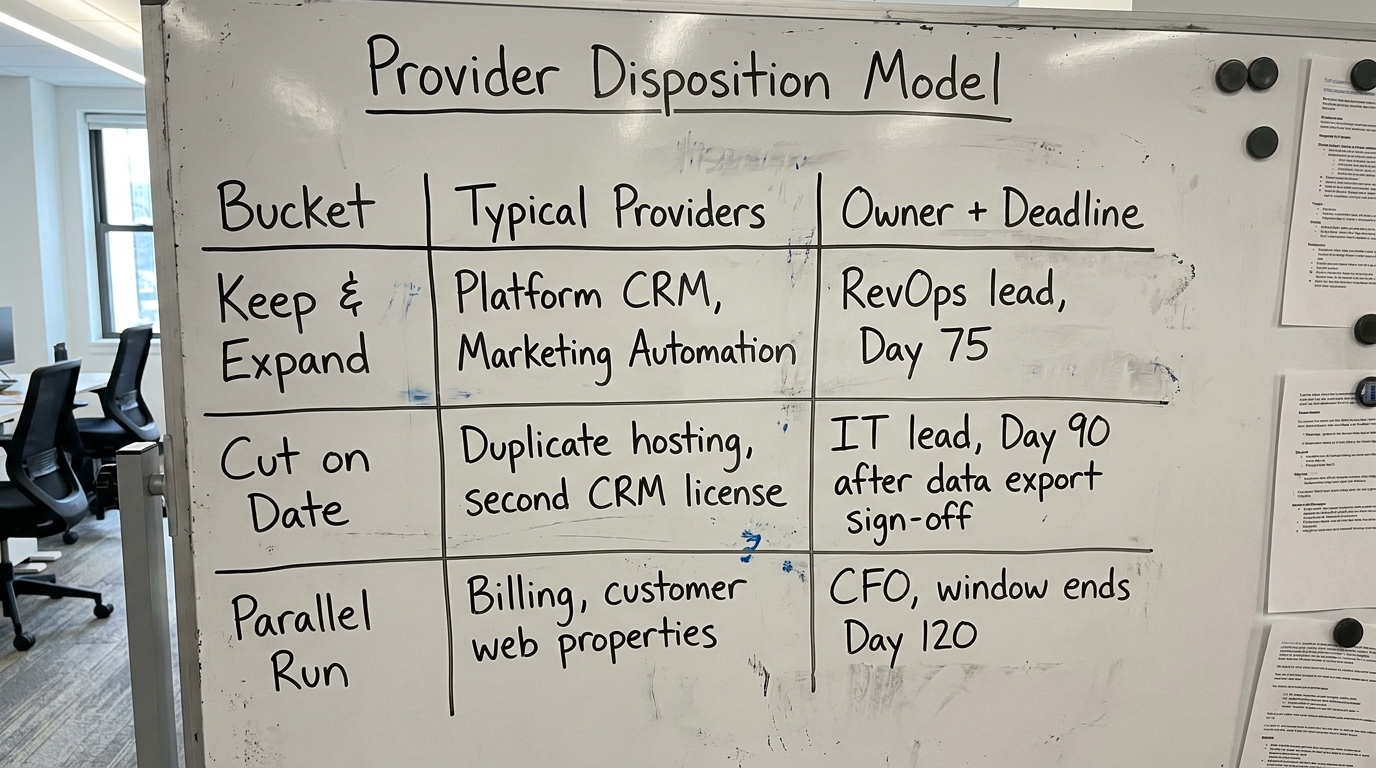
Every provider in the combined estate falls into one of three buckets, and the sorting has commercial consequences, not just technical ones.
Keep and expand
The platform’s provider stays, and the acquired business migrates onto it. This is the default for CRM and marketing automation because reporting consistency matters more than feature parity. The cost here is change management inside the acquired team, and that cost is real. Underprice it and adoption stalls.
Cut on a defined date
A duplicate provider gets a contract end date and a migration plan. The trap is cutting before the data has moved cleanly. Cancelling a hosting contract or a CRM license to save a few thousand a month, only to discover the export was incomplete, buys a much larger cleanup bill later.
Run in parallel through a stated window
Some providers cannot be cut on Day 1 without breaking live revenue. Billing systems and customer-facing web properties usually earn a parallel-run window. The discipline is naming the window’s end date up front, because a parallel run with no deadline becomes permanent, and you end up paying twice indefinitely.
This sorting is where a lot of integrations go quietly wrong. The team maps org charts and reporting lines, which feel like progress, while the CRM conflict that will actually break the forecast goes unexamined. As one analysis of add-on integrations argues, the consultants who map CRM conflicts in month one outperform those who model synergy on a slide.
3. Sequence the cutover against revenue, not against the org chart
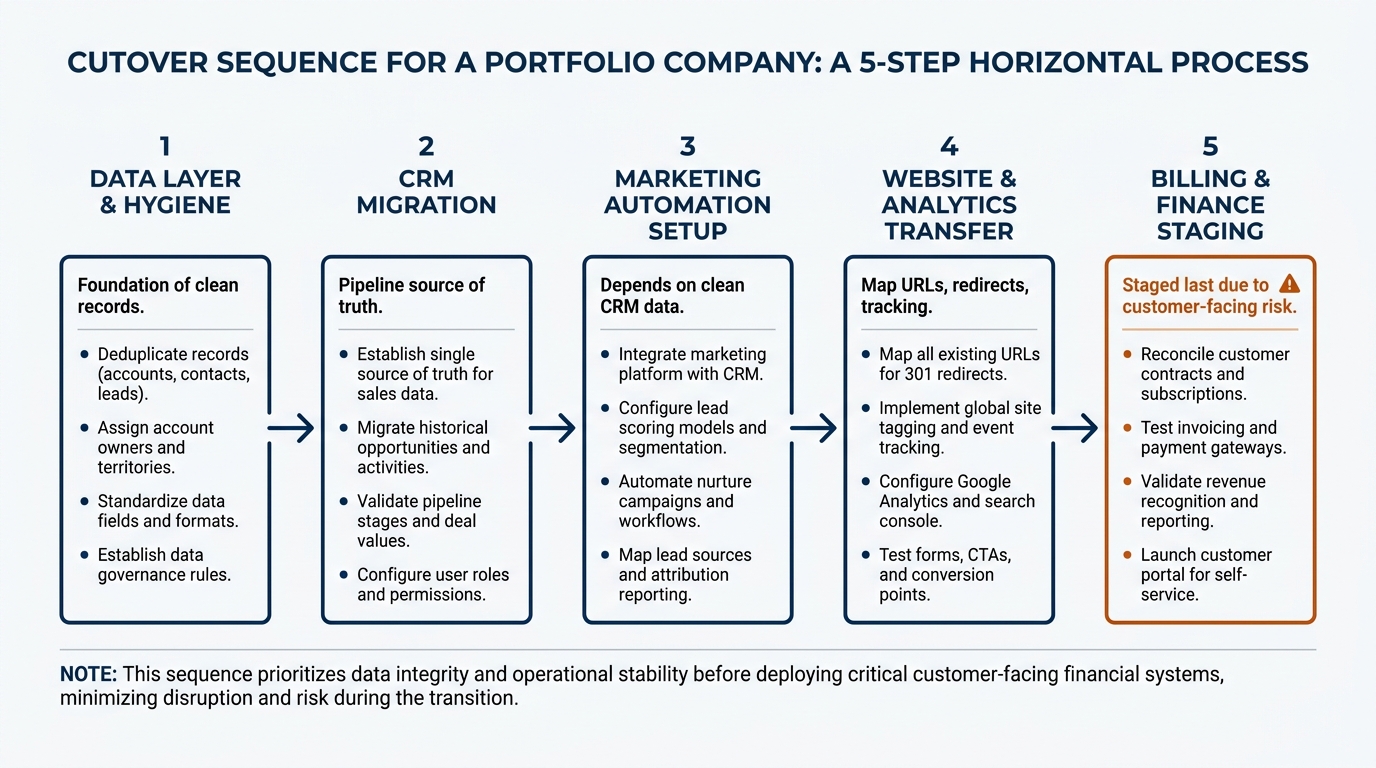
The order in which providers move should follow the revenue engine, not the reporting hierarchy. A useful sequence for most B2B portfolio companies fixes the data layer first (dedupe, assign owners), then moves CRM (the pipeline source of truth), then marketing automation (which depends on clean CRM data), then the website and analytics (mapping URLs, redirects, and tracking), and finally billing, staged last because billing errors are customer-facing and carry the highest revenue risk.
The data layer comes first because everything downstream inherits its problems. If the acquired company’s account and contact records are duplicated, mis-tagged, or missing owners, migrating the CRM just carries that mess into the platform system. McKinsey’s private capital research has repeatedly tied post-close underperformance to weak data foundations rather than to the headline synergy targets that get modeled in diligence.
CRM comes next because it is the source of truth for the pipeline the board is watching. Marketing automation follows because it depends on clean CRM data to segment and score. The website and analytics move after that, and billing moves last, on its own carefully staged plan, because a botched billing cutover is the fastest way to generate churn you did not forecast.
4. Decide who owns each provider decision, and give them the decision right
Every provider line in the plan needs a single named owner who can actually make the call. The most common failure is diffuse ownership: the RevOps lead thinks IT owns the CRM migration, IT thinks the acquired company’s sales director owns it, and three weeks pass with no cutover date set because no one has authority to commit.
Assign the decision right explicitly. The platform RevOps lead owns CRM and marketing automation. The CFO owns billing and anything that touches cash. The operating partner owns the escalation path when a date is at risk. Write these down in the same document as the disposition model so nobody can claim ambiguity.
This is also where the choice between internal ownership and an outside integrator gets decided. If the portfolio company has a RevOps function with capacity, it can own execution and buy specialist help for the hard cutovers. If it does not, the operating partner needs to bring in a partner who works to the deal timeline. The trade-offs are covered well in this piece on how to hire a post-close integration consultant without losing the first 100 days.
5. Judge providers on migration risk, not on feature lists
When you evaluate whether to keep a provider or replace it, the feature comparison is the least useful lens. Two CRMs both do the job. What separates them for an integration is how cleanly one exports and the other imports, whether the API supports the migration you need, and whether the provider’s support team can hold a cutover deadline.
Ask each provider three questions before you commit to a plan around it. Can you export every field, including custom objects and historical activity, in a format the target system reads? Can you run a test migration on a sandbox before the live cutover? Will you commit support resources to a specific cutover window? A provider that dodges any of the three is a schedule risk you should price in.
The same discipline applies when you judge an outside integration consultant. Whether they can name the CRM conflicts, the data quality gaps, and the cutover dependencies in the first weeks matters more than the synergy model they present. This is laid out in detail in the guidance on how to judge a technology integration consultant on an M&A deal, and more broadly in how to judge technology integration for private equity before it costs you a quarter.
6. Protect the revenue-generating web properties during the cutover
The acquired company’s website is a live revenue asset, and it is the provider decision most likely to get handled carelessly. Someone migrates the CMS, or points the domain at the platform’s hosting, and the organic traffic that was quietly generating leads drops because the redirects were incomplete or the page structure changed.
Treat any web migration as a revenue event. Map every URL that ranks or converts, set up the redirects before the switch, and confirm analytics tracking survives the move. If the acquired business runs content or video that drives inbound, preserve the technical setup that makes it discoverable. The mechanics matter more than they look, as the video SEO checklist for new content shows for one common case, and portfolio companies with active social channels should account for those too, as covered in this look at how SMBs use live streaming for social engagement.
7. Build the risk register before you build the timeline
A provider integration plan without a risk register is a wish list. Before the Gantt chart, list the things that can break: an incomplete data export, a provider that will not commit support, a parallel run with no end date, a web migration that drops traffic, a billing cutover that misfires. For each, name the owner and the mitigation.
This is standard practice in institutional deal work. The Harvard Law School Forum on Corporate Governance regularly publishes on how disciplined post-close governance separates the deals that hit plan from the ones that drift, and the risk register is where that discipline becomes visible. Firms like BCG have made similar points in their principal investors work about integration planning being the differentiator rather than the deal thesis.
The register also gives the operating partner something concrete to review at the first board meeting after close. Instead of a status color, the board sees which provider decisions are made, which are at risk, and who owns the open items. That is the conversation that keeps an integration on schedule.
8. Time the provider decisions to the deal calendar
Provider integration is not a background task you start when things settle down. The decisions map to specific triggers on the deal calendar, and each trigger has its own scope.
Confirmatory diligence
The provider inventory should start during technology due diligence. If diligence surfaces a CRM the acquired company is mid-migration on, or a hosting contract with a punitive early-termination clause, that changes the integration plan and sometimes the deal terms. Data from PitchBook and S&P Global Market Intelligence on deal activity shows how compressed timelines have become, which makes early inventory more valuable.
Day 1 and the first 100 days
The disposition model and the cutover sequence should be decided in the first 100 days, because that is the window where the acquired team expects change and the platform team still has momentum. Wait past it and every provider decision meets more resistance. The framing that these are commercial calls with owners and deadlines, not technical preferences, is the subject of a companion piece on how post-merger technology integration requires commercial decisions with owners and deadlines.
The first board meeting after close
By the first board meeting, the operating partner should be able to show the disposition model, the sequence, the risk register, and actual progress against the dates. That artifact demonstrates that the integration is being actively managed to a plan the board can hold the team to.
9. Decide when to bring in outside help, and what to judge it on
Not every portfolio company should run provider integration with internal resources alone. The signal that you need outside help is capacity and cutover complexity: multiple systems moving at once, a data layer that needs real cleanup, and a RevOps function already stretched by the day job of running revenue.
When you do bring in an integrator, judge them on the same standard you apply to the providers themselves. Can they name the risks in the first weeks? Do they work to the deal timeline or a generic project plan? Do they hand you owners and dates, or slides? The guidance on when to bring in an M&A integration advisor and what private equity should judge them on covers the evaluation, and the pre-work an operating partner should finish first is set out in what to decide before hiring a PMI consultant for a portfolio company and what to decide before you buy M&A integration consulting services.
Industry publications including PE Hub, Buyouts, and Private Equity International track how operating teams are structured across the market, and the pattern is consistent: firms that treat integration execution as a named function do better than those that treat it as an afterthought. Research bodies like Preqin and analysis in Harvard Business Review’s M&A coverage reinforce that the integration phase, not the acquisition, is where returns are made or lost. Standards bodies such as the AICPA & CIMA and disclosure filed with the U.S. Securities and Exchange Commission shape the reporting rigor that a clean data and billing cutover has to support.
10. The provider integration checklist
Before the first board meeting after close, an operating partner should be able to answer yes to each of these.
- Every revenue-touching capability has a named system of record, a cutover date, and a single owner.
- Each provider is sorted into keep, cut, or parallel run, and every parallel run has a stated end date.
- The cutover sequence starts with the data layer and ends with billing, ordered by revenue risk rather than the org chart.
- Decision rights are written down: RevOps owns CRM and marketing automation, the CFO owns billing, the operating partner owns escalation.
- Every provider you plan to keep has confirmed export, sandbox testing, and a committed support window.
- Web properties that generate revenue have a URL map, redirects, and preserved analytics before any migration.
- A risk register exists with an owner and a mitigation for each way the integration can break.
- The provider inventory started during diligence, and the disposition model was decided inside the first 100 days.
- The board can see how many days each workstream is ahead of or behind the baseline date.
Provider decisions look like plumbing, which is why they get deferred. They are the infrastructure the whole value-creation plan runs through, and the cost of getting them wrong shows up as a missed quarter. Handling them well determines whether an integration hits plan or spends the first year cleaning up.
If you are approaching close on a platform or bolt-on and need the provider disposition model, cutover sequence, and risk register built and executed to the deal timeline, review the private equity execution offer and the 100-Day Digital Execution program built for exactly this window.